Compare Uranium vs Oxygen: Periodic Table Element Comparison Table and Properties
Compare the elements Uranium and Oxygen on the basis of their properties, attributes and periodic table facts. Compare elements - Uranium and Oxygen comparison table side by side across over 90 properties. All the elements of similar categories show a lot of similarities and differences in their chemical, atomic, physical properties and uses. These similarities and dissimilarities should be known while we study periodic table elements. You can study the detailed comparison between Uranium vs Oxygen with most reliable information about their properties, attributes, facts, uses etc. You can compare U vs O on more than 90 properties like electronegativity, oxidation state, atomic shells, orbital structure, Electronaffinity, physical states, electrical conductivity and many more. This in-depth comparison helps students, educators, researchers, and science enthusiasts understand the differences and similarities between Uranium and Oxygen.
Uranium and Oxygen Comparison
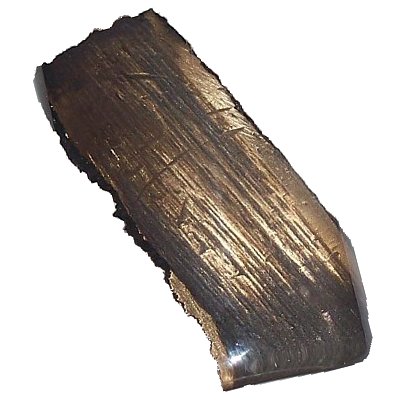
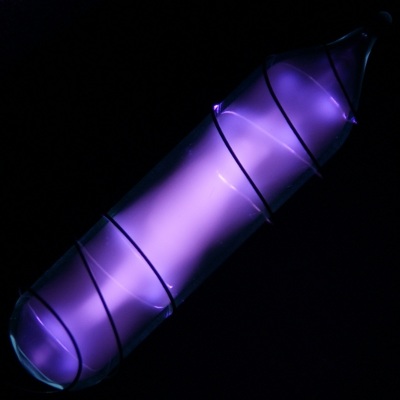
Here's a detailed comparison between Uranium (U) and Oxygen (O), focusing on their position in the periodic table, physical and chemical properties, stability, and uses.
Facts - Basic Element Details
| Name | Uranium | Oxygen |
|---|---|---|
| Atomic Number | 92 | 8 |
| Atomic Symbol | U | O |
| Atomic Weight | 238.02891 | 15.9994 |
| Phase at STP | Solid | Gas |
| Color | Silver | Colorless |
| Metallic Classification | Actinide | Other Nonmetal |
| Group in Periodic Table | Actinide (no group number) | group 16 |
| Group Name | oxygen family | |
| Period in Periodic Table | period 7 | period 2 |
| Block in Periodic Table | f -block | p -block |
| Electronic Configuration | [Rn] 5f3 6d1 7s2 | [He] 2s2 2p4 |
| Electronic Shell Structure (Electrons per shell) | 2, 8, 18, 32, 21, 9, 2 | 2, 6 |
| Melting Point | 1408 K | 54.8 K |
| Boiling Point | 4200 K | 90.2 K |
| CAS Number | CAS7440-61-1 | CAS7782-44-7 |
| Neighborhood Elements | Neighborhood Elements of Uranium | Neighborhood Elements of Oxygen |
History
| Parameter | Uranium | Oxygen |
|---|---|---|
| History | The element Uranium was discovered by H. Klaproth in year 1789 in Germany. Uranium derived its name from Uranus, the seventh planet in the Solar System. | The element Oxygen was discovered by W. Scheele in year 1771 in Sweden and United Kingdom. Oxygen derived its name from the Greek word oxy-, both 'sharp' and 'acid', and -gen, meaning 'acid-forming'. |
| Discovery | H. Klaproth (1789) | W. Scheele (1771) |
| Isolated | E.-M. Péligot (1841) | W. Scheele (1771) |
Presence: Abundance in Nature and Around Us
Parts per billion (ppb) by weight / by atoms (1ppb =10^-7 %)
| Property | Uranium | Oxygen |
|---|---|---|
| Abundance in Universe | 0.2 / 0.001 | 10000000 / 800000 |
| Abundance in Sun | 1 / 0.004 | 9000000 / 700000 |
| Abundance in Meteorites | 10 / 1 | 410000000 / 480000000 |
| Abundance in Earth's Crust | 1800 / 150 | 460000000 / 600000000 |
| Abundance in Oceans | 3.3 / 0.086 | 857000000 / 331000000 |
| Abundance in Humans | 1 / 0.03 | 610000000 / 240000000 |
Crystal Structure and Atomic Structure
| Property | Uranium | Oxygen |
|---|---|---|
| Atomic Volume | 12.495 cm3/mol | 22.4134 cm3/mol |
| Atomic Radius | 175 pm | 48 pm |
| Covalent Radius | - | 73 pm |
| Van der Waals Radius | 186 pm | 152 pm |
Atomic Spectrum - Spectral Lines | ||
| Emission Spectrum |  |  |
| Absorption Spectrum |  |  |
| Lattice Constant | 285.37, 586.95, 495.48 pm | 540.3, 342.9, 508.6 pm |
| Lattice Angle | π/2, π/2, π/2 | π/2, 2.313085, π/2 |
| Space Group Name | Cmcm | C12/m1 |
| Space Group Number | 63 | 12 |
| Crystal Structure | Base Centered Orthorhombic 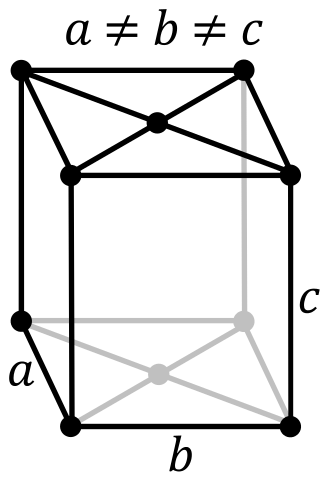 | Base Centered Monoclinic 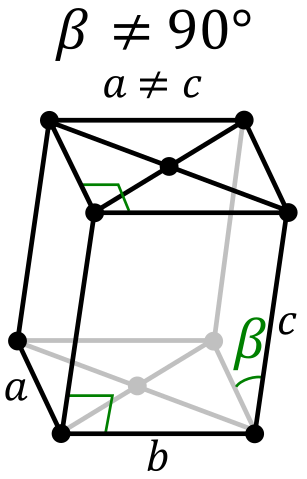 |
Atomic and Orbital Properties
| Property | Uranium | Oxygen |
|---|---|---|
| Atomic Number | 92 | 8 |
| Number of Electrons (with no charge) | 92 | 8 |
| Number of Protons | 92 | 8 |
| Mass Number | 238.02891 | 15.9994 |
| Number of Neutrons | 146 | 8 |
| Shell structure (Electrons per energy level) | 2, 8, 18, 32, 21, 9, 2 | 2, 6 |
| Electron Configuration | [Rn] 5f3 6d1 7s2 | [He] 2s2 2p4 |
| Valence Electrons | 5f3 6d1 7s2 | 2s2 2p4 |
| Oxidation State | 4, 6 | -2 |
| Atomic Term Symbol (Quantum Numbers) | 5L6 | 3P2 |
| Shell structure | 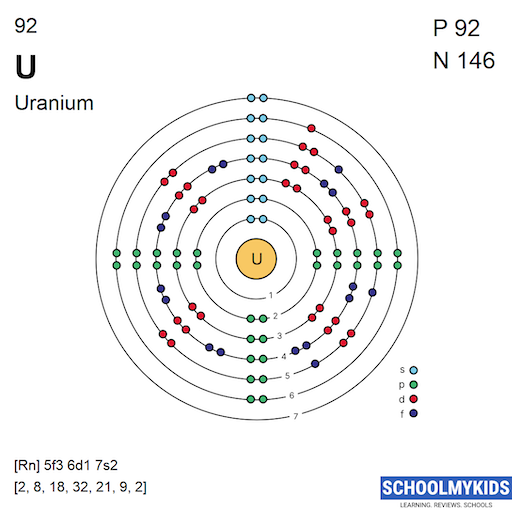 | 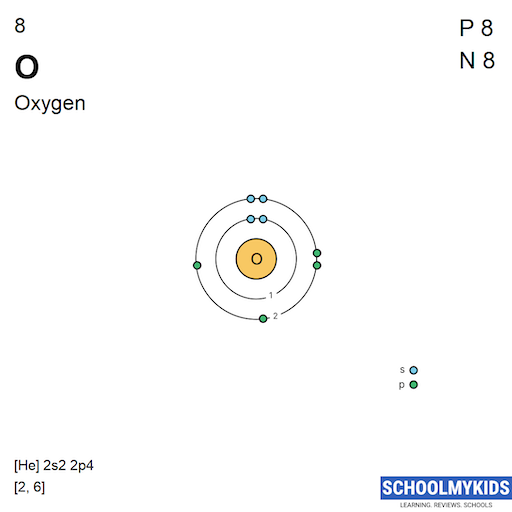 |
Isotopes and Nuclear Properties
Uranium has 0 stable naturally occuring isotopes while Oxygen has 3 stable naturally occuring isotopes.
| Parameter | Uranium | Oxygen |
|---|---|---|
| Known Isotopes | 217U, 218U, 219U, 220U, 221U, 222U, 223U, 224U, 225U, 226U, 227U, 228U, 229U, 230U, 231U, 232U, 233U, 234U, 235U, 236U, 237U, 238U, 239U, 240U, 241U, 242U | 12O, 13O, 14O, 15O, 16O, 17O, 18O, 19O, 20O, 21O, 22O, 23O, 24O, 25O, 26O, 27O, 28O |
| Stable Isotopes | - | Naturally occurring stable isotopes: 16O, 17O, 18O |
| Neutron Cross Section | 7.57 | 0.00028 |
| Neutron Mass Absorption | 0.0005 | 0.000001 |
Chemical Properties: Ionization Energies and electron affinity
| Property | Uranium | Oxygen |
|---|---|---|
| Valence or Valency | 6 | 2 |
| Electronegativity | 1.38 Pauling Scale | 3.44 Pauling Scale |
| Oxidation State | 4, 6 | -2 |
| Electron Affinity | - | 141 kJ/mol |
| Ionization Energies | 1st: 597.6 kJ/mol 2nd: 1420 kJ/mol | 1st: 1313.9 kJ/mol 2nd: 3388.3 kJ/mol 3rd: 5300.5 kJ/mol 4th: 7469.2 kJ/mol 5th: 10989.5 kJ/mol 6th: 13326.5 kJ/mol 7th: 71330 kJ/mol 8th: 84078 kJ/mol |
Physical Properties
Oxygen (0.001429 g/cm³) is less dense than Uranium (19.05 g/cm³). This means that a given volume of Uranium will be heavier than the same volume of Oxygen. Uranium is about 1333000.1 denser than Oxygen
| Property | Uranium | Oxygen |
|---|---|---|
| Phase at STP | Solid | Gas |
| Color | Silver | Colorless |
| Density | 19.05 g/cm3 | 0.001429 g/cm3 |
| Density (when liquid (at melting point)) | 17.3 g/cm3 | - |
| Molar Volume | 12.495 cm3/mol | 22.4134 cm3/mol |
Mechanical and Hardness Properties
| Property | Uranium | Oxygen |
|---|---|---|
Elastic Properties | ||
| Young Modulus | 208 | - |
| Shear Modulus | 111 GPa | - |
| Bulk Modulus | 100 GPa | - |
| Poisson Ratio | 0.23 | - |
Hardness - Tests to Measure of Hardness of Element | ||
| Mohs Hardness | 6 MPa | - |
| Vickers Hardness | 1960 MPa | - |
| Brinell Hardness | 2400 MPa | - |
Thermal and Electrical Conductivity
| Property | Uranium | Oxygen |
|---|---|---|
Heat and Conduction Properties | ||
| Thermal Conductivity | 27 W/(m K) | 0.02658 W/(m K) |
| Thermal Expansion | 0.0000139 /K | - |
Electrical Properties | ||
| Electrical Conductivity | 3600000 S/m | - |
| Resistivity | 2.79e-7 m Ω | - |
| Superconducting Point | 0.68 | - |
Magnetic and Optical Properties
| Property | Uranium | Oxygen |
|---|---|---|
Magnetic Properties | ||
| Magnetic Type | Paramagnetic | Paramagnetic |
| Curie Point | - | - |
| Mass Magnetic Susceptibility | 2.16e-8 m3/kg | 0.000001335 m3/kg |
| Molar Magnetic Susceptibility | 5.14e-9 m3/mol | 4.27184e-8 m3/mol |
| Volume Magnetic Susceptibility | 0.000411 | 0.00000190772 |
Optical Properties | ||
| Refractive Index | - | 1.000271 |
Acoustic Properties | ||
| Speed of Sound | 3155 m/s | 317.5 m/s |
Thermal Properties - Enthalpies and thermodynamics
| Property | Uranium | Oxygen |
|---|---|---|
| Melting Point | 1408 K | 54.8 K |
| Boiling Point | 4200 K | 90.2 K |
| Critical Temperature | - | 154.59 K |
| Superconducting Point | 0.68 | - |
Enthalpies | ||
| Heat of Fusion | 14 kJ/mol | 0.222 kJ/mol |
| Heat of Vaporization | 420 kJ/mol | 3.41 kJ/mol |
| Heat of Combustion | - | - |
Regulatory and Health - Health and Safety Parameters and Guidelines
| Parameter | Uranium | Oxygen |
|---|---|---|
| CAS Number | CAS7440-61-1 | CAS7782-44-7 |
| RTECS Number | RTECSYR3490000 | RTECSRS2060000 |
| DOT Hazard Class | 7 | 2.2 |
| DOT Numbers | 2979 | 1073 |
| EU Number | EU231-170-6 | - |
| NFPA Fire Rating | - | 0 |
| NFPA Health Rating | - | 3 |
| NFPA Reactivity Rating | - | 2 |
| NFPA Hazards | - | Oxidizing Agent |
| AutoIgnition Point | - | - |
| Flashpoint | - | - |
Compare Uranium and Oxygen With Other Elements
Compare Uranium and Oxygen with other elements of the periodic table. Explore howUranium and Oxygen stack up against other elements of the periodic table. Use our interactive comparison tool to analyze 90+ properties across different metals, non-metals, metalloids, and noble gases. Understanding these differences is crucial for applications in engineering, chemistry, electronics, biology, and material science.