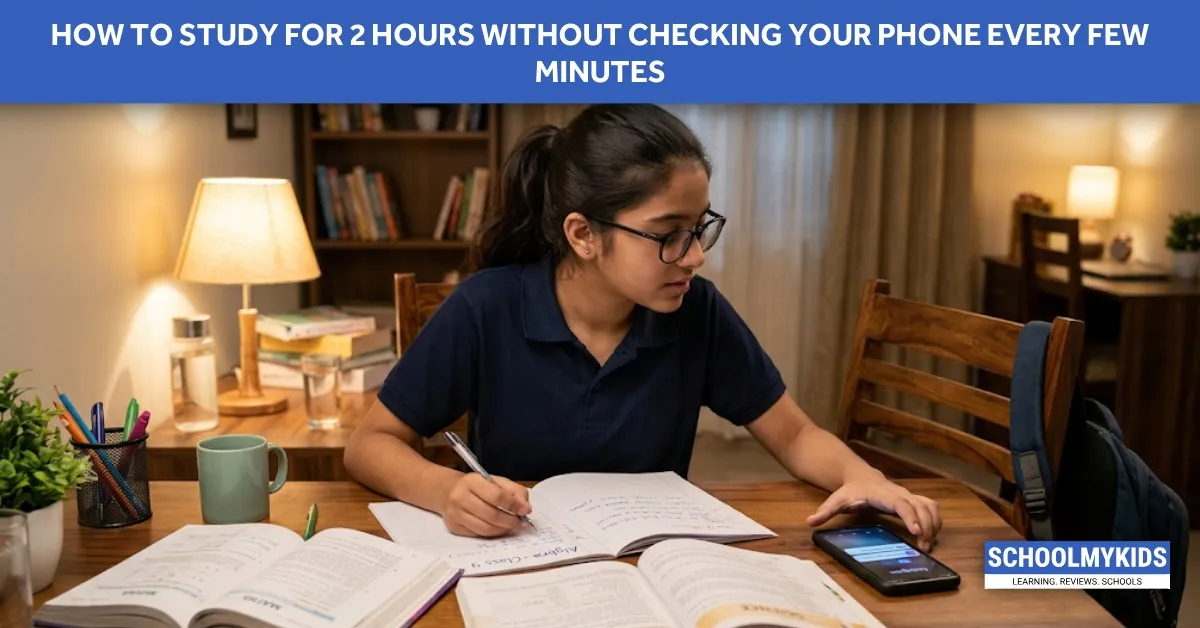
You sat down to study at 4 pm. You opened your book. You unlocked your phone to check “just one notification.”
It’s 5:30 pm now. You’ve read half a page. You’ve watched 14 reels. You’ve replied to three WhatsApp groups.
You’re not lazy. You’re not weak. Your brain has been trained to expect a reward every few seconds. And the phone delivers that reward faster than any textbook ever will.
Fortunately, two focused hours can beat six distracted hours. A Class 10 topper from Stone Ridge International School, Rudra Pratap Singh, scored 499/500 in the 2025 CBSE exams with just two focused hours of study daily.
So the question isn’t “how do I study longer?” It’s “how do I study without the phone winning?”
Let’s fix that.
First, Stop Calling It “Phone Addiction”
One Karnataka study found that 33.3% of adolescents were addicted to smartphones. Another 30.6% were at high risk (Journal of Clinical and Diagnostic Research, May 2026, 540 adolescents in Mangaluru schools). Recent Indian surveys show many teenagers spend 3 to 7 hours daily on screens and social media. An IIM-Rohtak study of nearly 39,000 youth found average screen time around 7 hours, while LocalCircles parent surveys report that 10 percent of urban children exceed 6 hours.
Those numbers are scary. But they’re not the whole story.
Your phone isn’t the problem. The habit loop is the problem. You feel bored. You pick up the phone. You feel a tiny hit of dopamine. You repeat.
You can’t delete the loop. But you can interrupt it. That’s what the next two hours are about.
The 2-Hour Study Plan That Actually Fits Indian Students
Forget the 25-minute Pomodoro. For JEE, NEET, and UPSC aspirants, a 50-minute focused block followed by a 10-minute break works better.
This is the full plan.
Hour 1: The Hard Stuff First
Time | What You Do |
|---|---|
0–50 min | Deep work. One subject. One topic. No switching. |
50–60 min | Break. Stand up. Drink water. No phone. |
Hour 2: The Second Block
Time | What You Do |
|---|---|
60–110 min | Second deep work block. Practice problems or revision. |
110–120 min | Cool down. Review what you covered. Write three things you learned. |
That’s it. Two 50-minute blocks. Two 10-minute breaks. One rule: the phone stays in another room for the full 120 minutes.
Why does this work? Because 50 minutes is long enough to get into a topic but short enough that your brain doesn’t panic. The 10-minute break is a reset. But if you touch the phone during that break, the reset fails. You’ll spend the next 50 minutes thinking about the reel you just watched.
The Focus Phone Trick From Kota Toppers
You’ve probably heard of JEE toppers switching to keypad phones. It went viral in February 2026. Toppers with 99.47 and 99.75 percentile pulled out basic feature phones at a felicitation event.
One topper, Om Shivhare, said he skipped social media entirely. Local shops in Kota now sell these “focus phones” to students who want distraction-blockers.
You don’t need to buy a new phone. But you can copy the idea.
Imagine the scenario. It’s 4 pm. You’re about to study. You take your SIM card out of your smartphone. You put it in an old keypad phone. You leave the smartphone in a drawer in another room. For two hours, you can only call and text.
Is it inconvenient? Yes. That’s the point. The friction stops the habit.
If you don’t have a second phone, use airplane mode. But airplane mode is easy to switch off. A physical distance (phone in another room) is harder to undo.
What to Do When the Urge Hits
You’ll feel it. Around minute 12, you’ll want to check your phone. Around minute 30, you’ll convince yourself you need to “look something up.”
So what do you do instead? Keep a piece of paper next to you. When the urge hits, write down what you want to check. “Check Instagram.” “Google this doubt.” “Reply to XYZ.”
Don’t act on it. Just write it down. At the end of the two hours, you can check the list. Most of the time, you won’t care anymore. The urge passed. The list becomes evidence that your brain was just bored, not curious.
How to Make the Plan Work in a Hostel or at Home
In a hostel, the phone often stays under the pillow. Ask a roommate to keep it for the full two hours. At home, give the phone to a parent or sibling and set a clear rule: no returning it until the timer ends.
Parents can help by turning the Wi-Fi off in the study room for those 120 minutes. The extra friction works better than any app.
If the house is noisy, use the same 50-minute blocks but move to a quieter corner or the terrace. The system stays the same. Only the location changes.
The Apps That Actually Help (And What They Don’t Do)
You’ve seen the app recommendations. Forest. Focus To-Do. Stay Focused. Cold Turkey.
This is the honest version.
Forest is the most popular focus app among Indian students. You plant a virtual tree. If you leave the app, the tree dies. The free version works well for most students. Paid upgrades are available if you want extra features. It’s gamified and it works for people who respond to gentle pressure.
Focus To-Do is free. It combines Pomodoro with a to-do list. Good if you like structure.
Stay Focused blocks Instagram, YouTube Shorts, and Reels. The app’s own data claims users cut screen time by 47 percent in the first week.
But the apps don’t stop you from picking up the phone. They just make it slightly harder. If you’re determined to scroll, you’ll find a way.
Use one app. Not five. Pick Forest if you like gamification. Pick Stay Focused if you need a hard block. Then put the phone in another room anyway. The app is backup, not the main plan.
Why Reels Are Harder to Resist Than Textbooks
You’re not imagining it. Short-form video is designed to hijack your attention. Instagram Reels and YouTube Shorts give you a new hit of stimulation every few seconds. Research referenced in studies on medical students in Southern India notes that 83.9 percent of university students reported distraction while studying due to short-form video. Indian research consistently links heavy short-form video use with reduced attention span.
Your textbook doesn’t do that. A paragraph on thermodynamics doesn’t change scenes every three seconds.
So when you switch from reels to studying, your brain feels like it’s moving through mud. That’s not a sign you’re bad at studying. It’s a sign your brain is adjusting to a slower pace.
Give it 10 minutes. The mud clears. The focus comes back.
A Quick FAQ on Studying Without Your Phone
What if I genuinely need the phone for a doubt?
Write the doubt on paper. Keep studying. Look it up during the break or after the two hours. Most doubts can wait 50 minutes.
I studied for 2 hours but still feel I didn’t do enough. Why?
Because you’re measuring time, not output. Two focused hours on one topic beats four distracted hours on five topics. Measure what you finished, not how long you sat.
What if I fail on day one and check the phone?
Good. You learned your trigger. Was it boredom? Anxiety? A notification? Tomorrow, remove that trigger. Put the phone farther away. Turn off the notification. Adjust the system.
Is a 2-hour study block enough for NEET or JEE?
For one session, yes. Toppers often do multiple 2-hour blocks across the day. The goal is to make each block clean. Two clean blocks beat six dirty ones.
Key Takeaways for JEE, NEET and Board Students
Two focused hours beat six distracted hours. CBSE Class 10 topper Rudra Pratap Singh scored 499/500 with just two hours daily.
Use the 50/10 Pomodoro variant for long-syllabus exams. Not the classic 25/5.
Put the phone in another room. Airplane mode is not enough. Physical distance works.
Copy the Kota “focus phone” trick. SIM in a keypad phone. Smartphone in a drawer.
Keep a paper list for urges. Write down what you want to check. Check it later.
Use one focus app. Forest for gamification. Stay Focused for hard blocks. Don’t stack apps.
Reels are engineered to distract you. Your brain needs 10 minutes to adjust. Give it that time.
You don’t need more willpower. You need a better system. Two hours. One room. No phone. Start tomorrow.







Be the first one to comment on this story.