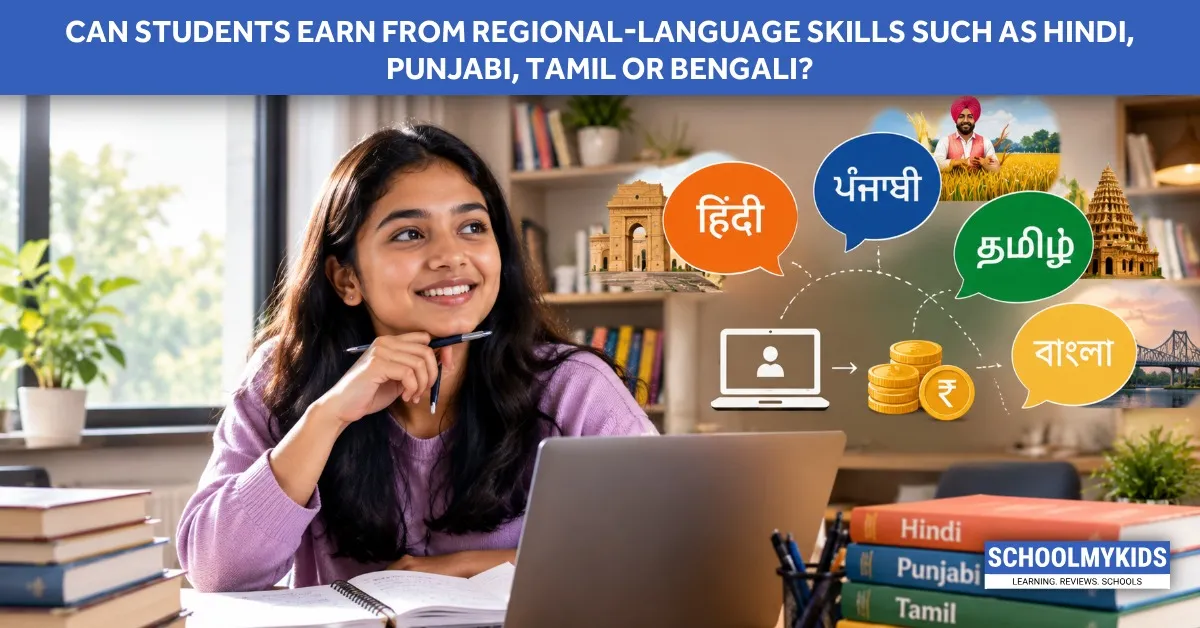
Riya thought her Hindi was useless.
She spoke it at home. She argued with her mother in Hindi. She watched Hindi reels. That’s it. No certificate. No fancy course.
Then she earned her first ₹4,000 in a week. Doing what? Reading Hindi scripts out loud for a YouTube channel.
So yes, students can earn from regional languages in 2026. But it’s not magic. It’s not “learn Tamil in 30 days and get rich.” It’s work. Real work.
The Short Answer
Yes, students can earn from regional languages in 2026.
You won’t get paid just because you speak Hindi. Half of India speaks Hindi. That’s not special.
What’s special is what you do with it.
Companies need regional language skills for specific tasks in 2026. Translation. Subtitling. AI data annotation. Voiceover. Tutoring. Content writing. Localisation.
They don’t need you to be fluent in five languages. They need you to be reliable in one.
What most students miss is that the demand is growing, not shrinking. India’s National Education Policy is pushing Indian languages harder than ever. CBSE’s three-language framework means students entering Class 6 from 2026-27 will study three languages, of which at least two must be Indian (Bhartiya Bhashas). That’s not just policy. That’s a signal. Language skills are becoming part of the mainstream skill economy.
How Tamil Speakers Earn Through AI Data Annotation
Imagine this. You’re a 19-year-old college student in Coimbatore. You speak Tamil at home.
Several AI data companies are hiring regional language speakers right now for Tamil, Punjabi, Bengali, Telugu and Marathi. The work is transcription and multilingual data annotation. Entry-level pay for consistent remote work often falls in the ₹20,000–₹35,000 per month range. No formal experience is required. Students are routinely accepted.
You listen to audio clips in Tamil. You type what you hear. You flag mistakes in AI-generated Tamil. That’s it.
Why does this work? Because AI companies are building Tamil, Punjabi, and Bengali voice bots. They need real speakers to train those bots. Your mother tongue becomes training data.
Punjabi Subtitling and Translation Gigs for Students
You’ve heard of Netflix. You’ve heard of Amazon Prime. You know they have regional content.
They need subtitlers. Punjabi shows need Punjabi subtitles. Punjabi YouTube channels need Punjabi captions.
Rates commonly seen on freelance platforms: translation at roughly ₹0.20 to ₹0.50 per word for beginner Indian-language pairs, and subtitling or transcription at ₹20 to ₹50 per minute depending on complexity and turnaround. That’s not glamorous. But a three-minute song takes 45 minutes. Do five a week and you’ve got pocket money that beats most internships.
Regional Language Voice Testing Jobs for AI Bots
This one is new. And most students haven’t heard of it.
Startups building Hinglish and regional-language voice bots need native speakers of Tamil, Telugu, Kannada, Malayalam and Marathi to listen to AI-generated speech and flag what sounds wrong. Unnatural pronunciation. Missing cultural context. Robot-like tone.
Entry-level remote voice-QA or language-testing roles in this space often pay in the ₹2–3 lakh per year range for part-time or internship work. No prior experience is required.
Imagine this. You listen to an AI voice speak Bengali. It says a sentence that’s grammatically correct but sounds like a textbook. You flag it. You say, “No one talks like this.” You get paid.
That’s not translation. That’s language quality control. And it’s one of the fastest-growing gigs in 2026.
Hindi Skills That Still Pay Well Despite Competition
Hindi is tricky. Because almost everyone speaks some Hindi. So the competition is huge.
But most Hindi speakers can’t write formal Hindi. They can chat in Hindi. They can’t write a product description. They can’t proofread a Hindi news article.
If you can write clean, correct Hindi, you’re rare. You can charge more.
A Delhi-based ed-tech company needs Hindi exam content for UPSC aspirants. They need someone who knows the difference between “अंतर” and “अन्तर.” A student who can do this can realistically charge ₹0.80 to ₹2 per word for clean, formal Hindi content, depending on volume and client. A 1,000-word article becomes ₹1,500 to ₹3,000.
How NEP and Bhashini Are Increasing Demand for Regional Languages
You might think this is a small side hustle. It’s not.
The Indian government is pouring money into Indian language technology. The Bhashini division of Digital India Corporation continues to hire language experts for translation, transcription and localisation roles in 2026 across languages such as Gujarati, Santhali, Sindhi, Telugu, Nepali and others. Contractual young-professional roles are advertised on the DIC portal.
Universities are being pushed to adopt “translanguaging”, explaining concepts in local languages, so students from rural backgrounds aren’t left behind.
What does this mean for you? It means the demand for regional language skills isn’t a trend. It’s policy. It’s funding. It’s the direction the system is moving.
How Students Can Start Earning From Regional Languages This Week
You don’t need a plan. You need one small action.
Open your phone. Record yourself reading a news paragraph in your language. Listen to it. Is it clear? Good. That’s your first sample.
Then register on one platform. Not five. One.
Truelancer is an Indian freelancing platform with regional language translation projects. Gengo accepts beginner translators without a degree or prior experience. You just need to pass a short test. Fiverr is beginner-friendly, though they take a 20% cut.
Post a simple offer. “I will translate Hindi to English for ₹200 per 500 words.” Or “I will subtitle Punjabi videos for ₹100 per minute.”
Will you get work immediately? Maybe not. But you’ll learn what clients ask. You’ll learn how to price.
Most students who post a clear sample and apply consistently get their first small paid task within 2–4 weeks. Consistent daily applications matter more than perfect rates in the beginning.
Tools You Already Own
You do not need paid software.
Phone voice recorder or free Audacity for audio samples.
YouTube’s free subtitle editor or CapCut for basic subtitling practice.
Google Docs for written samples.
That is enough to create your first portfolio piece this week.
Common Scams Students Must Avoid When Seeking Language Gigs
You’ll see ads. “Earn ₹15,000 to ₹40,000 per month from home. No experience needed.” Don’t believe them.
If a “job” asks you to pay a registration fee, buy a starter kit, or deposit money to unlock tasks, it’s a scam. No exceptions.
Fake data entry jobs and Telegram task scams target students specifically. They promise easy money. They take your money instead.
Real freelance work pays you. It doesn’t charge you to start.
Quick FAQ on Earning From Hindi, Tamil, Punjabi and Bengali Skills
I speak Hindi but can’t write it well. Can I still earn?
Yes. Voiceover and voice data collection don’t require writing. AI companies need people to record short phrases in their language. Wing Data hires freelance voice contributors for Bengali, Tamil, Punjabi, and more.
Do I need to know English too?
Not always. Tamil-to-Tamil transcription exists. Punjabi-to-Punjabi proofreading exists. But basic English opens more doors. Even reading-level English helps.
How much can a student realistically earn?
Start with ₹2,000 to ₹5,000 per month. After three months of regular work, ₹10,000 to ₹15,000 is possible. AI data annotation roles listed at ₹20,000 to ₹35,000 per month are for more consistent work. Not lakhs. Not overnight.
What’s the easiest language to earn from?
The one you speak best. Don’t chase Tamil if your Tamil is weak. Don’t force Punjabi if you can’t read Gurmukhi. Start with your strongest language.
Key Takeaways for Students Looking to Monetise Regional Language Skills
You can earn from Hindi, Punjabi, Tamil, or Bengali skills in 2026. But not just by speaking.
AI data annotation roles open to students commonly list ₹20,000–₹35,000/month for consistent work.
Subtitling and transcription commonly pay ₹20–₹50 per minute. Translation pays roughly ₹0.20–₹0.50 per word on freelance platforms for beginners.
Voice testing for AI bots is a growing gig paying in the ₹2–3 lakh per year range for regional-language speakers.
NEP’s three-language policy and Bhashini are making regional language skills more valuable, not less.
Never pay to start a freelance job. Real work pays you.
Start with one platform. One sample. One gig.
Riya didn’t wait for a certificate. She recorded a two-minute Hindi sample. She sent it to ten YouTube channels. One replied.
That’s how it started.
You can do the same. Today. Not next month.








Be the first one to comment on this story.