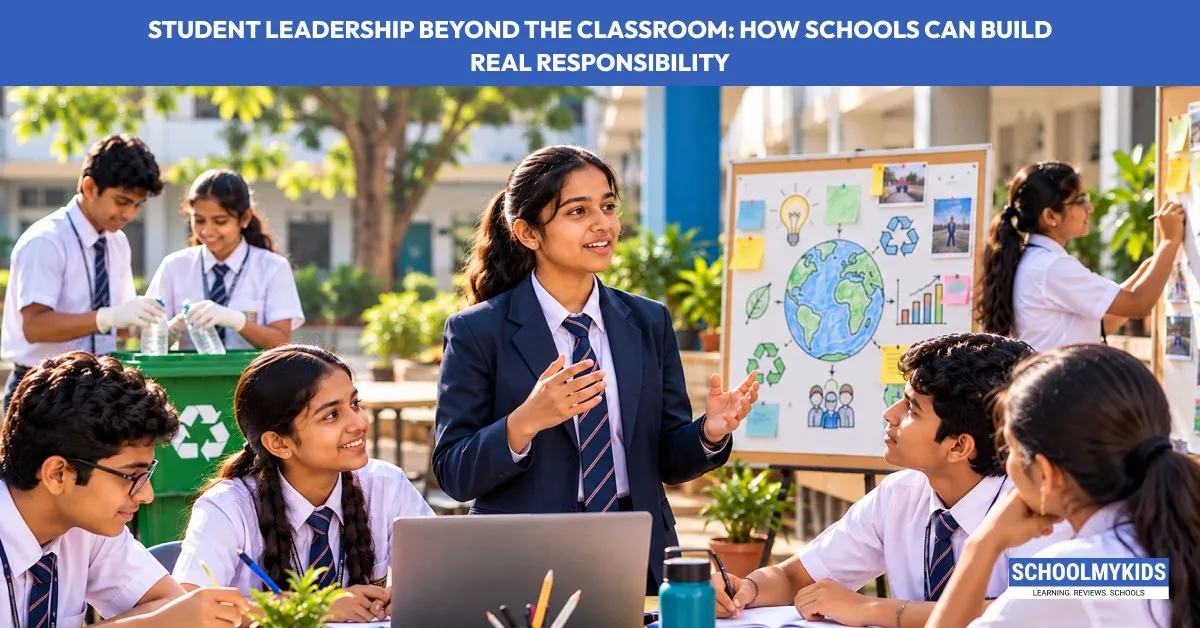
Your child comes home and says, “I got elected class representative.”
You feel proud. Your child has a leadership title.
Then nothing much changes.
No real responsibility. No decision-making. No chance to solve a problem. Just a badge, a speech and a few notices to announce.
In some schools, leadership positions can become mostly ceremonial.
A class representative may collect attendance forms or pass on announcements. That is useful work. But it is not leadership on its own.
Real leadership means making decisions within clear boundaries, taking responsibility for outcomes and learning how to respond when things do not go as planned.
Schools do not need to hand students unchecked power. They need to give them meaningful responsibility, with adult guidance and clear limits.
What is real student leadership in schools?
Real student leadership means giving students meaningful responsibility to make decisions, solve problems, manage projects and review outcomes within clear boundaries and adult guidance. A leadership title, badge or student-council position alone does not make a student a leader.
What Makes Student Leadership Real in Indian Schools?
Three things separate real leadership from a ceremonial title:
Decision-making: Can the student decide something that matters, within agreed boundaries?
Responsibility for resources: Do they manage materials, a small budget, time or a project?
Accountability: Do they review what worked, what did not and what they would do differently?
If students have none of these, the role is mostly ceremonial.
If they have even one or two in a meaningful way, the role can become real leadership.
A student does not need to run the school. They can lead a library corner, plan a waste-management project, mentor a younger student or present an improvement idea to the School Management Committee.
What Research Says About Student Leadership and Academic Performance
Leadership is not a shortcut to better marks. But research does show an interesting connection between leadership involvement and academic performance.
A 2025 study of 179 undergraduate student leaders found a positive correlation between leadership involvement and academic achievement. Students who reported greater involvement in leadership also tended to report better academic performance. The study was published in the International Journal of Evaluation and Research in Education.
The study focused on university students, so schools should not treat the finding as proof that student leadership automatically raises school marks.
The more useful lesson is what students practice when they take responsibility: planning, communication, time management, teamwork and problem-solving.
Leadership is not an academic shortcut. But it gives students regular opportunities to practice responsibility, decision-making and teamwork in real situations.
How NEP 2020 Supports Experiential Learning and Student Leadership
India’s National Education Policy 2020 places strong emphasis on experiential learning across school education. It recommends hands-on learning, arts-integrated and sports-integrated education, storytelling-based pedagogy and connections across subjects.
The National Curriculum Framework for School Education 2023 builds on this approach and encourages learning through activities, experiences and real-world contexts.
Student leadership fits naturally into this kind of learning. Instead of only reading about waste management, students can study the problem in their school, suggest a solution, put it into practice and review the results.
That is experiential learning with responsibility built into it.
The important part is not the title given to the student. It is the responsibility attached to the role.
Policy and classroom practice are not always the same. Some schools still rely heavily on oral explanation, textbooks and homework. Students may learn about leadership, but they may not get many chances to practice it.
That is where schools can make a difference.
Why Student Leadership Matters for Future Careers
Why is student leadership important?
Student leadership gives children and teenagers opportunities to practice decision-making, communication, teamwork, problem-solving and responsibility in real situations. These experiences complement academic learning and can help students build skills useful for higher education, work and everyday life.
Marks still matter. But college and work also involve skills such as initiative, communication, teamwork and problem-solving.
These skills do not develop only by sitting in a classroom.
They develop when students plan an event, manage a small project, handle a disagreement, present an idea or deal with a setback.
For example, some schools use structured programmes outside the regular classroom to give students opportunities to take responsibility and work towards personal goals. Programmes such as the International Award for Young People (IAYP) include voluntary service, skills development, physical activity and an adventurous journey. These experiences can give students practical opportunities to practice teamwork, responsibility, communication and resilience alongside their academic learning.
A student who gets regular opportunities to do these things in school gets early practice in skills that can be useful in college and work.
That does not mean every student must become a public speaker. Leadership can be quiet, practical and behind the scenes.
The student who organizes the team, keeps track of the work, spots a problem or helps a younger student is leading too.
How can schools develop student leadership?
Schools can develop student leadership by giving students age-appropriate responsibilities such as running a student council project, solving a school problem, mentoring younger students, managing a small project, leading a community-service activity or presenting improvement suggestions to school leaders. Adults should provide clear boundaries, safeguarding and guidance while allowing students to make appropriate decisions themselves.
6 Practical Student Leadership Ideas for Indian Schools
Student leadership works best when students have real responsibility and adults provide the structure around it.
Schools can decide what students can decide independently, what needs teacher approval and what should remain an adult responsibility.
The goal is simple: give students enough room to think, decide and act, while keeping adults responsible for safety, safeguarding and decisions that require professional judgement.
1. Give Student Councils Real Decision-Making Roles
Student councils should not only plan Annual Day.
They can take responsibility for one area of school improvement, such as the library, waste segregation, classroom cleanliness or peer support.
For example, a student council could review which library books students actually use. They could survey classmates, prepare a short proposal and present it to the principal or School Management Committee.
The adults still approve the final decision. But students do the research, make a case and help implement the change.
That is real leadership.
2. Let Students Solve Real School Problems
Give a small group a real problem.
For example: “Our school generates too much waste. Design and implement a practical solution.”
Students can research the issue, speak to the cleaning staff, design a segregation system, create awareness posters and monitor results.
One student may lead research. Another may manage materials. Another may handle communication. Roles can rotate every month.
The project does not need to be perfect. The learning comes from planning, doing, reviewing and improving.
3. Create Structured Peer Mentoring Programmes
Older students can mentor younger students, but the programme needs structure.
A Class 11 student may be paired with a Class 6 student for academic support, confidence building or help adjusting to school life.
Set clear expectations:
Meet at a fixed time.
Focus on specific goals.
Keep communication respectful and safe.
Involve a teacher as the point of support.
Review progress regularly.
Older students learn empathy, patience and communication. Younger students get guidance from someone closer to their age.
4. Use Atal Tinkering Labs and Innovation Spaces
Atal Tinkering Labs give students opportunities to build, experiment, develop ideas and work on projects.
Students can decide what to build, work with materials, develop their ideas and present their work. Schools can also use older students to support or mentor younger students during projects.
No ATL? Start smaller.
Create an innovation corner with cardboard, basic tools, recycled materials, charts and a small project board.
You do not need an expensive lab to give students this opportunity. The important part is giving them something to build, improve or solve.
5. Run Student-Led Community Service Projects
Students can identify a local problem and design a practical response.
In rural areas, this could be a health-awareness drive, agricultural experiment, digital-literacy session or community cleanliness project.
In urban areas, it could be waste management, library improvement, peer tutoring or a neighbourhood safety-awareness campaign.
The key is to let students identify the issue, plan the response and review the impact.
6. Create Student School Improvement Committees
Students can audit a specific area of school life and present practical suggestions.
They might look at safety around stairs, water availability, library use, classroom resources or accessibility for students with disabilities.
They should not be expected to fix everything. But they can identify problems, propose solutions and present them to school leadership.
When students see that their input leads to action, they understand that leadership is not just about holding a title.
Age-Appropriate Student Leadership for Classes 6 to 12
The right leadership opportunity depends on age and maturity.
Younger students can begin with guided responsibilities and teamwork, while older students can take on more independent planning, project management, representation and accountability.
The following is a practical framework schools can adapt based on students’ age, maturity and school context. It is not a prescribed national standard.
Class level | Suitable leadership opportunities | Main focus |
|---|---|---|
Classes 6 to 8 | Peer mentoring for younger students, managing a library corner, leading a group project with teacher guidance | Confidence, communication and basic responsibility |
Classes 9 and 10 | Student council roles with a defined decision, school improvement projects, mentoring middle-school students | Problem-solving, planning and accountability |
Classes 11 and 12 | Student representation in school processes, managing a small project budget, training younger leaders, leading community projects | Strategic thinking, stakeholder communication and real-world impact |
Board-exam years need balance. One focused role is better than five commitments. A student managing one meaningful library project may learn more than a student collecting five ceremonial titles.
How Rural Schools Can Build Student Leadership
Rural schools may have fewer resources. That does not mean students have to wait for expensive facilities before they can take responsibility.
Local problems can become useful leadership projects. Students might work on a community cleanliness drive, document a local water issue, help younger students with digital skills or test a simple agricultural idea with teacher guidance.
One example is the BRAIN programme by eVidyaloka, supported by Microsoft. According to eVidyaloka’s 2024-25 annual report, the programme reached 36,878 students across 402 schools in 10 states. The programme focuses on building AI readiness among rural students.
Its BRAINIAC challenge takes the idea further. Students work in teams to develop AI-based solutions to real problems in their communities. In the 2025 challenge, 748 teams submitted initial project ideas, covering areas such as health, sustainability, transport, agriculture and education.
The interesting part is not the technology. It is the process.
Students identify a problem, work with others, develop an idea and present a solution.
A school does not need to copy that programme to use the same principle. Give students a problem they can understand. Let them research it, divide the work, present an idea and review what happened.
The project can be small. The responsibility is what matters.
Why Girls Need Visible Leadership Opportunities in Schools
Girls should not have to wait until college or work to experience decision-making.
Research from India has found an association between greater female representation in school governance and improvements in some school outcomes. A 2024 study by Chandan Jain and Bharti Nandwani found that greater female representation in School Management Committees was associated with improvements in school quality, student enrolment and learning outcomes, with particularly positive effects for girls.
The study focused on School Management Committees rather than student councils, but it points to a wider lesson for schools: representation matters.
Girls should have genuine opportunities to speak, make decisions, manage projects and see other girls doing the same.
Leadership should not be reserved for the loudest students in the room.
Why Schools Hesitate to Implement Student Leadership
Principals and teachers often know that student leadership is valuable. But implementation is hard.
Common barriers include:
Time, because teachers already manage classes, paperwork and inspections.
Fear that a student may make a poor decision.
Lack of training in shared leadership and safeguarding.
Parental pressure to focus only on marks.
Limited infrastructure or project budgets.
These are real barriers. The answer is not to wait until every problem has been solved.
Start small.
Give students one clear responsibility. Set boundaries. Keep an adult involved. Review the outcome together.
A school does not need a large leadership programme to get started. Even one meaningful responsibility can give students a different experience of what it means to contribute to their school.
A Simple 4-Week Student Leadership Action Plan
Schools do not need to redesign their entire leadership system.
Start with one decision. One project. One month.
Week 1: Identify one decision currently made only by adults that students could help with. Library book selection, waste management or event planning are good starting points.
Week 2: Meet the student council. Explain the problem and ask them to propose a plan.
Week 3: Give them a clear role and boundaries. Let them research, decide and act with adult support.
Week 4: Review the result. Ask what worked, what did not and what they would change.
Do not wait for a perfect policy, large budget or full training programme.
Start with one decision. One project. One month.
FAQs About Student Leadership in Indian Schools
Will leadership distract students from academics?
Not if the role is well designed. A focused leadership responsibility can give students useful practice in planning, time management and engagement. But schools should avoid giving students too many roles, especially during board-exam years.
What if a student makes a wrong decision?
That is part of learning.
The school should set clear boundaries, provide guidance and help students understand what went wrong. Students can review the decision, see what they could have done differently and try again.
The goal is not to remove every possibility of failure. It is to help students learn how to handle it.
Can schools without resources implement this?
Yes. Peer mentoring, student-led problem-solving, library improvement and school audits can begin with almost no cost. Use existing materials, staff time and community support.
How can parents support leadership at home?
Give children age-appropriate responsibilities. Let them plan part of a family task, manage a small budget or solve a practical problem. Do not rescue them from every difficulty immediately. Guide them to think through options instead.
My child is shy. Can they still lead?
Yes. Leadership is not only public speaking.
Shy students may do well in research, planning, one-to-one mentoring, project management, documentation or written communication. Good leadership programmes offer different types of roles.
How do schools know the programme is working?
Track a few simple indicators:
Student participation and retention.
Number of student-initiated projects completed.
Teacher and parent feedback.
Student confidence and engagement.
Clear evidence that student suggestions were considered.
Without review, a leadership programme becomes another ceremony.
The Real Cost of Token Student Leadership
A student can graduate with strong academic results without having had many opportunities to practise initiative, responsibility or problem-solving in real situations.
College and work will often require students to handle situations that involve these skills.
Schools do not need to turn every student into a school captain. They need to give every student some meaningful chance to contribute, decide and learn.
A student may lead a team. Another may solve a library problem. Another may mentor a younger child. Another may quietly organise the work that keeps a project moving.
Leadership does not always look like standing on a stage.
Give titles, and students may remember the ceremony.
Give real responsibility, and students learn something they can use for life.
Want practical resources on NEP 2020 implementation and student leadership? Visit SchoolMyKids for guidance designed for Indian parents, schools and educators. Through the SchoolAI Scholarship Programme, SchoolMyKids aims to make AI-powered learning more accessible. Learn more about SchoolAI and the scholarship programme at SchoolMyKids.
References
John Michael D. Aquino, Christian P. San Luis (2025). The role of student leadership in academic achievement: A pathway to framework development. International Journal of Evaluation and Research in Education, 14(5), 3675–3685. https://ijere.iaescore.com/index.php/IJERE/article/view/34569
Ministry of Education, Government of India. (2020). National Education Policy 2020. https://static.pib.gov.in/WriteReadData/userfiles/NEP_Final_English_0.pdf
National Council of Educational Research and Training. (2023). National Curriculum Framework for School Education 2023.
eVidyaloka. (2025). Annual Report 2024-25.
AI learning for rural students: Microsoft partners with eVidyaloka to revolutionize AI education for 37,000 rural students in India. (2025, July 7). ET Education.
Jain, C., & Nandwani, B. (2024). Female representation in school management and school quality. Journal of Economic Behavior & Organization, 222, 84–103.







Be the first one to comment on this story.