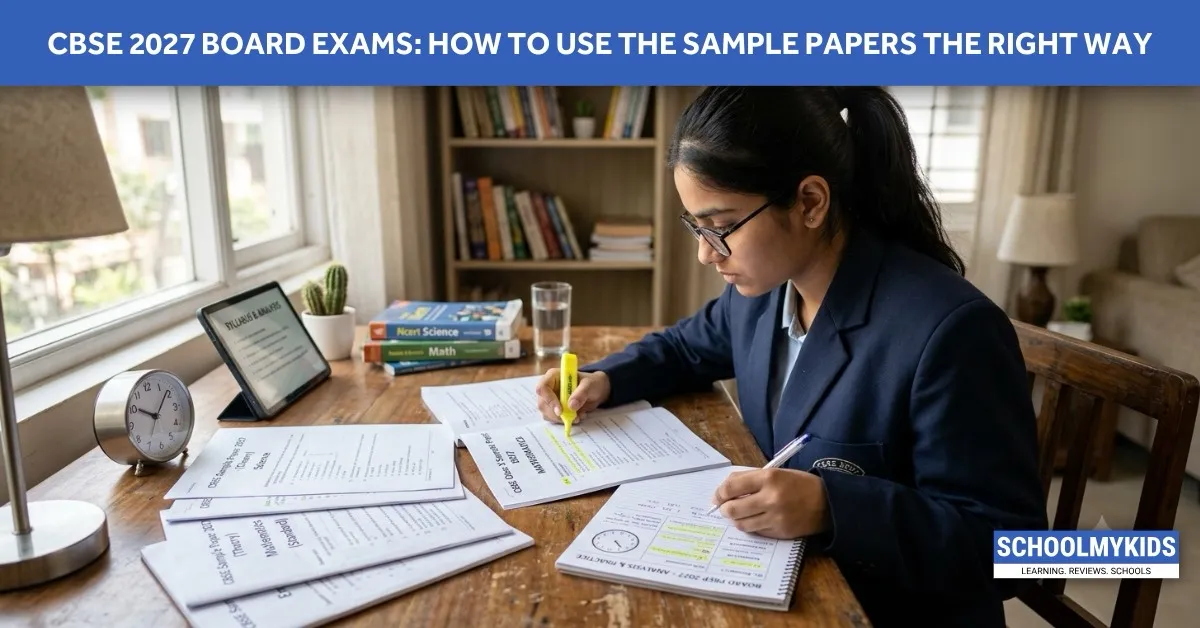
CBSE released the full set of sample question papers and marking schemes on 21 September 2026.
Most students will download them, glance through, and keep scrolling. That’s the trap.
The thing is, these papers show you the exact format, question types and mark distribution that will appear in the 2027 exams. And if you don't look at them carefully, you'll prepare the wrong way.
Official links:
Notification confirming no change in design: CBSE Academic circular dated 21 September 2026.
For Class 10 students, the two-attempt system continues: a compulsory main exam in February–March and an optional improvement chance later. The sample papers apply to both.
How to Download the Official Papers
Go to cbseacademic.nic.in
Click the link for Sample Question Papers for Classes X and XII (2026-27)
Choose Class 10 or Class 12
Select your subject
Download both the sample question paper and the marking scheme
What’s Actually in These Papers and Why It Matters
The 2027 sample papers follow the same overall design used last year. CBSE has confirmed there is no change in the question paper design or assessment pattern for the 2026-27 session.
That still doesn't mean you can ignore them. Question distribution, the mix of definition-type questions versus problem-solving versus case studies, and how marks are split across sections are all clearly laid out. If your teacher is still working only from older papers, you may miss the exact weightage of each type of question. Teachers are busy. Many prepare from what they know. So you need to do it yourself.
The papers have specific question types. Like, how many marks go to definition-type questions versus problem-solving versus case studies. If you don’t know this, you’ll waste time studying the wrong way.
In science, the papers continue to put weight on concept-application questions. Just straight memorization won't work. You need to think about applications.
In maths, word problems carry solid marks. So if you've been doing just textbook sums, you're missing practice.
In social science, the papers lean toward analysis. Less "write down the date" and more "explain why this happened."
You won’t know any of this unless you actually look at the papers.
The Marking Scheme Is The Real Tool (Not What You Think)
Everyone looks at the sample questions. Nobody looks at the marking scheme.
The marking scheme is literally the answer key. But it’s more than that. It shows you what the examiners consider a correct answer. What gets full marks. What gets partial marks.
This matters because your teacher might teach one way. But the examiner marks another way.
Look at the marking scheme for a few questions. You’ll notice patterns. Like, for a 3-mark question, they might accept 3 different types of answers. All get full marks. So you’re not locked into one right way.
Or for a 5-mark question, they show exactly what should be included. Not everything. Just specific points. If you give those points plus extra stuff, you still get 5 marks. Nothing more.
This changes how you prepare. You’re not trying to know everything. You’re trying to know what the examiner actually expects.
Nobody talks about this. Everyone’s obsessed with the questions. The marking scheme is where the actual information lives.
One more thing the marking schemes show: how partial marks are awarded. For a 3-mark or 5-mark answer, the scheme often lists the exact points that earn full credit. Extra correct information does not add marks, but missing a listed point does cost you. That is the level of precision examiners use.
How the Papers Are Arranged: Why Your Old Notes May Not Match
The papers show exactly how questions are arranged. Multiple-choice section first. Then short answer. Then long answer.
Your teacher probably taught topic by topic. They’ll ask history questions, then geography, then civics. All mixed up.
But the exam doesn’t work that way. All questions of one type are together. Then you switch to the next type.
This means when you prepare, don’t just know the content. Know how to answer it in the format that’s actually asked.
If the paper has 3 multiple-choice questions from your chapter, you need to practice multiple-choice on that topic. Not just understand it deeply.
If the paper has one 5-mark question from your chapter, practice that specific format.
This sounds obvious, but most students don’t do it. They study the chapter. They don’t practice answering it in exam format. Then in the actual exam, they freeze because the question format feels weird.
Which Chapters Get Tested More (Use the Papers to Prioritise)
Look at the sample papers CBSE released for your subjects. There's a clear pattern in what gets tested more often.
Some chapters appear more often. Some appear less. That tells you what CBSE cares about.
If you’re behind on the syllabus, you now have proof about which chapters matter most. You can prioritize based on the sample papers, not guesses.
For instance, if the independence movement shows up in every social science sample paper, you need to know it cold. If a specific battle shows up only once, you might be okay with a lighter touch.
This is concrete data. Use it.
What Students Actually Get Wrong
They download the paper. They think, “Oh, nice, sample papers exist.” They put it aside. They study from their textbooks.
Then 2 weeks before the exam, they start panicking. They look at the sample papers. They see questions they haven’t practiced. They freak out.
The time to look at these papers is now. Not 2 weeks before. Now.
Why? Because if you find gaps now, you have time to fix them. You can adjust your preparation. You can practice question formats you haven’t done. You can figure out which chapters need deeper study.
If you wait till the end, you can only cram. Cramming doesn’t work for board exams.
The Specific Things to Do Right Now
Download the sample paper for your subject. The main one, not all the regional variations.
Spend 30 minutes just reading the questions. Don’t answer them. Just read. Get a feel for what they’re asking.
Then look at the marking scheme. See what answers look like. See what’s considered correct.
Now take one section. Maybe 3 questions. Actually attempt them. Write answers like you’re in the exam. Give yourself time limits.
Check your answers against the marking scheme. See what you missed. What you got right.
Do this for one more section. That’s it for today. You’ve now actually looked at the exam format.
Repeat this process over the next few weeks. One or two sections at a time. Not the whole paper at once. That’s too overwhelming.
This takes maybe 30-45 minutes per section. You’re not spending hours. You’re doing targeted practice based on what the actual exam looks like.
Why Some Questions Feel Unfamiliar
When you look at the sample papers, some questions might feel like they’re not covered in your textbook. Or they’re covered but phrased differently.
This makes students panic. “Will the exam ask about things not in the book?”
Actually, no. The sample papers are drawn from the textbook. But maybe the specific chapter wasn’t covered in your school yet. Or your teacher skipped a section.
So if you see a question that seems unfamiliar, it’s probably something you just haven’t studied yet. Not something impossible.
Also, sometimes the sample papers have questions that are tricky. Confusing wording. Multiple interpretations. But examiners do this sometimes. You have to get used to it.
So looking at these papers now means you can ask your teacher about confusing questions. You can clarify. You’ve got time.
FAQs
Q1: Should I solve all the sample papers multiple times?
No. Solve each paper once, carefully. Check your answers against the marking scheme. See what you missed. Then focus on studying those topics better. Solving the same papers over and over is just mechanical. You need to learn from the mistakes, not repeat them. If you finish all official sample papers, look for practice papers from coaching centers or websites. But the official CBSE papers should take priority.
Q2: What if my school hasn’t finished teaching some chapters that appear in the sample papers?
That’s normal. Sample papers are released before schools finish teaching. It’s October. Exam is in March. Schools will finish eventually. But you now have a preview. You know what chapters are important. You can ask your teacher to cover them faster. Or you can start reading ahead on your own. Having this information is actually helpful. It lets you plan.
Q3: The marking scheme shows partial marks. Does that mean I don’t need to give complete answers?
No. Partial marks exist because you might not remember everything. But if you CAN give the complete answer, you should. Partial marks are a safety net. Not a target. Study to get full marks. The partial marks are just so you don’t lose everything if you forget one point.
Q4: Should I rely only on sample papers for preparation or keep studying the textbook too?
Study the textbook thoroughly. Use sample papers to practice answering questions. They’re not the same thing. The textbook teaches you the content. Sample papers teach you how the exam tests that content. You need both. The sample papers are a preview of the exam, not the entire preparation tool.







Be the first one to comment on this story.