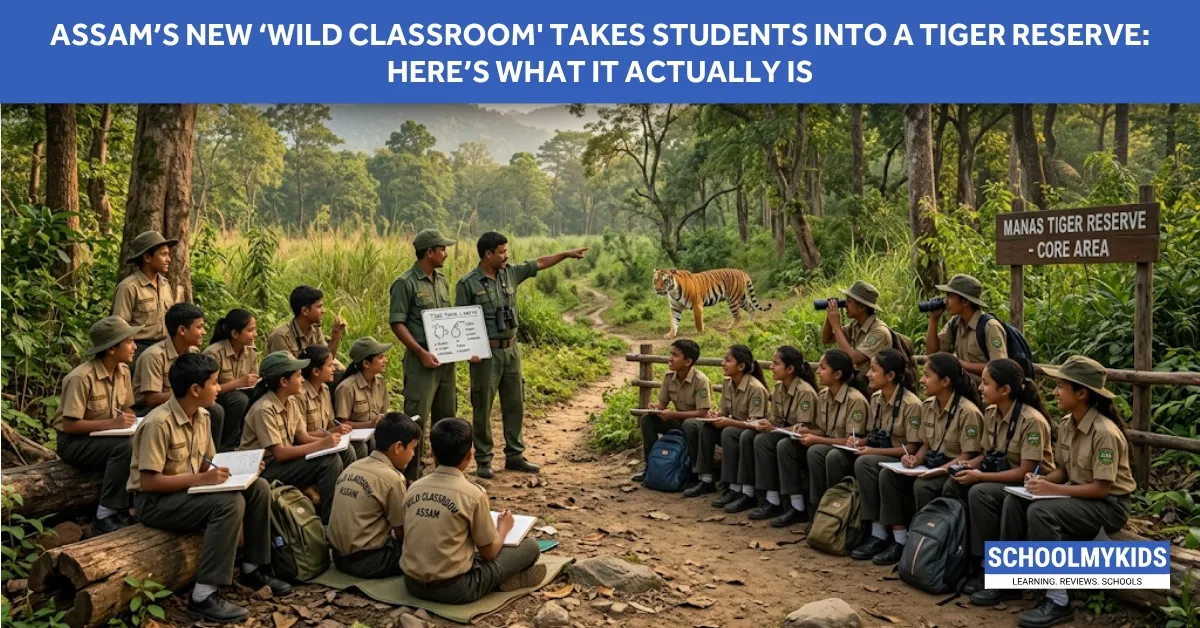
Assam’s Forest Department just started something called the Nameri Wild Classroom. It’s at Nameri Tiger Reserve. Students go there, stay a couple of days, and learn about wildlife by actually being in the forest instead of reading about it.
Forest and Climate Change Minister Jayanta Malla Baruah announced it. His point was basically this: some things you just can’t learn from a textbook. You have to be there.
Sounds nice in theory. Let’s get into what it actually involves.
Where Is Nameri Tiger Reserve Located
Nameri Tiger Reserve is in Sonitpur district, Assam. It sits in the foothills of the Eastern Himalayas, right along the Jia Bhoroli River. Up north, it borders Pakke Tiger Reserve in Arunachal Pradesh.
It became a wildlife sanctuary in 1985. Upgraded to a national park in 1998. Declared a tiger reserve in 2000. The place is known for dense forest cover, rare birds, and honestly just a lot of biodiversity packed into one area. That’s probably why they picked it for this.
Who Can Join the Nameri Wild Classroom
Class 8 and above. That includes college students too. So you could have a 13-year-old and a 20-year-old on the same trip, which is a pretty wide range.
One thing the announcement doesn’t fully spell out yet is the exact fees and how many spots are available or how selection works. It runs at a nominal cost. If your kid wants to join, schools and parents can write to outreach.namerinptr@gmail.com or WhatsApp 9401822244.
What Students Actually Do in the Nameri Wild Classroom
It runs for two or three days. Students stay there, not just visit for an afternoon. It runs at a nominal cost, and students stay at the Nameri eco-camp.
The activities: birdwatching, forest walks with a guide, wildlife tracking (basically learning to read footprints and signs animals leave behind), and stuff about river ecology. There’s also rafting on the Jia Bhoroli River, which honestly sounds like the part most students will be excited about. They also learn about local community traditions and knowledge around the reserve.
Naturalists and forest staff lead the groups. They’re the ones explaining how everything connects, how the river affects the forest, how the forest affects the animals, that whole web of things.
Students keep a field journal too. Write down what they see. At the end, they get a certificate.
Does the Nameri Wild Classroom Certificate Carry Any Value
The announcement doesn’t say if it counts for anything academically, like extra credit or a line on a college application. It’s probably more of a “you completed this” certificate than something official. Don’t assume it adds weight anywhere until a school or college tells you it does.
Why Field Learning Beats Textbooks for Wildlife
You can read fifty pages about bird behavior and still not really understand it until you’ve stood still for ten minutes and watched one bird do something weird. That sticks in your head way better than a paragraph does.
Field tracking is similar. You look at a hoofprint; you start asking questions. How old is this? Which direction was it going? Why here and not there? That’s actual thinking, not memorizing.
The minister basically said the same thing: that forests teach lessons books can’t. Can’t really argue with that one.
Can the Nameri Wild Classroom Lead to a Career in Conservation
Maybe. The minister mentioned it could push some students toward wildlife research, ecology, conservation work. Those are legit fields. People do build careers there.
But let’s be real. One three-day trip isn’t going to decide someone’s career. It might spark interest though. If a student comes back genuinely curious, the next step is probably picking the right science subjects in school, then looking at degree options later, like zoology or environmental science or forestry.
Don’t put pressure on one trip to “figure out the future.” That’s not what it’s for.
What to Pack and Expect for the Nameri Wild Classroom
There are no exact details shared yet, but the general sense is that comfortable shoes are needed, because there’s walking involved. Something for rain, since it’s forest terrain. A notebook, though they probably give you one for the journal part.
Living away from home for a couple of days might be new for some students, especially younger ones. Sharing a room, following a schedule, waking up early for the birdwatching slots. Worth preparing mentally for that if your kid hasn’t done an overnight school trip before.
Safety basics have not been spelled out yet. Night supervision, medical cover, and what happens if a student falls sick or gets hurt are still open questions. Ask for the ratio of staff to students and whether a doctor or trained first-aider stays on site.
Best Time and Practical Tips
The programme is set to start in the current tourism season. November to March is usually the more comfortable window for forest activities and rafting in this area. Confirm exact dates with the organisers because they can shift with weather or park regulations.
Key Questions Parents Should Ask Before Enrolment
Who’s supervising at night? What happens if a kid gets sick or hurt out there? Are the dates clashing with exams or school events? What’s actually included in the cost, if there is one? Is the group mixed-age or will Class 8 students and college students be separated for some activities?
These aren’t answered in what’s been released so far. Call the forest department office or check their official notices before committing to anything.
How the Nameri Wild Classroom Fits India’s Push for Experiential Learning
This fits into a pattern happening across India right now. Schools and governments are pushing for actual hands-on learning instead of just classroom lectures. NEP 2020 talks about this a lot too, experiential learning, not just rote stuff.
Assam doing this with its tiger reserves makes sense given what the state has to offer. Not every state has this kind of access to forests and wildlife reserves right in their backyard.
Key Points
Nameri Wild Classroom is a new programme by the Assam Forest Department at Nameri Tiger Reserve
Open to Class 8 students and above, including college students
Runs as a two- or three-day residential stay at the Nameri eco-camp
Activities: birdwatching, forest walks, wildlife tracking, river ecology, rafting on the Jia Bhoroli River, and local community traditions
Students keep field journals and get a certificate at the end
Nominal cost; contact outreach.namerinptr@gmail.com or WhatsApp 9401822244
Nameri Tiger Reserve is in Sonitpur district; sanctuary in 1985, national park in 1998, tiger reserve in 2000
Certificate value for school or college credit is not confirmed yet
Could spark interest in wildlife research or conservation careers, but is not a guaranteed career path
FAQs
Q1: Is this programme free or do you have to pay?
It runs at a nominal cost, but the exact amount is not listed in the announcement. For now, schools and parents can write to outreach.namerinptr@gmail.com or WhatsApp 9401822244.
Q2: Can a Class 8 student and a college student really do the same programme together?
Based on what’s announced, yes, both groups are eligible. It’s not clear if activities are split by age or skill level within the programme, so that’s worth asking about directly.
Q3: Will the certificate help with college applications or school grades?
Unknown right now. The announcement just says students receive a certificate on completion. It doesn’t mention academic credit or weightage. Don’t assume it carries official value until confirmed.
Q4: Is this a one-time thing or will it keep running?
The source material doesn’t say whether this is a pilot programme or something that’ll run regularly going forward. Keep an eye on official Assam Forest Department updates for that information.








Be the first one to comment on this story.