You already know plants need sunlight, water and air. Everyone does. But that idea really clicks only when you've actually tried keeping a plant alive at home. You watch its leaves droop. You water it. Then you see them perk up. That's different from just reading about it.
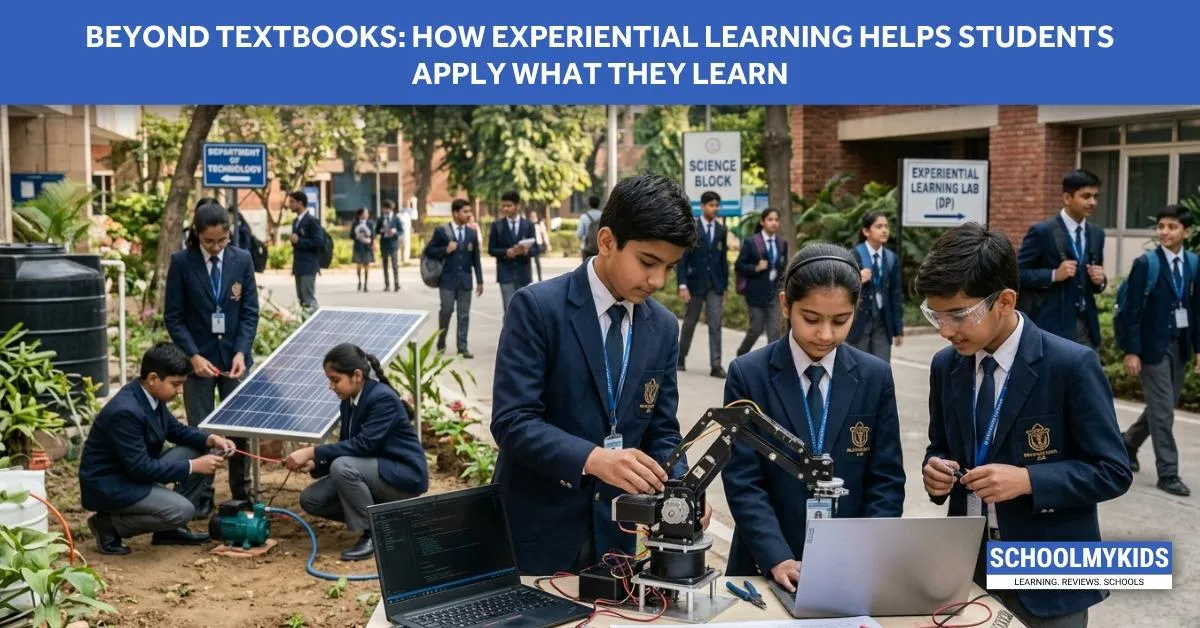
That is exactly what makes experiential learning work. Students aren't just reading about something. They're using it. Testing it. Tying it to stuff they actually do every day. Yes, a textbook can explain a concept. But an experience? That shows a student why it actually matters.
What Is Experiential Learning?
So what exactly is experiential learning?
It simply means learning by doing. By observing. By trying things out and then actually thinking about what happened. And it can happen anywhere. In a classroom, yes! But also at your home, outdoors, or right in your local community.
Think about a science class that includes an actual experiment instead of just a written explanation. Or a mathematics lesson where students plan a small event and work within a fixed budget. Maybe a social science class asks students to go out and interview older people about how their neighborhood has changed. Do you see the difference?
The important part is that the activity itself is only one part of the process. Students also need time to actually talk about what happened. What did they learn? What would they change if they tried again? This reflection is what helps them really understand the lesson.
Take water conservation, for example. Students can actually check how much water their homes use in just one day. They can spot where water is being wasted. Calculate what could be saved. Then suggest simple changes for their families or even their school.
Why Does It Matter Today?
Let's be honest about today's kids. They're growing up surrounded by phones, videos, online games, social media and instant access to pretty much everything. Now, these tools can definitely support learning. But they also train students to expect quick answers.
Unfortunately, finding an answer online doesn't always mean you actually understand it. Students still need to ask good questions. Check facts. Spot misinformation. And explain ideas in their own words. Now, artificial intelligence has made these skills even more critical. In fact, a 2026 survey found that nearly 7 in 10 middle and high school students actually worry that using AI for schoolwork is weakening their critical thinking skills. Students can use AI to gather ideas or organize information for sure. But they should verify the results and add their own reasoning. Always.
Say a student's preparing a project on air pollution. They can find several online articles within minutes. Easy. But this is not where the real learning begins. It begins when that student actually checks the sources. Compares the information with what's happening in their own area. Then suggests a practical solution for their school or neighborhood. That's learning.
The numbers back this up. The World Economic Forum's Future of Jobs Report 2025 found that seven out of ten employers consider analytical thinking an essential skill. The report also lists resilience, creative thinking, teamwork and technology skills among the qualities that'll matter most in the coming years.
India Is Moving Towards Learning by Doing
Now, experiential learning isn't just some trendy idea. It has a clear place in India's actual education plans. The National Education Policy 2020 recommends hands-on learning, art-integrated education, sports-integrated education and storytelling-based pedagogy as standard teaching practice. The policy also encourages students to connect ideas across subjects.
This approach can take many forms:
Students can learn mathematics through shopping lists, measurements, surveys and budgeting.
Science lessons can include gardening, waste checks, weather records and energy-saving projects.
Social science can include local maps, interviews and visits to public places.
Language lessons can use theatre, podcasts, school newspapers and storytelling.
Civics can include a mock election or a project about a local issue.
The best part is that a school does not need expensive equipment or long trips for this kind of learning. Not at all. A school garden works. A classroom survey works. Even a conversation with a local worker can offer useful lessons.
What Do Students Gain?
For one, they understand ideas better when they apply them in real situations. And the research backs this up. Studies show experiential learning helps students retain 90 percent of what they learn after one day. Compare that to just 10 percent from lectures. That's a huge difference. They also begin to see the value of subjects that may have seemed difficult or disconnected from everyday life.
Think about a child who helps plan a shopping list. That child isn't only learning about prices. They're also practicing estimation. Decision-making. Responsibility. Or take a group that designs a waste-reduction plan. They're learning about science, communication and teamwork. All at the same time.
Over time, projects can help students develop things like:
Confidence in making choices
Stronger speaking and writing skills
The ability to work with different kinds of people
Patience when the first attempt doesn't work
The habit of asking questions
Care for their community and surroundings
There's something else, too. Students may also discover strengths that just aren't visible in written tests. One student may lead a presentation and shine. Another may collect information, design a poster, manage materials or notice an important detail that everyone else missed.
Let's be clear that the goal should not be a perfect project or an expensive display. Not at all. The focus should remain on effort, reasoning, teamwork and improvement. That's what actually matters.
How Can Students Start?
Students do not need to wait for a school assignment to start learning this way. Everyday life offers plenty of chances to learn. You just need to look for them.
Start with one question. Just one. It could be something like, "Why does our classroom produce so much waste?" Or maybe, "How can I reduce the time I spend on my phone?" Simple questions work best.
Next step? Collect information and decide how to actually study the question. Students may conduct a small survey. Observe a routine. Speak to someone. Or compare two possible solutions. There's no single right way
Then create something from the findings. Could be a report, chart, video, model, podcast or short presentation. Whatever works. And keep a note of what worked and what didn't. Both matter.
Digital tools can make this whole process easier. Students can use a spreadsheet to track information. A camera to document changes. An online tool to create a presentation. But two important rules. Personal information should never be shared without permission. And sources should always be checked before use. Always.
Then ask one final question. It's a useful one. "What did I learn from doing this that I would not have learnt from reading about it?" If you can answer this, you've actually learned something.
Parents and Teachers Have an Important Role
Now, parents can support this kind of learning without spending a lot of money. Really. Children can help plan a grocery budget. Measure ingredients while cooking. Care for plants. Track electricity use. Or plan a family trip. All of these count.
Instead of jumping in with an answer, try asking:
"What do you think will happen?"
"How could we check that?"
"What would you try next?"
These are simple questions. But they work.
These questions do two important things. They show children that their ideas deserve attention. And they encourage children to think before seeking a ready-made answer. Which is exactly the point.
Teachers play a key role too. They can connect activities to the lesson and give students clear roles. They can assess the process as well as the final result. And students should know what they're expected to learn. They should also receive enough time and support. Both matter.
One more thing. Safety matters too. Outdoor activities, online research, interviews and visits should match the child's age and maturity level. Always. Adults should guide students when an activity involves roads, water, tools, strangers or sharing personal information. No exceptions here.
Some schools also give students planned opportunities for service, physical activity and personal challenges. Take IAYP (International Award for Young People) programme, for instance, it includes voluntary service, skills development, physical recreation and an adventurous journey. These experiences help students practice teamwork, build confidence and take on responsibility.
Make Learning Useful
We understand and agree that textbooks remain an important part of education. They absolutely do. They give students the ideas and facts they need. But experience? That shows students how to actually use them.
So the next time a student asks, "Will this come in the exam?" try asking instead: "Where can I use this in real life?"
This one question can turn a lesson into a skill. A project into confidence. Knowledge into action. And that's the whole point.
References:
World Economic Forum. Future of Jobs Report 2025. January 2025
National Education Policy 2020. Ministry of Education, Government of India
RAND. "More Students Use AI for Homework, and More Believe It Harms Critical Thinking." March 2026
Gitnux. "140+ Experiential Learning Statistics." February 2026
Frequently Asked Questions
What is experiential learning?
Experiential learning is a "learning by doing" approach where students learn by observing, trying things out, solving problems, and reflecting on what they experience. It helps connect classroom concepts with real-life situations.
How does experiential learning benefit students?
Experiential learning helps students apply what they learn in practical situations while developing skills such as critical thinking, communication, teamwork, decision-making, confidence, and problem-solving.How can parents and teachers encourage experiential learning?
Parents and teachers can encourage experiential learning through simple activities such as budgeting, cooking, gardening, surveys, experiments, interviews, and community projects. Asking questions like “What do you think will happen?” and “How could we check that?” also encourages children to think independently.




Be the first one to comment on this story.