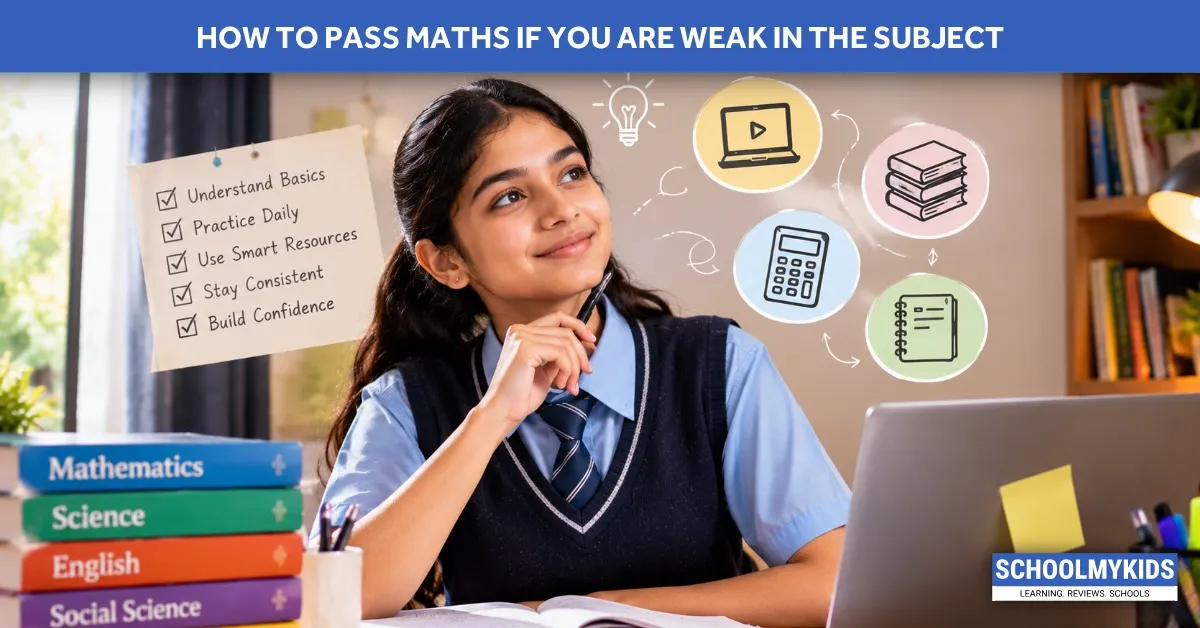
Last mock test, you got 14 out of 80. Your friend got 62 and wasn’t even trying. Your mother wants to know what the tuition fee is for. You close the notebook and think, maybe maths is just not for you.
Stop right there. How to pass maths is a smaller problem than it looks from where you sit. You need 33 marks out of 100, and CBSE says that is the pass line in every subject. This blog is for the self-study students, the tuition students, and those who do a little of both.
What Are the Pass Marks in Maths for Class 10?
You need 33 out of 100 to clear CBSE Class 10 Maths. The paper is 80 marks of theory and 20 marks of internal assessment, and you get 3 hours to write it, as the CBSE curriculum shows.
Say your school gives you 15 out of 20 internal marks. You then need only 18 more from the board paper, which is 18 out of 80. That’s about one mark in every four and a half. Check the exact pass rule in the latest CBSE circular, but the picture is clear. Internal marks matter, so ask your teacher early what they depend on.
Is 33 too low to aim for? Maybe. It’s still the right first target. Once you cross it with ease, push higher. State board student? Read your own board’s notice, because pass rules differ.
Standard or Basic: Which Maths Paper Should You Choose?
CBSE gives two options in Class 10, Standard (code 041) and Basic (code 241), and both have 80 theory marks plus 20 internal. Basic suits you if Maths is not in your Class 11 plan. Standard keeps the science door open.
Your school may have its own rules for Class 11 subjects, so ask before you fill the form. The board has also confirmed no change in paper design for 2026-27. One practical test helps. Attempt a free Standard and Basic sample paper and see which one you can actually write.
Which Chapters Give Easy Marks If You Are Weak in Maths?
Algebra, Number Systems, Coordinate Geometry and Statistics and Probability carry 43 marks together (20 + 6 + 6 + 11). Most of the work in these units is formulas and fixed steps. Practice beats talent here. Why start with these? Early wins build confidence, and confidence is half the battle in maths.
The marks below come from the official curriculum.
Unit | Marks | Where to start |
|---|---|---|
Algebra | 20 | Linear equations, then the quadratic formula |
Geometry | 15 | Similar triangles, but only after the other units |
Trigonometry | 12 | Standard values table, learnt by heart |
Statistics and Probability | 11 | Mean, median, mode, then simple probability |
Mensuration | 10 | All area and volume formulas on one sheet |
Number Systems | 6 | HCF, LCM, irrational number proofs |
Coordinate Geometry | 6 | Distance and section formulas |
Can you skip a chapter? Don’t, at least in round one. Leave Geometry proofs for the end. Come back when the rest feels steady.
A 30 Day Maths Study Plan for Weak Students
Give each week one job. Week 1 fixes basics, weeks 2 and 3 cover the scoring units, and week 4 is for full papers.
Week | Focus | Daily work |
|---|---|---|
1 | Class 9 basics, tables, fractions, algebra identities | 90 minutes, 10 sums from NCERT examples |
2 | Algebra, Number Systems, Coordinate Geometry | 2 hours, one exercise a day |
3 | Statistics and Probability, Trigonometry, Mensuration | 2 hours, make a one page formula sheet |
4 | Sample papers and Geometry | A full 3 hour paper every second day, then fix every error |
Will 30 days be enough? For passing, yes, if the daily work really happens. For 90 plus, no. Picture a typical week 2 evening. You sit down at 6 pm, open the Algebra exercise, and solve five sums. Two go wrong. You note both in the error notebook, redo them, and stop at 7.30. No heroics, no all-nighters. Sounds boring but it works. This is how to pass maths without the night-before panic.
Maths Self Study Without Tuition
Every topic follows one loop. Read a solved example, cover the solution, and solve it again alone.
Read one solved example in the NCERT textbook.
Cover it and solve it on your own.
Do the exercise questions in order.
Copy every wrong answer into an error notebook, with the right step beside it.
Open that notebook after three days and redo those sums.
Stuck and nobody to ask? Watch a free lesson on DIKSHA, the Ministry of Education platform. Note the doubt. Ask your school teacher tomorrow. How many questions a day? Five to ten is enough early on. Ten right sums beat fifty copied ones. Mark every sample paper against the official marking scheme too, since that teaches you how marks are given.
How to Use Maths Tuition Without Wasting the Fees
Tuition works when the tutor sees your mistakes. So try the homework alone first, and bring the wrong answers to class. Otherwise, you are paying someone to solve sums while you watch.
Ask your tutor to check one full paper each week.
Request a second method after the NCERT method is clear.
Finish textbook exercises before buying guides.
Name the chapters that scare you.
Every student has a different setup, so pick the row that fits you.
Student type | Start with | Weekly check |
|---|---|---|
Self study only | NCERT examples, error notebook | One sample paper, marked by you with the CBSE scheme |
School plus tuition | Homework tried before class | One paper checked by the tutor |
Tuition only, little practice | 5 questions daily, alone | Tutor tracks your repeat mistakes |
How to Handle Maths Anxiety and Silly Mistakes
A two-minute recheck fixes most silly mistakes. Fear of numbers also shrinks when your session starts with one easy question.
Why do formulas vanish in the exam hall? Because you only read them. Write your formula sheet by hand every Sunday. The hand remembers what the eyes forget. Panic during the paper? Close your eyes for ten seconds, breathe slowly, and restart with the easiest question on the page.
Write the formula before you substitute.
Underline given values.
Check signs and units at the end.
Rest five minutes after every 45.
Board Exam Maths Tips to Secure Pass Marks
Start with the questions you know, since the marking scheme pays for each correct step. The official scheme gives one mark for MCQs with no part marks, and splits longer answers into steps.
Say you reach a 3-mark question and get stuck halfway. Don’t leave it blank. Write the formula, the substitution, and whatever you do know. A half-right answer earns something. A blank earns nothing.
Draw a neat figure for every geometry question.
Read each MCQ twice, because a wrong option earns zero.
Show units in the final answer.
Keep the last 15 minutes for revision.
What If You Do Not Pass Maths in the First Attempt?
You get a second chance now. One bad paper doesn’t decide your year. Plan it early. CBSE holds two Class 10 board exams, with the February one mandatory and the May one optional.
Students who have passed can improve up to three subjects (Science, Mathematics, Social Science and the languages) in the May exam. Students placed in the compartment category after the February exam also write the failed subject or subjects in the same May exam under the compartment category. Watch cbse.gov.in for the latest schedule.
Key Takeaways
How to pass maths comes down to a short list.
Aim for 33 first and collect internal marks early.
Start with Algebra, Number Systems, Coordinate Geometry, and Statistics and Probability.
Follow the 30-day plan and keep an error notebook.
Solve one full paper a week and mark it honestly.
Write every step you know in the exam.
Keep the May exam as a safety net.
FAQs
Can a weak student pass maths in one month?
Yes, it is possible if you study daily and start with the high-scoring units. Follow the 30-day plan above and attempt a full sample paper every second day in the last week.
Is NCERT enough to pass maths?
The NCERT textbook is the prescribed book for CBSE Class 10 Maths. Solve every example and exercise, then add sample papers.
Can you pass maths without tuition?
Yes. NCERT books, CBSE sample papers with marking schemes, and DIKSHA lessons are all free. Check your answers against the scheme every week.
How many hours should a weak student study maths daily?
Aim for 90 minutes to 2 hours of focused practice. Short daily sessions beat one long Sunday session.
Do Standard and Basic Maths carry the same marks?
Both have 80 theory marks and 20 internal marks. Check your school’s Class 11 rule before choosing.
What if you fail maths in the February exam?
Write the May exam under the compartment category. Confirm dates on the official CBSE website.







Be the first one to comment on this story.