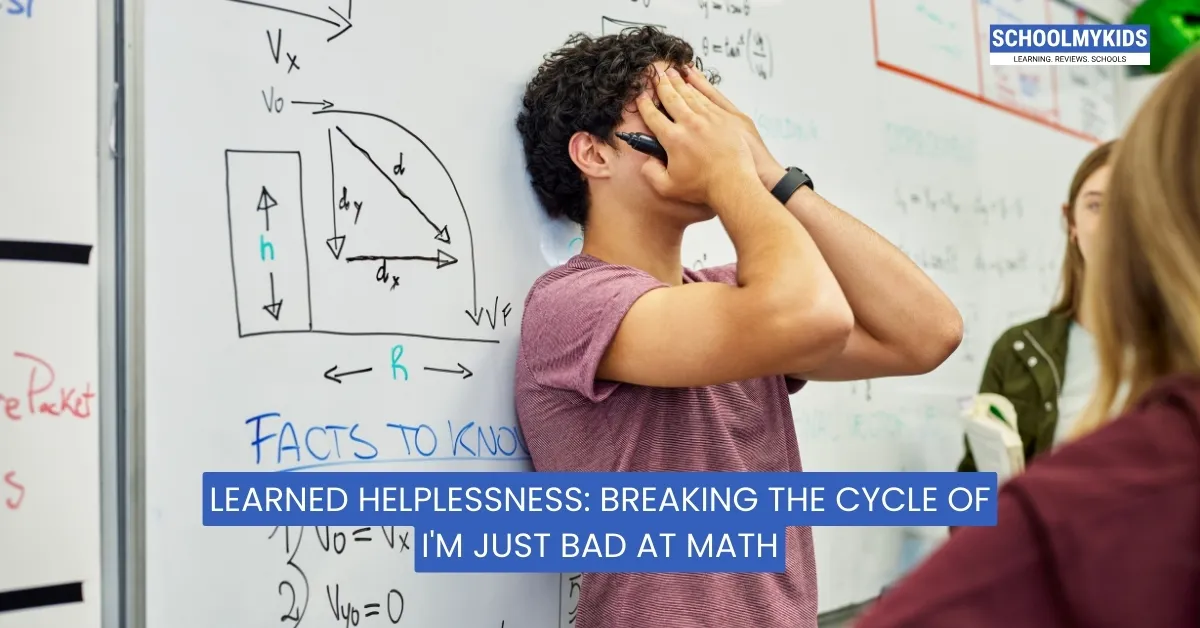
Where the “I’m Bad at Math” Story Begins
Very few children start school believing they are bad at math. That belief is learned, usually early, and reinforced quietly.
A few confusing lessons.One embarrassing moment at the board.Repeated low marks without explanation.Comments like “some people are just not math people.”
Eventually, the student stops trying.
Not because they can’t learn, but because they’ve learned something else instead: that effort won’t help. This is learned helplessness, and math classrooms are one of its most common breeding grounds.
What Learned Helplessness Actually Is
Not Laziness, Not Low Intelligence
Learned helplessness occurs when repeated failure convinces someone that their actions don’t matter. The brain stops investing effort because it expects defeat.
The key belief is simple and damaging:“Nothing I do will change the outcome.”
Once this belief forms, students disengage automatically. Motivation drops. Attention fades. Avoidance grows.
This is not a math problem. It’s a belief problem.
Why Math Triggers It So Easily
Math builds cumulatively. Miss one concept, and the next becomes harder. Confusion compounds fast.
When gaps are ignored, students experience repeated failure without understanding why. That unpredictability trains helplessness faster than any other subject.
How the Cycle Reinforces Itself
Failure → Avoidance → More Failure
A student struggles, avoids practice, performs worse, and then uses the result as proof of being “bad at math.”
This loop feels logical to the student. From the outside, it looks like lack of effort. Inside, it feels like self-protection.
Trying and failing hurts more than not trying at all.
Labels Become Identity
Once students say, “I’m bad at math,” they stop seeing difficulty as temporary. It becomes personal.
They compare themselves to fast classmates and assume speed equals intelligence. Slow thinking feels like proof of inadequacy.
It isn’t. It’s just a different processing speed.
How Schools Accidentally Strengthen Helplessness
Speed-Based Evaluation
Timed tests reward quick recall, not understanding. Students who think carefully fall behind and internalize failure.
Speed becomes mistaken for ability.
Correct Answers Without Explanation
When teachers move on after giving answers, students who didn’t understand are left behind silently.
Unanswered confusion turns into resignation.
Praising Talent Over Process
Comments like “you’re so smart” or “math just comes naturally to her” send the wrong message.
They imply that math ability is fixed. Students who struggle conclude they lack the required trait.
Breaking the Helplessness Pattern
Shift From Outcome to Control
The goal is not immediate improvement in marks. It is restoring the belief that effort affects results.
Students must experience small, predictable wins:
- Solving easier problems correctly
- Understanding one step clearly
- Fixing one specific mistake pattern
Control rebuilds confidence faster than praise.
Slow Down to Fill Gaps
Rushing forward keeps the cycle alive. Going backward to fix foundational gaps breaks it.
Mastery at lower levels restores trust in learning.
Progress feels real when confusion decreases, not when grades magically rise.
Practical Strategies That Actually Work
Redefine What “Good at Math” Means
Being good at math means:
- Asking the right questions
- Making mistakes and correcting them
- Understanding why methods work
It does not mean instant answers.
Students need permission to be slow and thoughtful.
Replace “I’m Bad at Math” With Specific Language
Vague self-labels should be replaced with specific statements:
- “I struggle with fractions”
- “I get confused during word problems”
- “I rush algebra steps”
Specific problems are solvable. Global identities are not.
Track Effort and Strategy, Not Just Scores
Students should note:
- What they tried
- What worked
- What didn’t
This shifts focus from helplessness to experimentation.
How Parents and Teachers Can Help
Normalize Struggle Openly
Struggle should be described as expected, not exceptional.
When adults frame difficulty as part of learning, students stop interpreting it as failure.
Give Feedback That Restores Agency
Instead of “wrong,” say:
- “This step is correct, this part needs adjustment”
- “Your method works until here”
Partial success matters. It shows that effort has an impact.
Why This Matters Beyond Math
Learned helplessness doesn’t stay in one subject. It spreads.
Students who believe effort doesn’t matter stop taking risks everywhere. They avoid challenges, opportunities, and growth.
Breaking it in math often restores confidence across academics.
A Healthier Way to Think About Math Ability
Math is not a talent lottery.It is a skill built through understanding, practice, and feedback.
Students are not bad at math.They are bad at being confused without support.
Once the belief shifts from “I can’t” to “I don’t understand yet,” the cycle breaks.
And when that happens, improvement follows quietly, without drama.







Be the first one to comment on this story.