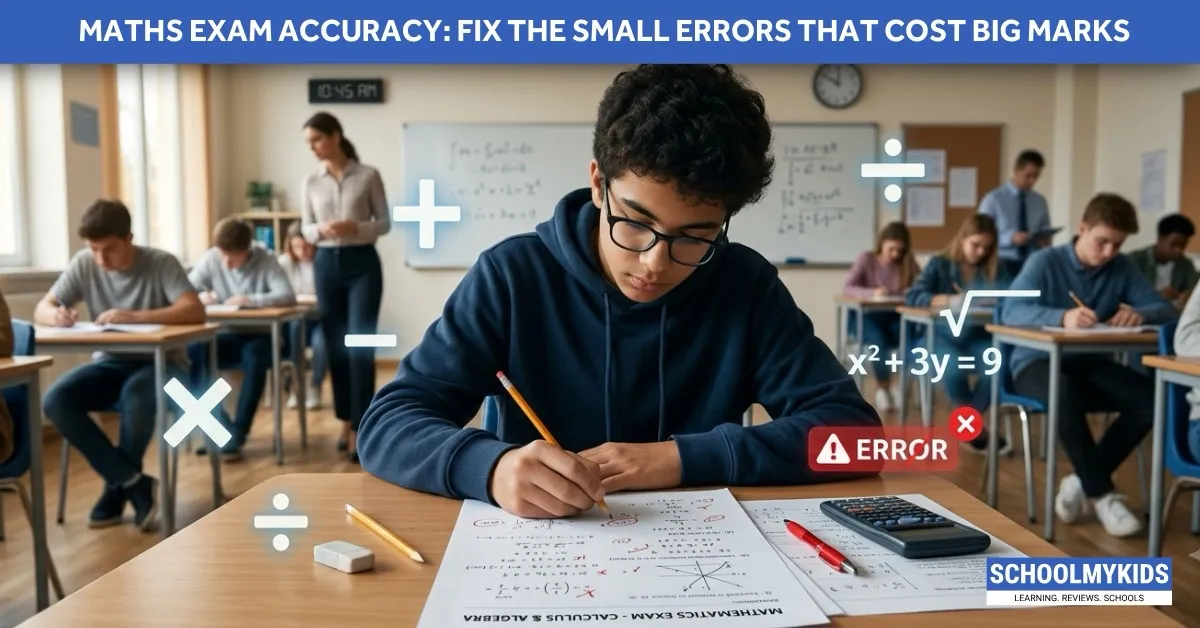
You’re sitting at home doing practice problems. You solve a question perfectly. You get it right. Then the exam happens. The exact same type of question appears. You solve it. You get it wrong.
When you see the answer key later, you realize your method was correct. Your setup was right. But somewhere in the middle, you wrote 3 instead of 2. Or you forgot a negative sign. Or you divided when you should have multiplied.
This happens to a lot of students. It’s not that you don’t understand math. It’s that something breaks between your brain knowing the answer and your hand writing the answer. Careless errors of this kind (sign slips, simple arithmetic mistakes, misreading) regularly appear in examiners’ reports across GCSE, A-Level and equivalent papers.
Why Exams Make Your Brain Act Weird
When you’re at home, you’re calm. You can erase. You can think for 10 minutes about one step. Nobody’s watching.
In the exam, your brain is alert (which is good) but also anxious (which isn’t). Anxiety actually speeds up your thinking. You rush. You skip steps. You don’t double-check. Your handwriting gets messier, which makes it easier to misread your own numbers.
Plus, you’re solving 30 questions in 3 hours. You move fast because you know you might run out of time. Fast thinking + anxiety + time pressure = silly mistakes.
This isn’t a character flaw. It’s how brains work under stress.
Research backs this up. A large meta-analysis found a consistent negative link between maths anxiety and performance (correlation around –0.28). PISA data shows that higher mathematics anxiety is linked, on average across OECD countries, to a drop of roughly 34 score points, nearly a year of schooling.
The Types Of Silly Mistakes: Know Your Enemy
Sign Errors: The Most Common
You’re solving: -3x + 5 = 20
You write: -3x = 15, so x = 5
But you actually got x = -5. The negative sign vanished.
Sign errors are repeatedly listed among the most frequent causes of lost marks in recent examiner reports for A-Level and GCSE mathematics.
Why? Your brain calculated correctly, but your hand didn’t write it. You were thinking about the next step while writing this one.
Arithmetic Slips: The Embarrassing Ones
2 + 3 = 6. Wait, no, it’s 5. But you already moved on with the wrong answer.
These happen when you’re going fast. Your mouth would say “five,” but your pencil wrote “six.”
Reading The Question Wrong: The Preventable Ones
The question asks: “How many solutions does this equation have?”
You solve for x instead and write “x = 3.”
You didn’t read carefully. You just saw “equation,” and your brain auto-filled “solve it.”
Calculation Chain Disasters: The Snowball Effect
First step: You get 12 (correct)
Second step: You use 12 but misread it as 21
Third step onwards: Everything uses 21, so everything’s wrong
One tiny misread creates a chain of wrong answers.
Unit/Decimal Mistakes: The Overlooked Ones
The answer is 0.5, but you wrote 5.
Or the question asks in meters, but the answer is in centimeters.
You solved it right but presented it wrong.
What Actually Stops These Mistakes: Techniques That Work
Write Bigger, Not Smaller
Messy handwriting causes misreads. If you write small and tight, you’ll misread your own 7 as a 1 later.
Write numbers bigger, especially when doing multi-step problems. This takes slightly more space but prevents disaster.
Read The Question Out Loud (Silently)
In your head, read the question word by word. Don’t skim. “Solve for x” is different from “find how many solutions.” Your eyes miss the difference if you rush.
Copy Down Numbers Explicitly
Instead of: “Substituting in the equation…”
Write: “Substituting x = 3 in the equation 2x + 5 = 11”
This takes three extra seconds but forces you to be specific. You’re less likely to mix up what number you’re using.
Circle Your Final Answer (Seriously)
When you finish a question, circle the final number. This does two things: forces you to identify what your final answer actually is (you’d be surprised how many students lose this in their work), and prevents you from accidentally continuing past the answer and changing it.
Do The Reverse Check On Hard Questions
If you got x = 3, plug 3 back into the original equation. Does it work? Takes 15 seconds. Saves you marks.
You won’t do this for every question (no time), but for anything tricky, do it.
The Speed Trap: Why Rushing Kills You
Students think: “I need to solve 30 questions in 3 hours. That’s 6 minutes per question. I should go fast.”
Reality: 20 questions solved carefully in 2 hours beats 30 questions solved sloppily in 3 hours.
Why? Wrong answers score zero. Partially correct answers sometimes score marks. Careful work with fewer questions usually beats rushed work with more questions.
But most students don’t realize this until after the exam when they see they lost 15 marks to silly mistakes.
Pace yourself. Don’t try to solve everything. Solve fewer questions, but solve them right.
Practice Exam Simulation: How To Actually Practice
Doing practice problems at home doesn’t prevent exam mistakes because the conditions are different.
You need to practice under exam conditions. Timer on. No phone nearby. Pen only (no erasing). 30 questions in 3 hours.
Do this once a week, not just the night before the exam. Your brain needs to learn the exam rhythm.
When you’re practicing this way, your silly mistakes will happen now, not during the real exam. Then you can work on fixing them.
Keep a Simple Mistake Log
After every practice paper or timed session, note the silly mistakes you actually made. Write three short lines for each one:
What went wrong (example: missed the negative sign)
Why it happened (example: rushed the second step)
What will stop it next time (example: circle every negative before moving on)
Do this for two or three papers. Patterns appear quickly. Once you see your own repeated slips, you can target them instead of guessing. Many students find this single habit cuts their careless errors more than any other technique.
The Last 5 Minutes: What Actually Helps
Don’t use the last 5 minutes to solve a new question. Use it to scan your answers.
Skim through. Check:
Did I answer what was asked? (Not what I assumed was asked)
Are my final answers clearly visible?
Do the answers make sense? (If the question is about distance, your answer shouldn’t be negative)
Did I write the units? (If applicable)
You won’t catch everything. But you’ll catch some mistakes. Some is better than none.
A Real Example: What This Looks Like
Home Practice:
Question: If 2x + 3 = 11, find x.
You write:
2x + 3 = 11
2x = 8
x = 4
Checked it. Correct. Moved on.
Exam Version (Same Question):
You write:
2x + 3 = 11
2x = 8
x = 4 ✓ (you circled it)
Check: 2(4) + 3 = 8 + 3 = 11 ✓
Took 30 seconds extra. But you actually verified it. At home, you verified it too, but in the exam, that verification step prevents the panic-mistake.
For Parents
If your child keeps losing marks to the same small slips, sit with them once a week while they review one practice paper. Ask them to explain the mistake in their own words and write the fix themselves. This turns the log into a shared tool rather than another lecture.
Key Takeaways
Exam anxiety makes your brain rush. This causes silly mistakes, not knowledge gaps
Sign errors and arithmetic slips are the most common silly mistakes
Writing bigger and reading carefully prevent most mistakes
Reverse-checking hard questions saves marks
Speed doesn’t win; accuracy wins
Practice under exam conditions to train your brain
Use the last 5 minutes to scan answers, not solve new questions
Circle final answers so you know what your answer actually is
FAQs
Q1: I know how to solve the problem but still get it wrong. What’s the actual fix?
Your issue isn’t understanding; it’s execution. Slow down. Write numbers bigger. Read the question twice before starting. Copy down the numbers you’re using into your work. These habits take seconds but prevent the disconnect between knowing and doing. Practice one of these habits at a time until it becomes automatic, then add the next one.
Q2: I do practice problems at home and get them right. Why do I get them wrong in the exam?
You’re practicing in a different mental state. Home is calm. Exams are stressful. Your brain behaves differently. To fix this, practice under exam conditions once a week. Timer on. No erasing. Treat it like a real exam. Your silly mistakes will happen in practice, where you can learn from them.
Q3: I’m running out of time, so I solve fast and make mistakes. Should I skip questions or solve fast?
Skip questions. A question left blank scores 0. A question solved carelessly and wrong also scores 0. But a question you skip and come back to if you have time is potentially 0 or full marks. Fast solving usually means both speed and mistakes, which is the worst combination.
Q4: My silly mistakes happen in specific topics like geometry or trigonometry. Is that normal?
Yes. Some topics require more focus. Geometry has lots of angle and length values to track. Trigonometry has multiple formulas. More variables mean more chances for mix-ups. For these topics especially, write everything out explicitly. Don’t skip steps. The extra writing feels slow but prevents mistakes.








Be the first one to comment on this story.