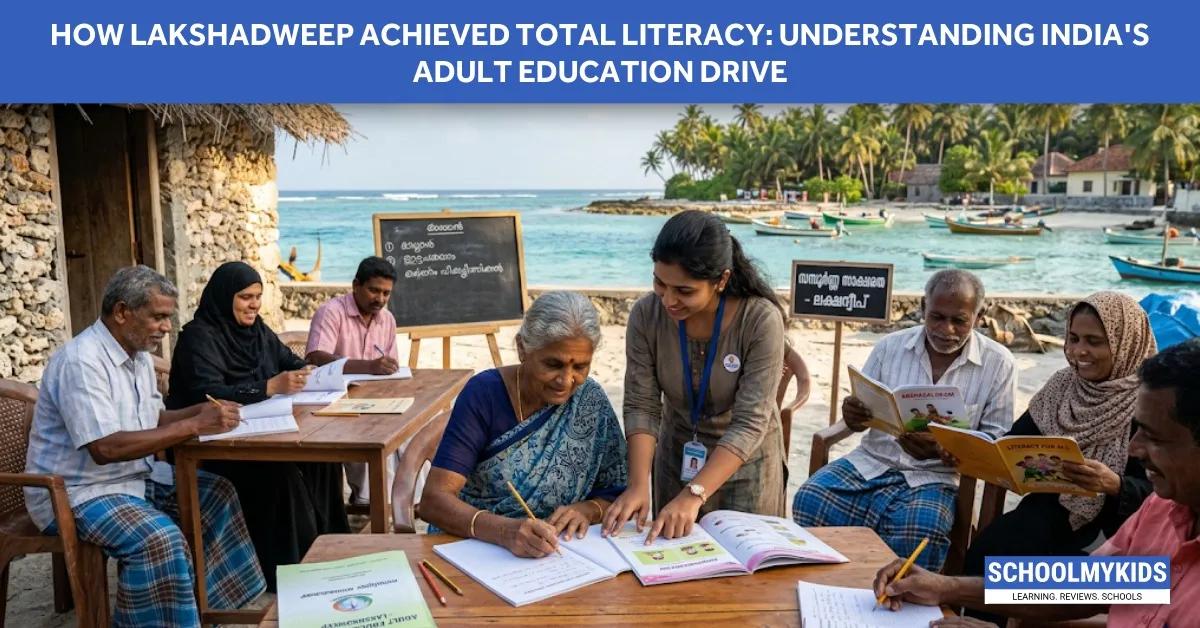
The news came out on a Sunday. October 11, 2026. Lakshadweep was declared a 100% literate Union Territory.
Most people read the headline and moved on. Another government achievement. Another press release.
But we are going to explore what the headline does not tell you. Someone had to knock on doors. Someone had to sit with a 60-year-old woman who had never held a pencil and teach her to write her own name. Someone had to convince a fisherman that learning numbers was not a waste of his evening.
That is the story behind the number. And it has a lot to say to a student sitting in a classroom, complaining about a boring lecture.
What Actually Happened in Lakshadweep?
The Department of Education ran a survey. They found 1,113 adults across the islands who could not read or write. Not children. Adults. People aged 15 and above who had missed school for one reason or another.
The government did not build new classrooms. It did something simpler. Teachers and supervisors volunteered to go to people’s homes. Doorstep assessments. Home-based testing for learners who could not come to exam centres, or were too hesitant to sit in a room full of strangers.
Follow-up rounds happened. Re-testing happened. Nobody was left behind because they were scared.
All eligible learners cleared the Foundational Literacy and Numeracy Assessment Test. That is the FLNAT. It checks whether an adult can read a basic sentence, write a simple word, and do everyday maths.
And with that, Lakshadweep became fully literate under the ULLAS scheme.
What Is ULLAS? (And Why You Have Not Heard of It)
ULLAS stands for Understanding of Lifelong Learning for All in Society. It is also called the New India Literacy Programme, or Nav Bharat Saaksharta Karyakram.
It started in 2022. It runs until 2027. The target is five crore adults aged 15 and above who missed formal schooling. That is a huge number. For context, that is more than the entire population of many countries.
The scheme has five parts. Basic reading and writing. Numeracy. Life skills. Vocational skills. And continuing education. It is not just about signing your name. It is about being able to read a medicine label, calculate change at a shop, and understand a bank form.
As of late October 2026, official ULLAS figures reported about 4 crore registered learners and more than 52 lakh volunteers. More than 3.3 crore learners had taken the FLNAT, with nearly 3 crore having passed.
Lakshadweep is one of the smaller pieces of this puzzle. But it is a piece that finished.
Why Doorstep Teaching Worked
Think about this. You are an adult. You cannot read. A notice goes up saying there is a literacy class at the community centre.
Are you going to go?
Maybe not. Shame is a real thing. Fear of being laughed at is a real thing. A 50-year-old man who cannot read does not want to sit in a room with strangers and struggle with an alphabet book.
So the teachers went to them. That is the detail that matters. It was not a grand policy innovation. It was a teacher walking to someone’s house, sitting on their floor, and starting with the letter A.
The broader lesson from doorstep programmes is that sessions often have to be arranged in homes or familiar spaces when learners are hesitant to attend a centre. That is how it works on the ground. You adjust the system to fit the people, not the other way around.
The Reality Behind “100% Literate”
The phrase sounds absolute. It is not.
Under the ULLAS framework, a state or UT is treated as fully literate if its literacy rate is 95% or above. The “100%” label refers to the programme’s benchmark, not a claim that every single person on every island can now read a newspaper.
That is not a criticism. It is how these targets work. It is worth knowing, because “100% literacy” is not the end of the story. It is the start of a harder chapter.
The Problem Nobody Talks About: Relapse
The uncomfortable truth about adult literacy is that people forget.
Studies from earlier literacy missions found that adults who learn to read in their 40s or 50s often lose those skills if they do not use them. It is called relapse into illiteracy. Without books, newspapers, or daily practice, the letters fade.
A fisherman who learns to write his name does not need to write it every day. A homemaker who learns basic arithmetic does not always get a chance to use it. The skill sits idle. And idle skills rust.
ULLAS has a continuing education component for this reason. But follow-up is the hardest part of any adult education programme. It is easy to declare a district literate. It is harder to keep it literate five years later.
Lakshadweep now faces that question. What happens after the declaration? Will there be reading corners? Will there be follow-up classes? Will the volunteers keep coming?
The answer is not in the press release. It is in the months and years that follow.
What Students Can Learn From This
You might be wondering why a student should care about adult literacy in a small Union Territory.
The Lakshadweep model is a masterclass in three things every student struggles with.
One: You do not need perfect conditions to start.
They did not wait for a new building. They did not wait for a fleet of trained teachers. They used volunteers. They used homes. They started with what was available.
You do not need a perfect study table, the newest iPad, or a quiet house to start studying. You need one book and twenty minutes.
Two: Shame is the biggest barrier. Not ability.
The adults who hesitated to come to exam centres were not incapable. They were embarrassed. The teachers who went to their homes understood this.
Students face the same thing. You do not ask a doubt because you think the whole class will laugh. You do not attempt a question because you are afraid of getting it wrong. The barrier is not the syllabus. It is the fear of looking foolish.
The fix is the same. Someone has to come to you. Or you have to go to someone. A friend, a teacher, a senior. Do not sit alone with the shame.
Three: Repetition is not optional.
The Lakshadweep team did not test people once and move on. They did follow-up rounds. Re-testing. Second chances.
You will forget chapters. You will bomb mock tests. The students who score well are not the ones who never fail. They are the ones who re-test themselves until the lesson sticks.
The Bigger Picture: Where India Stands
India has been running adult literacy programmes since the 1980s. The Total Literacy Campaign of the 1990s was a major national effort that brought adult literacy onto the policy agenda. Kerala was declared fully literate in 1991 under the then National Literacy Mission norms. Mizoram and Goa have made similar claims in recent years.
But the job is not done. Millions of adults still cannot read basic text. The ULLAS target of five crore learners is ambitious. Lakshadweep finishing the race is one island group. The mainland is a different challenge.
Still, it is a reminder. Literacy is not a school problem. It is a lifetime problem. And it can be solved, one doorstep at a time.
A Few Things People Ask
Does “100% literate” mean nobody in Lakshadweep is illiterate? No. It means the UT met the ULLAS benchmark of 95% or above. A small number of people may still be outside the programme, or may have been missed by the survey.
Did they use the ULLAS app? The scheme has a mobile app, and it is used in many states. For Lakshadweep, the reports focus on doorstep teaching and home-based assessment. Teachers and volunteers carried the process, not just an app.
Is this the first time a state has achieved this? No. Kerala was declared fully literate in 1991. Mizoram and Goa have also been recognised under different frameworks. Lakshadweep is the latest UT to reach the mark under ULLAS.
What happens to the 1,113 learners now? They are certified as literate. The long-term test is whether they keep reading and writing. That depends on follow-up programmes and community support.
Lakshadweep did the hard part first. It found the people who were invisible. It went to their homes. It did not wait for them to come to a classroom.
That is a lesson worth carrying, even if you are sitting in one.




Be the first one to comment on this story.