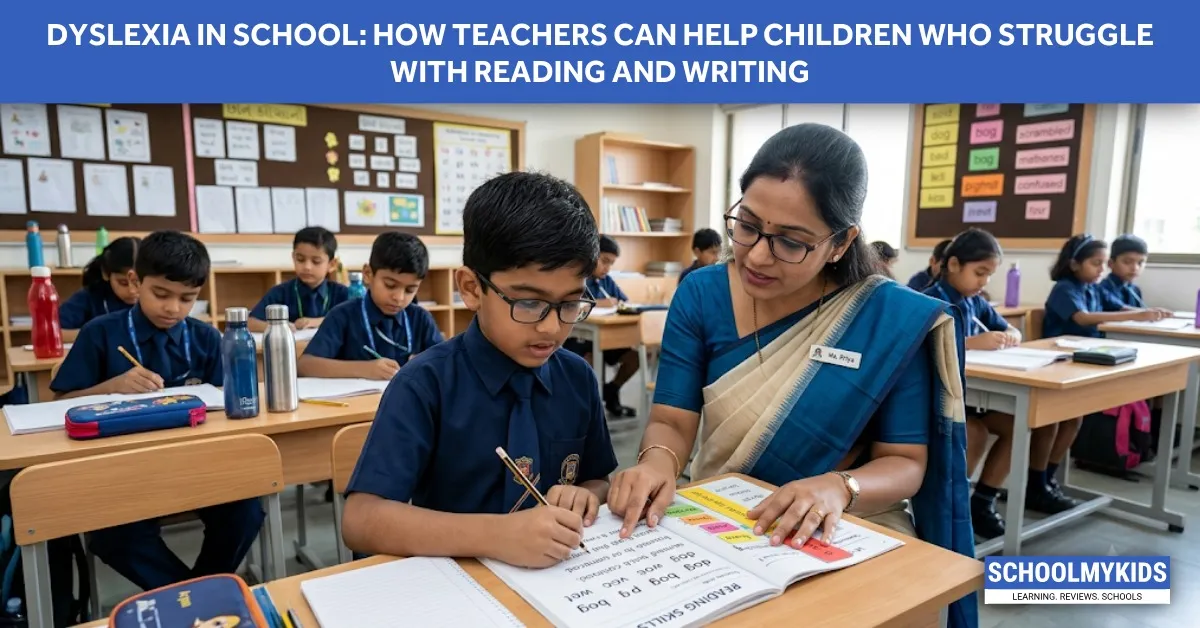
A teacher once told a boy in her Class 4 that he was “not trying hard enough.” He could explain a cricket match better than anyone in the room. He could tell you the score, the overs, the run rate. But when the same numbers appeared in his maths book, his face went blank.
He wasn’t lazy. He wasn’t careless. He was dyslexic. And nobody in that class knew what the word meant.
That was 15 years ago. The boy is now 24. He still cannot read a menu without help.
The rules have changed since then. The awareness has grown. But the gap between what we know and what actually happens in a classroom is still wide. And teachers are the ones standing in that gap.
First, What Dyslexia Actually Is (And What It Is Not)
Dyslexia is a specific learning disability. It affects reading, spelling, and writing. It has nothing to do with intelligence. A dyslexic child can be brilliant in conversation and still struggle to decode a paragraph.
The numbers are not small. Indian studies place dyslexia prevalence among school children between roughly 6% and 11%. Some estimates go higher, up to 15% [1]. In a class of 40 students, that means two or three children are likely to have some form of specific learning disability.
A 2023 review [2] found an average gap of nearly four years between the time a mother first suspects something is wrong and the child actually getting a diagnosis. Four years. That is four years of being called lazy. Four years of being told to concentrate. Four years of losing confidence.
What Teachers Get Wrong (And Why It Is Not Their Fault)
A study of 135 private school teachers in Rajasthan [3] found something revealing. Most of them, 73%, knew dyslexia was a neurological condition. All of them knew it was reading-related. But nearly half believed dyslexia could be cured by medicine. And more than half believed it affected general intelligence.
Neither is true. There is no medicine for dyslexia. And it does not touch intelligence.
Another study found that as many as seven in ten teachers remain unaware of specific learning disabilities until they receive targeted training [4]. That is not a failure of teachers. That is a failure of the system that trained them.
The good news is that teachers want to learn. In the Rajasthan study, 97% said they wanted to learn teaching methods that would help dyslexic children. The willingness is there. The training is what is missing.
What the System Already Provides (That Most Teachers Do Not Know)
The government has built more scaffolding than most teachers realise.
The Rights of Persons with Disabilities Act, 2016 explicitly includes dyslexia and other specific learning disabilities. The RPwD Rules, 2017 recommend that all children be screened for SLD indicators by age 8 or Class III, whichever comes first.
NCERT has developed a mobile app called PRASHAST. It is a pre-assessment holistic screening tool. Teachers can use it to screen students for possible disabilities at the school level. Millions of screenings have already been conducted for the 21 disability conditions recognised under the RPwD Act, including SLD.
For board exams, CBSE has provisions. Students with recognised benchmark disabilities under the RPwD Act, including dyslexia, can get extra time, a scribe or reader where appropriate, exemption from certain language requirements, and in some cases, the use of a calculator or computer. These provisions have been consolidated since a 2018 circular.
And just this October, NCERT ran a five-day live training series from October 19 to 23, 2026. The theme was “Language and Numeracy-Friendly Classrooms for Learners with SLD.” It was broadcast on PM eVidya DTH ISL Channel 31, the NCERT Official YouTube channel, and the NCERT Events YouTube channel. It was free. No registration. It was open to teachers, parents, and anyone interested.
Most teachers did not know it was happening.
Five Things a Teacher Can Do Tomorrow Morning
You do not need a special education degree to help a dyslexic child in your classroom. You need a few small changes.
One: Stop asking them to read aloud without warning.
A dyslexic child who is called on to read in front of the class experiences genuine fear. Their heart races. Their face flushes. They stumble over words they know. The humiliation stays with them longer than the lesson.
If you must call on them, tell them the day before. Let them practise the paragraph at home. Or let them read a shorter section. Or let them read to you privately, not to the whole class.
Two: Do not judge the writing by the spelling.
A dyslexic child’s ideas can be excellent. The spelling can be terrible. If you mark every spelling error in red, the child stops writing altogether. They learn that their ideas do not matter because their spelling is wrong.
Grade the content first. Circle the spelling errors. But do not let the spelling decide the marks for a history answer or a science explanation.
Three: Give instructions in more than one way.
You said it once. You wrote it on the board. You moved on. The dyslexic child heard half of it and is now copying from a neighbour.
Say it. Write it. Ask the child to repeat it back to you. Not in front of the class. Quietly, at their desk. That thirty-second check saves an hour of confusion.
Four: Use larger fonts and more space.
A worksheet with cramped text and small print is a wall. The child gives up before they start. Use larger fonts. Leave more space between lines. Break long instructions into numbered steps.
NCERT’s training module recommends exactly this: multi-sensory reading aids, larger visual fonts, and structured reading approaches. Small changes. Big difference.
Five: Watch for the child who is quiet, not the one who is loud.
The loud, disruptive child gets noticed. The quiet one who never raises their hand, who copies from the neighbour, who says “I forgot my book” every week, is often the one who is struggling the most. Dyslexia is invisible. You have to look for it.
The Myth That Needs to Die
The most damaging myth is that dyslexia is a rich child’s problem. That it is a Western diagnosis. That it does not happen in government schools or in Hindi-medium classrooms.
It does. Dyslexia is not language-specific. It affects children reading Devanagari, Tamil, Bengali, and English. It affects children in DPS and children in the municipal school down the road.
The difference is diagnosis. A child in a private school with aware parents gets a clinical assessment and exam concessions. A child in a government school gets called lazy and drops out by Class 8.
That is not a learning problem. That is an access problem. And teachers are the first point of access.
A Few Things Teachers Ask
I have 60 children in my class. How do I find time for one? You do not need extra time. You need different attention. Notice who avoids reading. Notice who copies from the board. Notice who writes beautifully but answers orally better. Five minutes of observation during a regular lesson tells you more than a formal test.
I am not a special educator. Can I really help? Yes. You are not diagnosing. You are noticing. You are adapting. A special educator can come later. Your job is to stop the child from falling through the floor before anyone catches them.
What if the parents deny it? Many parents do. Stigma is real. Do not argue. Give them information. Tell them about the CBSE concessions. Tell them about PRASHAST. Tell them that a diagnosis is not a label; it is a key to support. Let them sit with it.
Where can I learn more? The NCERT sessions are recorded. They are on the NCERT YouTube channel. The PRASHAST app is free. The CBSE handbook on inclusive education is available on the CBSE academic website. Start with one video. Not ten.
The boy in Class 4 did not need a miracle. He needed one teacher who knew what dyslexia was. One teacher who said, “You are not lazy. Your brain works differently. Let me help.”
That teacher exists in every school. Sometimes they just need to be told what to look for.
Sources:
[1] Scaria LM, Bhaskaran D, George B. Prevalence of Specific Learning Disorders (SLD) Among Children in India: A Systematic Review and Meta-Analysis. Indian Journal of Psychological Medicine. 2023. Pooled SLD prevalence 8 percent (95 percent CI 4-11). Individual Indian school studies report ranges of roughly 6 to 15 percent.
[2] Scaria LM, Bhaskaran D, George B. Prevalence of Specific Learning Disorders (SLD) Among Children in India: A Systematic Review and Meta-Analysis. Indian Journal of Psychological Medicine. 2023. Notes the nearly four-year gap between a mother’s first suspicion and formal diagnosis.
[3] Perceptions of Dyslexia in Primary Education: A Study of Teachers in Rajasthan (2026). Sample of 135 private school teachers. Exact figures match: 73 percent recognised it as neurological, 100 percent as reading-related, about 50 percent believed medicine could cure it, 53 percent believed it affects general intelligence, 97 percent wanted training in methods.
[4] Multiple Indian school-based studies report unawareness rates of around 70 percent or higher until teachers receive targeted training (consistent finding across several teacher surveys).






Be the first one to comment on this story.