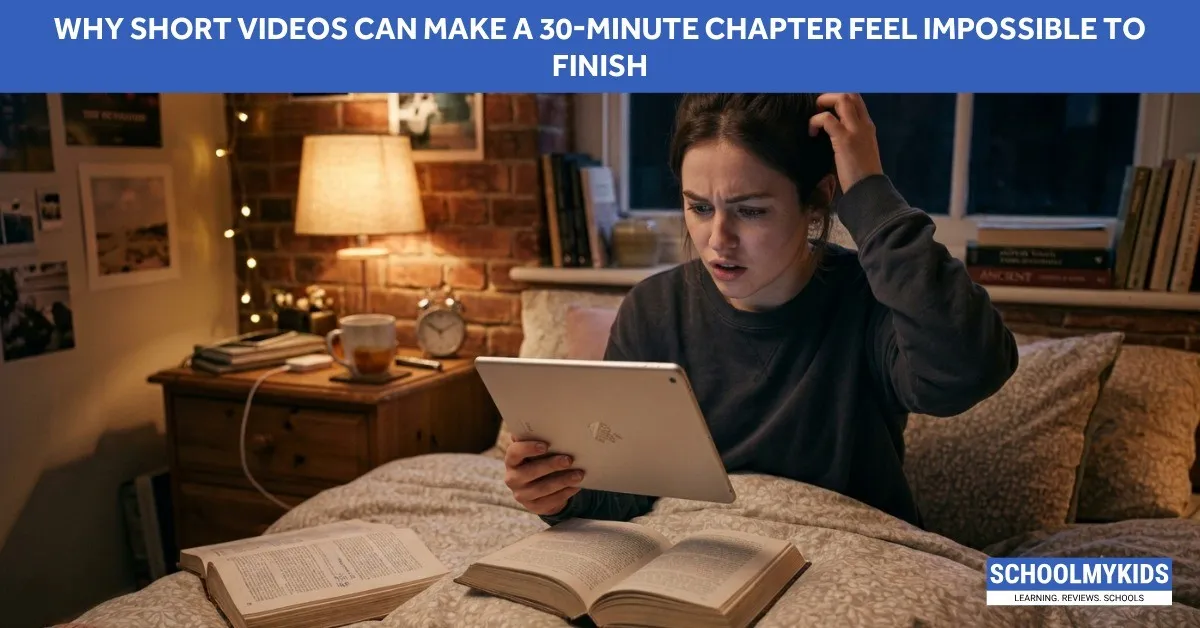
You’ve got thirty pages to read. You get through maybe two pages before your brain starts wandering. Not to your phone. Just wandering. Like your mind is itchy. Restless. You try again. Same thing.
Then you break down and scroll for ten minutes. Read one more page. Break again.
You feel lazy. Undisciplined. Like other students don’t struggle with this. They probably don’t.
They do. But it’s not laziness. It’s not lack of discipline. Your brain is literally neurologically rewired right now to expect stimulation every 15-60 seconds.
What’s Actually Happening In Your Brain
Every time you scroll YouTube Shorts or Instagram Reels, your brain gets a tiny hit of dopamine. That’s the neurotransmitter that creates motivation and pleasure. It’s not metaphorical. It’s chemical.
But what makes short videos specifically addictive? It’s not the video itself. It’s the unpredictability. You swipe. You don’t know what video is coming next. Your brain enters what researchers call a “variable reward schedule.” It’s the same mechanism that keeps people gambling. Slot machines work the same way.
When your brain gets exposed to variable rewards constantly (every swipe might have something amazing), it starts expecting that pattern everywhere. Your textbook doesn’t have variable rewards. Page 3 looks suspiciously like page 2. The dopamine hit never comes. So your brain goes “this is boring” and triggers the urge to find something that delivers the reward loop.
That’s not you being broken. That’s neurology working exactly as designed.
The Specific Numbers and Why They Matter
Data on video completion shows most people abandon content well before the one-minute mark, even when interested. One large analysis of business videos found 66% of viewers finish clips under one minute, with completion falling sharply for anything longer (Vidyard 2023 analysis of more than 1.7 million videos). On short-form platforms, the drop-off after 60 seconds is even steeper.
Research shows that even brief exposure to short-form video right before studying impairs sustained attention during reading. A 2025 SDSU eye-tracking study found that college students who scrolled TikTok for five minutes beforehand showed clearly lower focus on long-form articles compared with controls. They moved their eyes more rapidly and scanned instead of reading steadily. Separate findings link short-form video viewing before study sessions to reduced reading attention scores.
Regular short-form video exposure is linked to much shorter sustained attention on single tasks. Gloria Mark’s research at UC Irvine shows average attention on a single screen has fallen to about 47 seconds in recent years, with a median near 40 seconds. That is down from roughly 2.5 minutes in 2004. After scrolling, the brain’s readiness for longer focus drops further.
So when you’re trying to read a chapter, and you keep getting distracted every 5-10 minutes, you’re not failing. You’re operating at the maximum capacity that your brain can currently handle.
Why “Just Put Your Phone Away” Doesn’t Work
Everyone tells you this. Teachers. Parents. Self-help articles. “Just remove the distraction.”
But the problem isn’t even your phone anymore. It’s your baseline expectation for stimulation. Your brain now expects novelty every 15 seconds. It’s like your brain’s thermostat got turned up. A thirty-minute chapter feels cold by comparison.
Putting your phone away helps a tiny bit. But the real issue is that your brain’s wiring has shifted.
Clinical observations and short-form reduction studies report measurable focus improvements within 2–3 weeks when daily use drops under 30 minutes. The brain begins to recalibrate with consistent lower exposure. Gains are not instant and vary by person, but the pattern is reliable once total daily time stays reduced.
Your brain can rewire itself. But it takes time.
What Makes Long Content Feel Impossible Right Now
The prefrontal cortex is the part of your brain responsible for sustained focus, impulse control, and delayed rewards. It continues maturing well into the mid-20s, with some network measures extending further. That's not an excuse. That's just how human brains work.
Right now at your age, you’re especially vulnerable to short-form videos’ effects because that part of your brain is still under construction.
Also, your brain’s baseline for “interesting” has shifted. A 30-minute chapter feels slow. Boring. Unstimulating. Because you’re measuring it against Instagram’s pace.
If you stuck with the chapter for 15-20 minutes without checking your phone, your brain would start entering a flow state. You’d get absorbed. The content would start feeling engaging. But most students quit before that point because the first 10 minutes feel impossible.
The Pattern You’re Probably In Right Now
Try to study
Feel restless after 5 minutes
Check phone for “just a second”
Spend 10-15 minutes scrolling
Feel guilty, put phone away
Try to read again, but you’re exhausted from the context switching
Give up and tell yourself you’ll study “later”
Each time you do this, your brain learns that studying is uncomfortable and scrolling fixes the discomfort. Your brain is literally training itself to prefer scrolling over reading.
What Actually Works (Not What Sounds Good)
The absolute first step: Track your actual short-form video consumption. Not estimate. Actually track it. Open your screen time. Most students are shocked. They think they scroll “a little.” Data shows 45 minutes to 2 hours daily for regular users.
Then gradually reduce. Not quit completely. Gradually. 30 minutes less per day this week. Another 30 minutes less next week. Your brain needs time to recalibrate.
Use the 20-minute rule: Read for 20 minutes straight. No phone. No breaks. After 20 minutes, your brain will start entering a focus state. That first 10 minutes is brutal. By minute 15, it gets easier. By minute 20, you’re probably not hating it.
Separate your phone completely during study. Not another room. Another floor if possible. Your brain will stop allocating energy to “not checking” it when it’s literally not accessible.
Track the improvement. After one week of reduced video consumption, measure your attention span on reading again. You’ll notice the difference. That positive feedback matters psychologically.
Why Understanding This Matters
You’re not lazy. You’re not undisciplined. Your brain has been trained by platforms designed by thousands of engineers specifically to exploit your dopamine system.
That’s not weakness. That’s just the environment you’re in.
But once you understand it’s a rewiring issue, not a character issue, you can actually fix it. You can’t fix yourself through willpower. But you can gradually retrain your brain by reducing the stimulus that’s rewiring it in the first place.
One more factor that rarely gets mentioned is sleep. Heavy short-form use often delays bedtime and fragments rest. Even modest sleep loss the night before makes the first 10–15 minutes of reading feel harder. Protecting 7–8 hours of sleep alongside lower video time usually speeds up focus gains.
Key Takeaways
Most people abandon videos well before the one-minute mark, even when interested (Vidyard 2023 data)
Brief short-form video exposure before studying reduces sustained attention during reading (SDSU 2025 eye-tracking)
Average attention on a single screen has fallen to about 47 seconds (Gloria Mark, UC Irvine)
Variable reward system (unpredictability) is what makes short videos addictive
Prefrontal cortex continues maturing into the mid-20s, making teens and young adults more vulnerable
Flow state actually begins around 15-20 minutes but most quit before then
Reducing video consumption by 30 minutes per day shows focus improvements in 2-3 weeks
It’s neurological retraining needed, not willpower or discipline
Brain’s baseline expectations shift after short-form exposure
Frequently Asked Questions
Q1: If I spend 30 minutes less on TikTok, will I be able to focus immediately?
No. Takes 2-3 weeks for measurable improvement. Your brain doesn’t recalibrate overnight. But it does recalibrate if you stay consistent.
Q2: Is there a way to use short videos without destroying my focus?
Yes, but it requires discipline. 30 minutes maximum daily. And preferably not before studying. If you watch short videos right before studying, you’re basically asking your brain to shift from 60-second stimulation to 30-minute reading. It can’t do that instantly.
Q3: Does this mean I can never watch short videos again?
No. But the amount matters. Regular users consuming 90 minutes daily show focus problems. Users at 30 minutes or less don’t show the same issues.
Q4: My friends can watch TikTok and then study fine. Why can’t I?
Probably they’re actually struggling too but hiding it. Or they’ve limited exposure more than they think. Or they have a different baseline predisposition. But honestly, if they’re watching significant amounts of TikTok daily and studying multiple hours, they’re either not studying effectively or you’re not seeing the full picture.
Q5: How do I know if short videos are actually affecting me?
Measure. Check your screen time. Read something for 20 minutes without your phone nearby and count how many times you want to check it. Read something you’re interested in. If you’re still struggling, it’s probably the rewiring.





Be the first one to comment on this story.