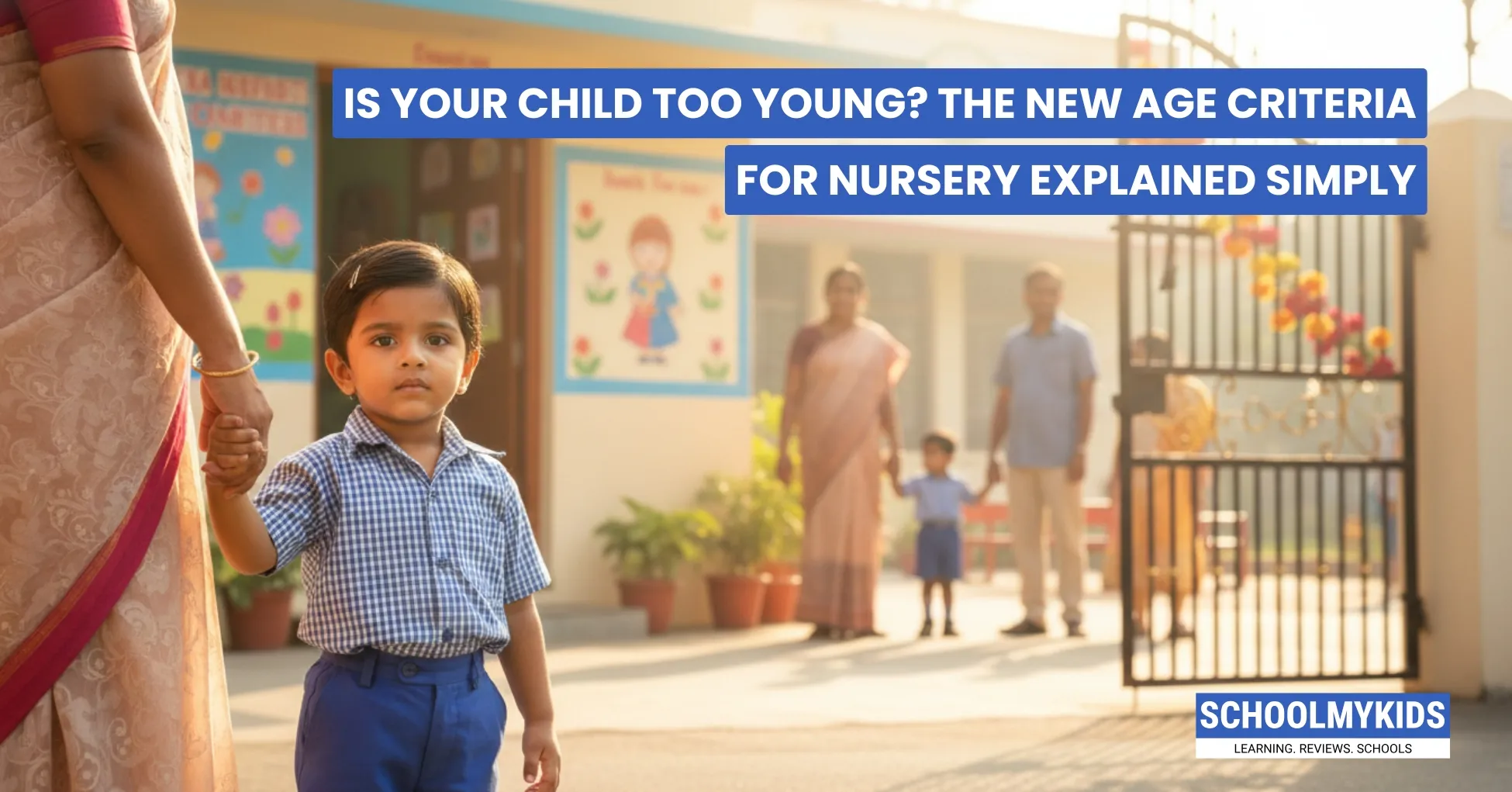
If you're a parent in Delhi planning your child's school admission, there's something important you need to know. The government just announced new age rules for nursery admissions, and it might feel confusing at first. But don't worry, we are going to break it down for you.
What's Actually Changing?
Starting from the 2026-27 school year, your child will need to be at least 3 years old by March 31st to get into nursery.
For Class 1, the government is moving towards a uniform age of 6+ years (up to 7 years). However, this will not happen overnight. The change will be introduced gradually over several academic years.
In 2026–27 and 2027–28, new admissions to Class 1 will still allow children aged 5+ to 6 years. From 2028–29 onwards, Class 1 admissions will strictly follow the 6+ age rule.
The bigger idea behind this change is to add one full year to early childhood education, so children are not rushed into formal schooling before they are developmentally ready.
Why Should You Care?
You're probably thinking, "Great, another policy change. How does this affect my child?"
If your child is currently in nursery or KG during 2025-26, these new rules don't apply to them. They'll move up to the next class as usual. The government made sure existing students aren't affected.
But if you're planning to admit your child to nursery in 2026 or later, pay attention. The age game has changed.
Note: These rules apply to all government, government-aided, and recognized unaided private schools under Delhi's Directorate of Education (DoE). Check if your target school falls under this.
The New School Structure
The government is restructuring the Foundational Stage of schooling in line with the National Education Policy (NEP) 2020.
Instead of two preschool levels, there will now be three.
Here’s the final structure once fully implemented:
- Nursery (Balvatika 1 / Pre-School 1): 3+ years up to 4 years
- Lower KG (Balvatika 2 / Pre-School 2): 4+ years up to 5 years
- Upper KG (Balvatika 3 / Pre-School 3): 5+ years up to 6 years
- Class 1: 6+ years up to 7 years
All ages are calculated as on March 31 of the admission year. Heads of schools are allowed to relax the minimum or maximum age by up to one month, at their discretion.
What This Means for Your Planning
Let's say your child turns 3 in April 2026. They are technically not eligible, but a one-month age relaxation may apply. If the birthday falls before April 30, admission may still be possible at the school principal’s discretion.
But if your child turns 3 in May 2026, you will likely need to wait until the next academic year.
Note: If your child is already in a recognized school and has passed the prior class with a valid School Leaving Certificate (SLC) and marksheet, they're exempt from these age rules for promotion to the next class. No disruptions for ongoing students!
The Transition Phase
The government isn't switching everything overnight. They're doing it gradually, which is smart but can feel messy for a couple of years.
In 2026-27, there will only be Nursery, KG, and Class 1. Lower KG and Upper KG don't exist yet in that year.
In 2027-28, Lower KG joins the party, along with Upper KG (but only for fresh admissions).
By 2028-29, the complete structure with all three preschool levels will be in place.
Questions You're Probably Asking
"My child is younger than the cutoff. Are we stuck?"
Not necessarily. Remember that one-month relaxation we mentioned? Talk to the school principal. Also, if your child is already studying in a recognized school with proper documents, the age rules won't stop them from moving to the next class.
"Will my 5-year-old have to repeat a year?"
No. Current students continue their journey as planned. These rules are for new admissions only.
"Why is the government doing this?"
They're following the National Education Policy 2020. The idea is that younger children aren't developmentally ready for formal Class 1 learning. An extra year in preschool means more time for them to develop social skills, learn through play, and build a strong foundation.
What You Should Do Now
First, don't panic. If your child is already in school, nothing changes for them.
If you're planning admissions for 2026 or beyond, check your child's birth date and count backwards from March 31st. That'll tell you which year they're eligible for nursery.
Talk to the schools you're interested in. Ask them how they're preparing for this change and confirm if they're under DoE jurisdiction. Good schools are already planning how to handle this transition. Heads of schools must inform parents clearly, so request a session if needed.
Conclusion
Every policy change feels overwhelming at first. But this change gives your child more time to be a child before the pressure of formal schooling begins. An extra year of playing, exploring, and learning at their own pace isn't a bad thing.
Yes, it means adjusting your plans. Yes, it might mean waiting an extra year if your child's birthday falls awkwardly. But in the long run, starting Class 1 at 6 instead of 5 might actually benefit your child.
The key is to stay informed and plan ahead. These rules apply to all government, government-aided, and private schools under Delhi's education department. So wherever you're planning to admit your child, these ages apply.






Be the first one to comment on this story.