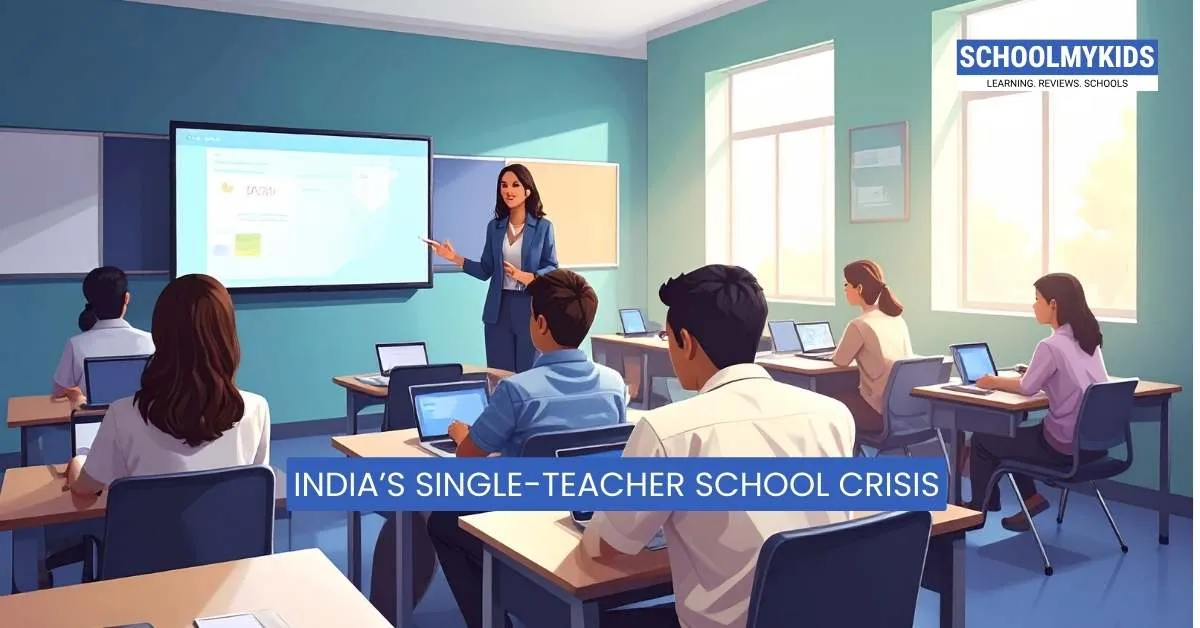
India proudly talks about demographic dividend, digital classrooms, and future-ready students. Meanwhile, thousands of government schools across the country run on one teacher for all classes, all subjects, all responsibilities. This is not a hidden issue. It is a long-ignored one.
The single-teacher school crisis is less about numbers and more about what the education system quietly accepts as “good enough” for rural and disadvantaged children.
What Is a Single-Teacher School?
A single-teacher school is exactly what it sounds like:
- One teacher
- Multiple grades
- All subjects
- Teaching, administration, mid-day meals, surveys, election duty, and paperwork
In many cases, this one teacher handles Classes 1 to 5 simultaneously, sometimes even up to middle school.
This is not multitasking. This is institutional negligence disguised as adjustment.
How Widespread Is the Problem?
Single-teacher schools are most common in:
- Rural and tribal areas
- Remote villages
- Hilly and forest regions
- Low-enrolment government schools
States with large rural populations are hit hardest. The problem persists despite decades of policy documents promising teacher-pupil ratios that look great on paper and collapse on contact with reality.
The uncomfortable truth: these schools continue because they are out of sight and politically low-cost.
What Teaching Looks Like in These Schools
A single teacher typically:
- Teaches multiple grades in the same room
- Rotates attention between age groups
- Relies heavily on rote worksheets
- Sacrifices depth for crowd control
There is no subject specialization. No remedial support. No individual attention. Assessment becomes symbolic rather than meaningful.
Learning slows down not because children are incapable, but because the structure is.
Impact on Students
1. Learning Gaps Start Early
Foundational literacy and numeracy suffer the most. When basics collapse, everything built on them becomes fragile.
2. First-Generation Learners Are Hit Hardest
Children without academic support at home depend entirely on school. Single-teacher setups quietly punish them the most.
3. Dropout Risk Increases
Irregular teaching, limited engagement, and low learning outcomes push students out of the system early.
The crisis does not announce itself. It shows up years later as low achievement and lost potential.
Impact on Teachers
This is where the system gets especially cynical.
Single teachers face:
- Burnout
- Emotional exhaustion
- Professional stagnation
- Accountability without support
They are expected to deliver outcomes designed for fully staffed schools. When results fall short, blame conveniently shifts to “teacher quality” rather than structural failure.
One teacher cannot replace a system. Expecting that is cruelty wrapped in policy language.
Why This Problem Persists
1. Teacher Vacancies and Delayed Recruitment
Posts remain unfilled for years due to budget constraints, slow hiring processes, and administrative apathy.
2. Low Enrolment Justifications
Schools with fewer students are deemed unworthy of full staffing. This logic ignores the fact that low enrolment is often the result of poor staffing, not the cause.
3. Urban Bias in Education Planning
Policy conversations focus on smart classrooms and edtech pilots while basic staffing issues remain unresolved in rural schools.
4. Normalization of Inequality
Somewhere along the way, the system decided that certain children can make do with less.
Can Technology Fix This?
Edtech can support learning. It cannot replace a teacher.
Without:
- Electricity
- Internet
- Devices
- Adult guidance
Technology becomes another abandoned intervention. Digital solutions layered over structural neglect only make inequality look modern.
What Actually Needs to Change
1. Minimum Staffing Guarantees
No primary school should operate with fewer than two teachers, regardless of enrolment.
2. Cluster-Based Teaching Models
Shared subject teachers across nearby schools can reduce isolation without closing schools.
3. Transparent Vacancy Data
Public, real-time data on teacher shortages would make neglect harder to hide.
4. Administrative Load Reduction
Teachers should teach. Non-academic duties should stop consuming classroom time.
These are not innovative ideas. They are basic governance.
The Bigger Picture
India’s single-teacher school crisis exposes a deeper problem:
Educational inequality in India is not accidental. It is tolerated.
As long as affected children remain invisible in rankings, reports, and urban discourse, the crisis continues quietly. No outrage. No urgency. Just acceptance.
Conclusion
A school with one teacher is not a school running efficiently.It is a system admitting it has given up on equal opportunity.
If India is serious about foundational learning, literacy, and long-term human capital, the single-teacher school model cannot be treated as a minor logistical issue. It is a structural failure with generational consequences.


Be the first one to comment on this story.