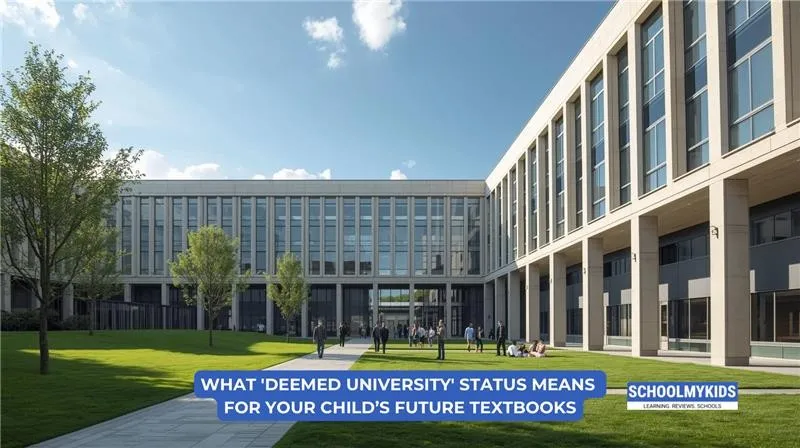
You've probably heard of NCERT textbooks. Your child uses them, or you did when you were in school. They're the books with those familiar covers that millions of students across India study from every year.
Now, NCERT is about to get a major upgrade. By the end of January 2026, it's expected to become a "deemed university."
Understanding NCERT's Current Role in Indian Education
NCERT stands for National Council of Educational Research and Training. It was set up in 1961, and its main job has been to:
- Design the national curriculum for schools
- Create textbooks for classes 1 to 12
- Train teachers
- Do research on education
Think of NCERT as the organization that decides what should be taught and how. If your child is in a CBSE school or many state board schools, they're using NCERT books. Around 28,000 schools across India follow these textbooks.
But NCERT has never been a university. It can't give degrees. It can't run postgraduate programs. It's been an "advisory body" that creates curriculum and books, but it doesn't have the powers that universities have.
What Does "Deemed University" Mean?
A deemed university is an institution that the government recognizes as having university-level powers even though it's not a traditional university.
India has around 145 deemed universities, and they enjoy special freedoms. They can:
- Design their own courses
- Award their own degrees (bachelor's, master's, PhD)
- Set their own admission rules
- Conduct independent research
The first institution to get this status was the Indian Institute of Science back in 1958.
Why Is This Change Happening?
Union Education Minister Dharmendra Pradhan announced this plan back in 2023. The idea was to transform NCERT into a research-focused institution that could collaborate internationally and contribute more to education globally.
The groundwork is done. Sources say the University Grants Commission (UGC) just needs to hold a meeting to finalize this, and the decision should come by the end of January 2026.
This move fits with the National Education Policy 2020, which wants more research-driven institutions and better integration across different levels of education.
The Big Question: Will My Child's Textbooks Change?
You're probably wondering if this means NCERT textbooks will suddenly be different.
The short answer: Not immediately.
What Will Stay the Same:
- NCERT will still make textbooks. That's not going away. Creating school textbooks has always been NCERT's main job, and it will continue.
- The books will still be used by CBSE and state boards. Schools that currently use NCERT textbooks will keep using them.
- Funding remains focused on school education. NCERT's primary funding will continue to come from the Department of School Education and Literacy. This means the focus stays on school-level education, not just higher education.
What Could Change (Over Time):
- Better research backing the textbooks. As a deemed university, NCERT can expand its research. This means the curriculum and textbooks could be based on more current, evidence-based research about how children learn best.
- More qualified people working on the curriculum. NCERT will now be able to offer PhD programs in education, curriculum design, and related fields. This means more highly trained people could be working on what your child learns.
- Global collaboration. NCERT can now partner with international universities and institutions. This could bring in global best practices in education.
What Parents Need to Understand
- This is not about privatization. Some parents might worry that NCERT becoming a university means it will start charging fees or becoming commercial. That's not what this is about. NCERT remains a government body under the Ministry of Education.
- Your child's current books are fine. There's no need to panic or think the books are suddenly outdated. Any changes to textbooks happen through a long process and aren't sudden.
- The focus is still on school education. Even with university status, NCERT's foundational commitment to school-level education remains central.
Should You Be Worried or Excited?
Neither extreme.
This is an administrative change that gives NCERT more tools to do its job. It doesn't mean your child's education is being overhauled tomorrow.
What it could mean in the long run:
- More research-based teaching methods
- Better-trained teachers
- Curriculum that's updated based on actual studies of how children learn
- Exposure to international educational practices
What Happens Next?
The UGC will meet soon and is expected to approve this by the end of January 2026. After that, NCERT could start its first degree programs in the 2026-27 academic year.
But remember that creating new courses and programs takes time. Setting up research centers takes time. Any impact on school textbooks would be gradual, not sudden.
Conclusion
Your child's NCERT textbooks aren't going anywhere. The same organization that's been creating them since 1961 will continue to do so.
What's changing is that NCERT now has more power and freedom to improve how it does this work. It can do more research, train teachers better, and bring in global expertise.
Think of it as giving more tools to the people who are already doing the job, and not replacing them or changing the entire system overnight.


Be the first one to comment on this story.