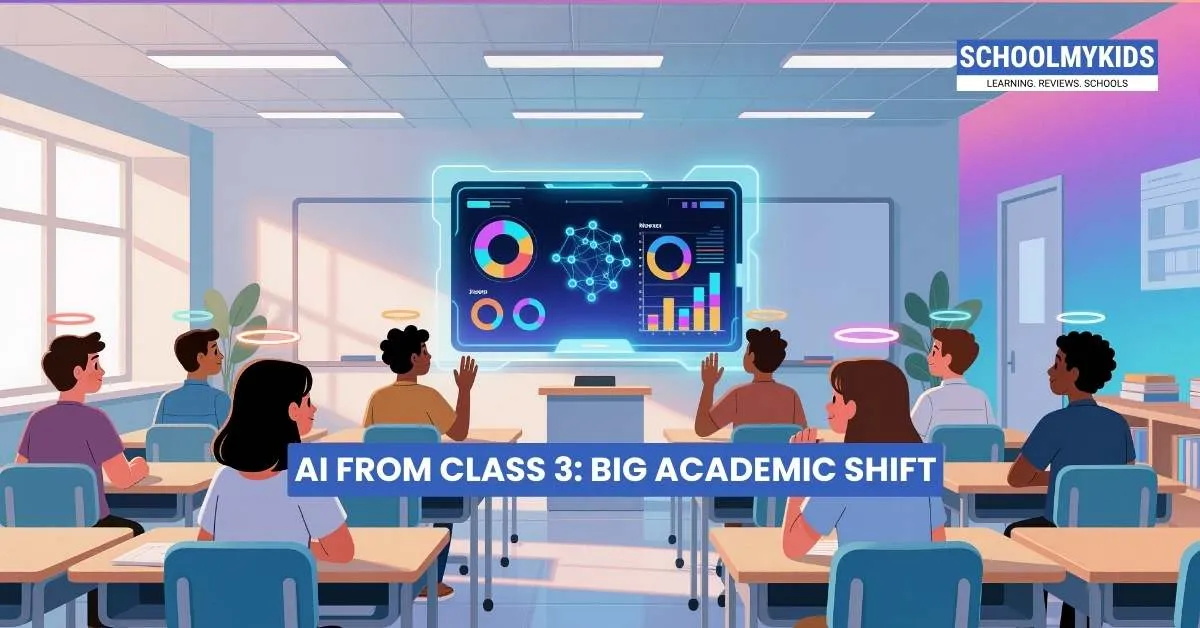
AI from Class 3: A Big Academic Shift
Introducing Artificial Intelligence (AI) as early as Class 3 marks one of the most significant shifts in modern education. This move is not about turning eight-year-olds into programmers or data scientists. It is about reshaping how children think, learn, and interact with knowledge in a world where AI is already woven into daily life.
For decades, early education focused on reading, writing, arithmetic, and memory-based learning. AI changes that equation. It pushes schools to move beyond rote learning and toward logic, curiosity, and problem-solving, starting much earlier than before.
Why Introduce AI So Early?
Children today grow up surrounded by technology. Voice assistants, recommendation algorithms, smart games, and adaptive apps are already influencing how they think. Teaching AI from Class 3 does three important things:
- Demystifies technology: AI stops being “magic” and becomes something understandable. Children learn that machines follow rules created by humans.
- Builds thinking skills early: AI education focuses on patterns, decision-making, and cause-and-effect relationships, not coding syntax.
- Prepares students for future learning: Early exposure creates a foundation. By the time students reach higher classes, AI feels familiar, not intimidating.
This is not acceleration for the sake of speed. It is in alignment with reality.
What AI Education in Class 3 Actually Looks Like
Despite the panic headlines, AI in early grades is not technical.
At this level, AI learning usually includes:
- Understanding what machines can and cannot do
- Simple ideas of input, output, and rules
- Recognizing patterns and predictions
- Differentiating between human thinking and machine responses
- Ethical basics like fairness, privacy, and responsibility
Lessons are often activity-based: storytelling, games, puzzles, visual examples, and classroom discussions. No heavy screens. No complex software. Mostly thinking exercises disguised as play.
From Memorization to Mindset
The real shift is not the subject. It is the learning philosophy.
Traditional early education rewards:
- Correct answers
- Fast recall
- Repetition
AI-oriented education rewards:
- Asking questions
- Exploring multiple solutions
- Understanding why something works
- Accepting trial and error
This quietly challenges the old topper culture where memorization equals intelligence. AI classrooms value process over perfection, which is a radical change for many education systems.
Role of Teachers: From Instructors to Guides
AI in early education does not replace teachers. It changes their role.
Teachers move from:
- Delivering fixed content to
- Guiding exploration and discussion
They help students:
- Frame questions
- Reflect on outcomes
- Understand mistakes
- Think ethically about technology
This demands new teacher training models. Without that, AI education risks becoming another superficial checkbox subject.
Concerns Parents Commonly Have
“Is this too much pressure too early?”
Only if it is taught wrongly. When taught conceptually and playfully, AI adds clarity, not burden.
“Will this increase screen time?”
Good AI curricula focus more on thinking than devices. Screens are tools, not the center.
“Will children lose basic skills?”
On the contrary, AI learning often strengthens math, language, and reasoning by applying them in real contexts.
The real danger is not AI. It is a poor implementation.
Equity and Access: The Real Challenge
Introducing AI from Class 3 exposes a serious fault line.
- Well-resourced schools adopt meaningful AI programs
- Underfunded schools risk shallow or no exposure
If not handled carefully, AI education could widen the learning gap instead of closing it. Policy, teacher training, and curriculum design matter more than flashy tech partnerships.
Ethics Starts Early
One underrated benefit of early AI education is ethical awareness.
Children begin to ask:
- Can machines be biased?
- Who controls technology?
- Should everything be automated?
These questions shape responsible citizens, not just skilled workers. Starting these conversations early builds digital maturity that textbooks alone cannot.
What This Shift Signals About the Future of Education
Introducing AI from Class 3 signals that education systems are finally admitting a hard truth:
Memorization alone cannot prepare students for a thinking-driven world.
This shift encourages:
- Lifelong learning habits
- Comfort with uncertainty
- Adaptability over fixed knowledge
AI becomes less of a subject and more of a lens through which students understand the modern world.
Conclusion
AI from Class 3 is not about machines replacing childhood. It is about protecting childhood from obsolete learning models.
When done right, this shift nurtures curiosity, confidence, and critical thinking at an age when minds are most flexible. When done poorly, it becomes another buzzword-driven burden.
The technology itself is neutral.The educational intent will decide whether this becomes a breakthrough or just another failed reform.
Either way, the classroom has already changed. The only question is whether education systems are ready to change intelligently with it.






Be the first one to comment on this story.