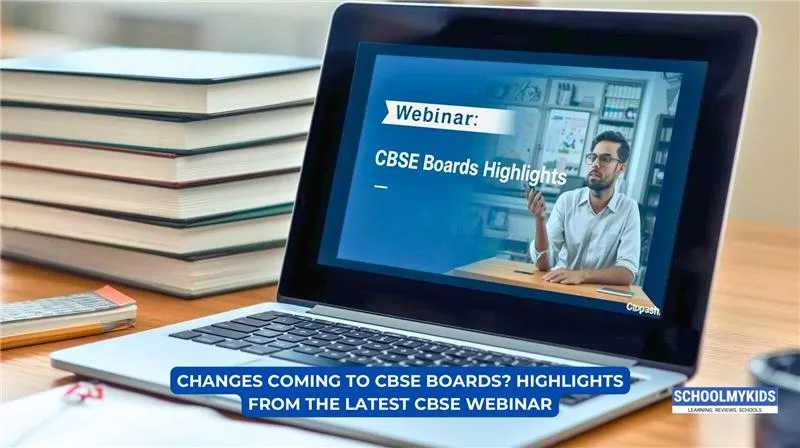
Recently, CBSE held an important webinar to make sure everyone was on the same page.
On February 13, 2026, CBSE's senior officials, including Dr. Sanyam Bhardwaj (Controller of Examinations), CBSE Chairman Rahul Singh, and Joint Secretary Manish Agarwal, addressed principals, teachers, and exam centre superintendents across the country. The webcast ran for over two hours and covered everything from how answer sheets will be evaluated to how schools must handle question papers.
If you're a student preparing for your boards, we are going to give you a clear breakdown of what was shared and what it means for you.
Why Was This Webinar Held?
Joint Secretary Manish Agarwal opened the session by outlining its purpose. This wasn't just a routine meeting. CBSE organised this webinar specifically to:
- Ensure safe and smooth conduct of exams.
- Introduce and explain new initiatives for 2026.
- Build confidence among all stakeholders, including principals, teachers, parents, and students.
- Communicate the latest updates directly from the Board.
Given that the 2026 board exams involve over 46 lakh students, more than 31,000 affiliated schools, and 8,074 exam centres across India and 26 countries, a coordinated session like this was necessary.
The Three Big Changes for 2026
Dr. Sanyam Bhardwaj walked through the three major changes introduced this year.
1. Two Board Exams for Class 10
Class 10 students will have the opportunity to appear for board exams twice this academic year. The first exam begins February 17 and wraps up by March 11, 2026. The second exam is scheduled from May 15 to June 1, 2026.
The results of both exams will be considered for the final merit list, and the better score will count. So if you sit for the second exam and don't perform as well, there's no penalty. Your stronger result is what goes on record.
This is a significant student-friendly move. One difficult day no longer determines everything.
2. On-Screen Marking (OSM) for Class 12
This is the biggest change on the evaluation side. For Class 12, answer books will no longer be physically distributed to teachers. Instead, all answer sheets will be scanned centrally and uploaded to a secure digital server. Evaluators will then assess the scripts on their screens through a secure portal.
CBSE Chairman Rahul Singh explained it clearly during the session: answer scripts won't be distributed school-wise anymore. Everything goes through the central server.
What this means for students:
- No more totalling errors; marks are calculated automatically.
- No risk of unevaluated answers being missed.
- Faster results, as evaluation has been brought down from 12 days to around 8 to 9 days.
- Wider participation from teachers, including those in CBSE-affiliated schools abroad.
CBSE also announced that teachers will receive proper training before evaluation begins, along with short instructional videos and practice scripts to familiarise themselves with the system.
NOTE: Because of this digital shift, there will be no marks verification for Class 12 in 2026 onwards. The traditional process of requesting a marks recount no longer applies. However, re-evaluation is still available if you apply for it; the digital evaluation marks will be reviewed.
3. Section-Wise Answer Books for Class 10: Science and Social Science
For Class 10 students appearing for Science and Social Science, the answer booklets have been divided into separate sections based on subjects.
- Science is divided into Physics, Chemistry, and Biology.
- Social Science is divided into History, Geography, Political Science, and Economics.
You are required to write your answers in the correct section. Subject-specific teachers will evaluate each section separately, which improves the overall quality and accuracy of marking.
This might sound like a small change, but it is not. Writing a Biology answer in the Physics section, for instance, can lead to it going unevaluated. Please be careful about which section you are writing in.
Scale of CBSE Board Exams 2026: The Numbers
Just to give you a sense of how big this exercise is:
- 46 lakh students appearing across India and 26 countries
- 1,85,94,79 students registered for Class 12 specifically
- Over 1 crore answer books to be evaluated for Class 12 alone
- More than 31,000 affiliated schools
- Over 8,074 examination centres
This is why CBSE is investing so heavily in digital systems. The scale makes manual processes prone to errors.
What CBSE Said About Exam Security
CBSE Chairman Rahul Singh was firm on this. Schools must follow all SOPs without exception. Key points he emphasised:
- Question papers must be handled securely at all times
- CCTV surveillance will be in place for three months
- Frisking procedures must be followed at exam centres
- Answer books must be submitted on time
Mobile phones are strictly prohibited inside exam halls. Students must reach their exam centre on time. The Controller of Examinations specifically directed students on punctuality.
A Note on Social Media
CBSE addressed the issue of misinformation during the webinar as well. Every year, rumours about paper leaks and exam cancellations spread on social media, causing unnecessary panic among students.
CBSE's clear message: rely only on official communication from cbse.gov.in. Do not share or engage with unverified information. If you see something suspicious online, ignore it and check the official website.
For Parents
CBSE also addressed parents directly during the session. Parents are expected to be aware of the rules and regulations set by the Board and guide their children to appear for the exam with integrity. Any form of malpractice has serious consequences. It's not worth it, and parents play a role in making sure students understand that.
Quick Summary for Students
Here's everything you need to remember:
- Exams begin February 17, 2026
- Class 10 students get a second attempt (optional) from May 15 onwards
- Class 12 answer sheets will be evaluated digitally; no totaling errors, faster results
- No marks verification for Class 12 this year; re-evaluation is still available
- Write your Class 10 Science and Social Science answers in the correct section
- Reach your exam centre on time, and keep your phone away
- Follow only official CBSE updates; don't trust social media rumors
You've already done the hard part by preparing. Now it's about going in calm, following the rules, and giving it your best. CBSE has put a lot of thought into making this process fair for everyone. Trust the system, trust your preparation.
All the best for your exams.



Be the first one to comment on this story.