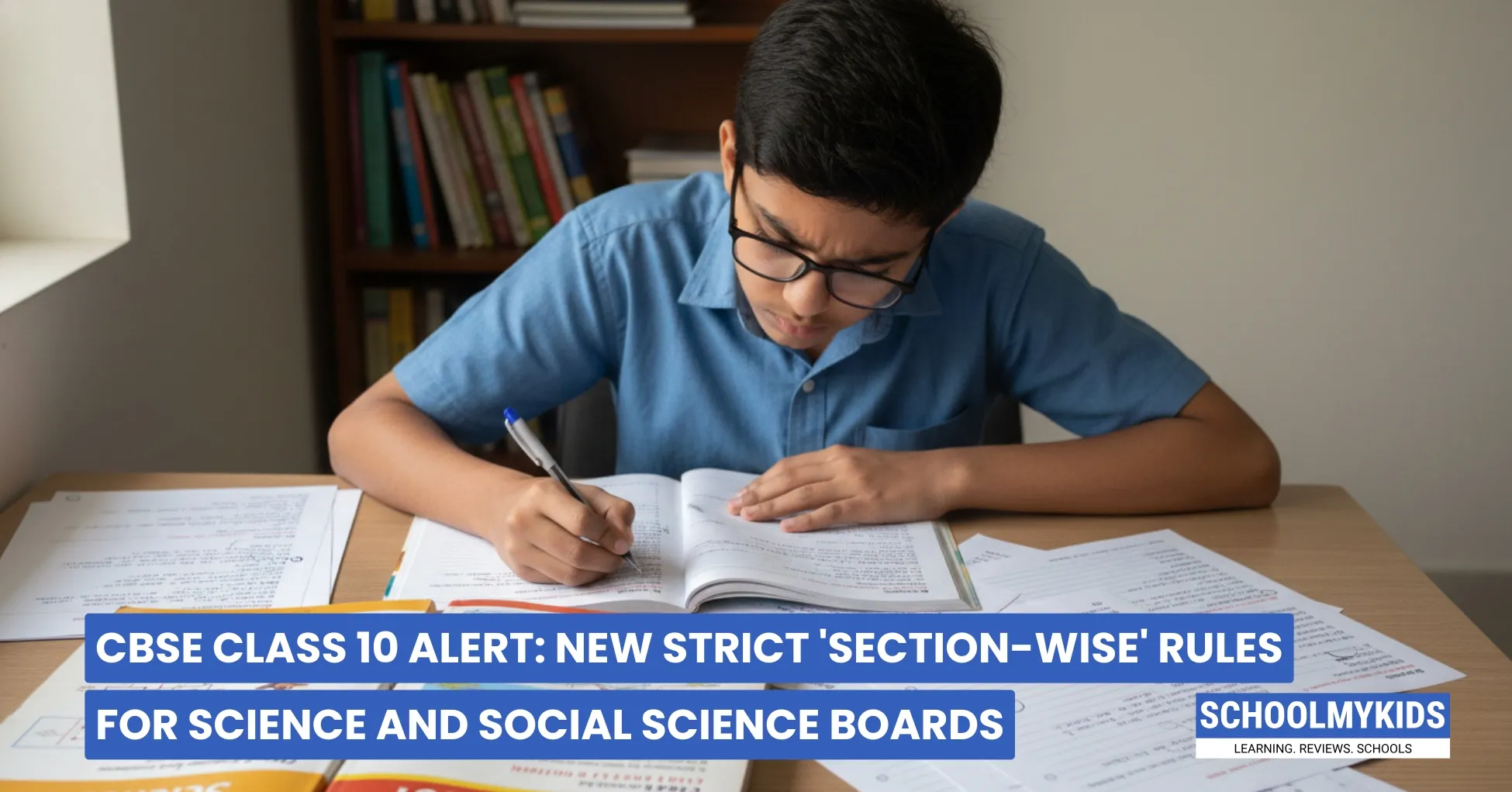
If you're appearing for the CBSE Class 10 boards in 2026, listen up. There's been a major update that's going to change how you write your Science and Social Science papers. And this isn't something you can afford to ignore.
CBSE has released a circular that introduces strict section-wise rules for these two subjects. What does that mean? Let’s break it down for you.
What's Changed?
Starting from the February 2026 boards, your Science and Social Science answer sheets will need to follow a fixed structure. You can't just write answers anywhere you like anymore.
For Science, your paper is now divided into three clear sections:
- Section A: Biology
- Section B: Chemistry
- Section C: Physics
For Social Science, it's four sections:
- Section A: History
- Section B: Geography
- Section C: Political Science
- Section D: Economics
Sounds simple enough, right? But this means that you MUST write your answers in the correct section only.
The Big Warning
CBSE has made it crystal clear: if you write a Chemistry answer in the Biology section, it won't be checked. At all. Even if your answer is completely correct, it will be ignored during evaluation.
There's no room for mistakes here. No second chances during re-evaluation or verification, either. Once you've written something in the wrong section, those marks are gone.
Why Should You Care?
Many of you might think, "I'll just be careful on exam day." But exam pressure is real. When you're sitting in that hall with limited time, your mind is racing, and it's very easy to lose track of which section you're in.
Imagine you're solving a tough Physics numericals question. You finish it, feel proud, flip the page, and accidentally write your next Chemistry answer right below it because you forgot to move to Section B. That's it. No marks for that answer, no matter how perfect it is.
Sounds unfair. But those are the rules now, and CBSE isn't budging.
What This Means for Your Preparation
This change isn't just about exam day; it affects how you need to prepare from now on.
- Practice becomes even more important: You can't just solve questions anymore. You need to practice writing them in the right format. That means using section-wise answer sheets during every mock test, every practice session, every time you sit down to revise.
- Your school will help: CBSE has told schools to start using section-wise answer sheets for all internal tests and pre-boards. So pay attention during those tests. They're not just for marks; they're training you for the real thing.
- Download sample papers: Head to the CBSE website and download the latest sample papers. They'll show you exactly how the paper will look and how you should structure your answers.
Why Is CBSE Doing This?
According to the board, this change is meant to bring "clarity and transparency" to the evaluation process. When thousands of answer sheets are being checked, having a fixed structure helps teachers evaluate faster and more accurately. It reduces confusion and makes sure everyone is checked the same way.
From CBSE's perspective, it makes sense. But from a student's perspective, it adds one more thing to worry about during an already stressful exam.
How to Prepare Smartly
Here's what you should do right now:
- Get familiar with the format: Look at the new structure. Understand which topics fall under which section. Make a mental map so you don't have to think about it during the exam.
- Label your sections clearly: On exam day, as soon as you get your answer booklet, divide it into sections immediately. Write big, clear headings: Section A - Biology, Section B - Chemistry, and so on. Make it impossible to miss.
- Plan before you write: Before you start answering, quickly scan the paper and decide which questions you'll attempt from each section. This helps you stay organized.
- Practice with a timer: Do at least 5-6 full mock tests where you strictly follow the section-wise format. Time yourself. Get comfortable with the pressure.
Conclusion
These new rules might feel like extra pressure, but they're here to stay. The CBSE Class 10 board exams will start on February 17, 2026. You have time to adapt, but you need to start now.
Don't wait until the last minute to figure this out. Make section-wise practice a part of your daily routine. Talk to your teachers if you're confused. Ask for section-divided answer sheets during practice tests.
The goal is to make it so natural that you don't even have to think about it when you're sitting for the actual exam. Just take it seriously from day one, and you'll be fine.





Be the first one to comment on this story.