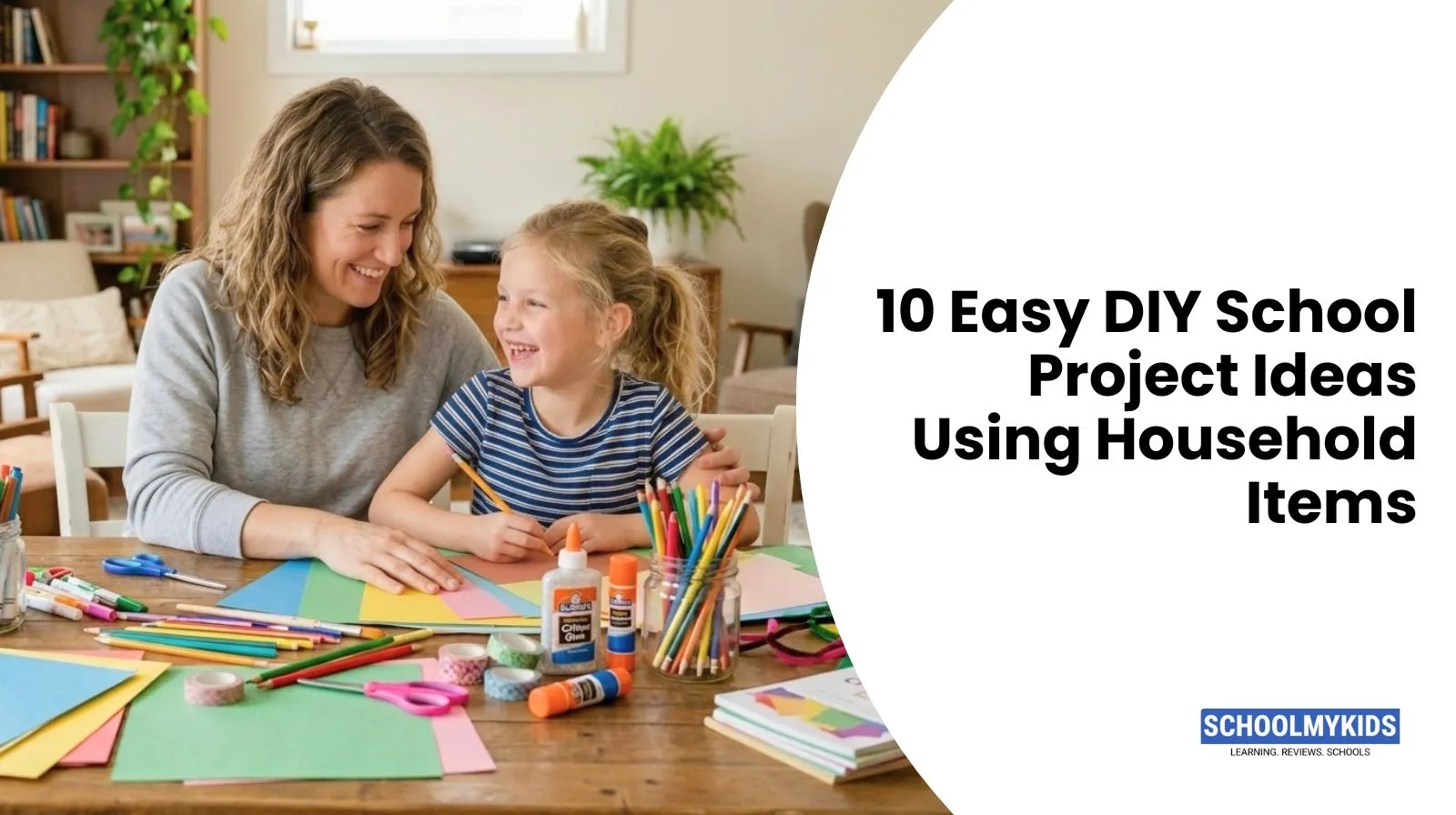
Every year, thousands of students across India scramble to find the perfect school project; something that impresses teachers, fits the curriculum, and doesn’t require a trip to a specialty store. The good news? Some of the best school project ideas are sitting right in your kitchen, storeroom, or recycling bin.
Whether you are preparing for a science exhibition, an art assessment, or a class activity, this guide covers 10 creative DIY school projects using everyday household items.
Why DIY School Projects Using Household Items Are the Smart Choice
Benefit | Why It Matters |
|---|---|
Cost-effective | No extra expenditure; items already at home |
Curriculum-aligned | Projects can map directly to CBSE/ICSE chapters |
Develops creativity | Students learn to think with available resources |
Eco-friendly | Reuses waste materials, teaches sustainability |
Teacher-approved | Handmade projects demonstrate genuine effort |
Time-efficient | No waiting for deliveries or store visits |
CBSE and other Indian boards increasingly emphasize project-based and experiential learning, in line with the National Curriculum Framework (NCF) 2023, which promotes “learning by doing.” So, these projects aren’t just fun; they directly support your grades.
Pro-Tip for 2026 Assessments: NCF 2023 guidelines encourage connecting school projects to real-world relevance. When presenting your model, mention the Sustainable Development Goal (SDG) it supports. For example, the Water Purification project supports SDG 6: Clean Water and Sanitation. This one detail can significantly elevate your presentation score.
10 DIY School Project Ideas That Actually Work
1. Volcano Model - The Classic Science Fair Project
Subject: Chemistry | Best for: Classes 5–8 | Time: 3–4 hours (plus drying)
This is one of the most popular science fair projects for a reason. It visually demonstrates a classic acid-base chemical reaction and is always a crowd-pleaser at exhibitions.
Materials Needed: Plastic bottle, newspaper, flour, water, salt, baking soda, vinegar, food coloring, paint.
How to Make It:
Build the volcano shape around the bottle using newspaper and flour-paste (papier-mâché).
Let it dry for 24 hours, then paint it brown and grey.
At the time of display, pour baking soda inside, add red food coloring, then pour vinegar.
The Science: The reaction between baking soda (NaHCO₃) and vinegar (CH₃COOH) produces Carbon Dioxide (CO₂) gas, which causes the dramatic fizzing overflow: NaHCO₃ + CH₃COOH → CH₃COONa + H₂O + CO₂
Learning Outcome: Demonstrates basic acid-base reactions and gas production, relevant to chemistry concepts across middle school. Aligns with CBSE/NCERT middle school science themes on chemical changes.
Safety Note: Adult supervision recommended during the chemical reaction step. Keep away from your eyes.
2. Working Windmill Model - Renewable Energy in Action
Subject: Physics / Environmental Science | Best for: Classes 7–9 | Time: 4–5 hours
One of the most impressive Science Exhibition Models for Class 8, this project demonstrates how mechanical energy converts to electrical energy, touching on basic principles of energy generation and magnetic effects of current, the concepts that CBSE middle school physics teachers look for. It connects directly to CBSE themes on energy sources and conservation. SDG 7: Affordable and Clean Energy.
Materials Needed: Cardboard, wooden skewers or pencils, a plastic bottle, a small LED bulb, copper wire, a small motor (from an old toy).
How to Make It:
Cut four equal blade shapes from cardboard and attach them to a central skewer at equal angles.
Connect the skewer to the small motor.
When the blades spin, the motor can act as a small generator and produce current. In practice, the LED may glow faintly and may require strong airflow or a higher-quality motor.
Pro-Tip: Results depend on the motor quality. Use a fan to spin the blades during your presentation for a consistently bright LED.
Learning Outcome: Demonstrates wind energy conversion and basic principles of energy generation and magnetic effects of current, relevant to CBSE middle school physics and energy conservation topics.
3. Water Purification Model
Subject: Environmental Science / Chemistry | Best for: Classes 6–9 | Time: 2–3 hours
This is one of the most relevant school project ideas for 2026, given the growing emphasis on water conservation. SDG 6: Clean Water and Sanitation.
Layer | Material Used | Function |
|---|---|---|
Top layer | Pebbles | Removes large debris |
Second layer | Coarse sand | Filters medium particles |
Third layer | Fine sand | Filters fine particles |
Bottom layer | Natural lump charcoal or activated charcoal | Removes odor and impurities |
Materials Needed: Two plastic bottles, pebbles, coarse sand, fine sand, natural lump charcoal or activated charcoal.
Important: Do NOT use commercial charcoal briquettes (used for grilling); these often contain added chemicals. Use natural lump charcoal made from burnt wood or coconut shells, or store-bought activated charcoal for best results. Home-burnt charcoal is sufficient for a demonstration but is not fully activated without steam processing.
Learning Outcome: Aligns with CBSE/NCERT middle school topics on water conservation, pollution, and environmental science.
Note: This model demonstrates filtration only. The filtered water is not safe for drinking without proper purification like boiling or chemical treatment.
4. Solar System Mobile
Subject: Science / Astronomy | Best for: Classes 4–7 | Time: 3–4 hours
A beautifully crafted solar system model is one of the best craft ideas for school that also doubles as a classroom decoration.
Materials Needed: Thermocol balls (different sizes), paint, thread, a wire hanger or cardboard rod.
Planet | Color to Use | Size (Relative) |
|---|---|---|
Mercury | Grey | Smallest |
Venus | Yellowish-white | Small |
Earth | Blue-green | Small |
Mars | Red-orange | Small |
Jupiter | Brown-orange striped | Largest |
Saturn | Golden with ring | Very large |
Uranus | Light blue | Medium |
Neptune | Deep blue | Medium |
Learning Outcome: Builds awareness of the solar system and space science, relevant to astronomy topics in CBSE/NCERT middle school science.
5. Cardboard Bridge Strength Test
Subject: Physics / Engineering | Best for: Classes 7–10 | Time: 2–3 hours
Among creative DIY school projects, this one stands out because it introduces students to structural engineering concepts and makes for a strong Inspire Award MANAK submission idea when given a unique, problem-solving twist.
Materials Needed: Cardboard, scissors, glue, coins or small weights for testing.
How to Make It:
Build three bridge designs; flat, arched, and truss-style, using the same amount of cardboard.
Place weights on each and record which design holds the most before collapsing.
Learning Outcome: Demonstrates principles of force, pressure, and structural design, relevant to CBSE middle school physics and engineering concepts.
6. Homemade Compass
Subject: Physics / Geography | Best for: Classes 6–8 | Time: 30 minutes
Simple, elegant, and genuinely functional; this is one of those easy school projects that looks basic but teaches a powerful concept: Earth’s magnetic field.
Materials Needed: A needle, a small piece of cork or thermocol, a bowl of water, a magnet.
How to Make It:
Stroke the needle with the magnet 30–40 times in one direction only.
Place the needle on the cork and float it in the bowl of water.
The needle will align itself to point North-South.
Learning Outcome: Aligns with magnetism and magnetic effects topics in CBSE/NCERT middle school science (Classes 6–8).
7. Paper Mâché Relief Map of India
Subject: Geography / Social Science | Best for: Classes 5–8 | Time: 5–6 hours (plus drying)
This is one of the most impressive handmade school project ideas for Social Science and Geography assessments.
Materials Needed: Cardboard base, newspaper strips, flour-water paste, paint, a printed outline map of India.
How to Make It:
Trace India’s outline onto cardboard.
Build raised landforms using layered papier-mache.
Once dry, paint and label major geographical features.
Learning Outcome: Covers India’s physical geography; the Himalayas, the Deccan Plateau, Indo-Gangetic Plain; aligned to CBSE/NCERT Geography for Classes 6 and above.
8. Periscope from Cardboard and Mirrors
Subject: Physics / Optics | Best for: Classes 7–9 | Time: 2–3 hours
This is a fantastic science model for school exhibition that demonstrates the law of reflection using mirrors.
Materials Needed: A long cardboard box (or two cardboard tubes joined), two small mirrors, tape, scissors.
How to Make It:
Cut two openings at opposite ends of the tube; one at the top facing forward, one at the bottom facing forward.
Place mirrors at 45-degree angles at each opening.
Look through the bottom opening and see what’s above eye level.
Learning Outcome: Demonstrates laws of reflection in optics; angle of incidence equals angle of reflection, relevant to CBSE/NCERT physics light concepts in middle school.
9. Waste Material Sculpture - Best Creative School Project with Waste Material
Subject: Art / EVS | Best for: All Classes | Time: 2–4 hours
One of the best creative school projects with waste material, this project encourages artistic thinking while promoting environmental responsibility. This project introduces students to the Circular Economy, where waste is redesigned into value, making it a natural fit for classroom discussions on sustainability. SDG 12: Responsible Consumption and Production.
Materials Needed: Plastic bottles, cardboard boxes, bottle caps, old CDs, cloth scraps, glue, paint.
Ideas to Build:
A robot figure using boxes and bottles
A cityscape model using various-sized cartons
An animal sculpture using egg cartons and paper rolls
Learning Outcome: Develops spatial thinking, creativity, and awareness of upcycling, aligned to Environmental Studies across all classes.
10. Lung Capacity Demonstrator
Subject: Biology | Best for: Classes 7–10 | Time: 1–2 hours
For students looking for the best school project ideas for Class 8 in Biology, this model visually demonstrates how lungs expand and contract during breathing, a core concept in CBSE Class 7 (Respiration in Organisms) and Class 8 (Health and Disease), continuing through Class 10.
Materials Needed: A plastic bottle, two balloons, a straw, clay/putty, scissors.
How to Make It:
Cut the bottom off a plastic bottle.
Insert a small balloon tied to a straw through the bottle cap; this represents a lung.
Stretch a larger balloon across the open bottom; this is the diaphragm.
Pull the large balloon down and watch the inner balloon inflate.
Troubleshooting: If the inner balloon doesn’t inflate, check the seal around the straw. Press clay firmly around the straw at the bottle cap to make it fully airtight.
Learning Outcome: Explains diaphragm function and respiratory mechanics, relevant to biology life processes chapters in CBSE Classes 7–10.
Quick Comparison: Best Projects by Class, Subject and Time
Project | Class | Subject | Difficulty | Time Needed |
|---|---|---|---|---|
Volcano Model | 5–8 | Chemistry | Easy | 3–4 hrs + drying |
Windmill Model | 7–9 | Physics | Medium | 4–5 hrs |
Water Purification | 6–9 | Env. Science | Easy | 2–3 hrs |
Solar System Mobile | 4–7 | Astronomy | Easy | 3–4 hrs |
Cardboard Bridge | 7–10 | Physics/Engineering | Medium | 2–3 hrs |
Homemade Compass | 6–8 | Physics | Easy | 30 mins |
Relief Map of India | 5–8 | Geography | Medium | 5–6 hrs + drying |
Periscope | 7–9 | Physics/Optics | Medium | 2–3 hrs |
Waste Material Sculpture | All | Art/EVS | Easy | 2–4 hrs |
Lung Capacity Model | 7–10 | Biology | Medium | 1–2 hrs |
Note: Curriculum links are based on common NCERT/CBSE themes. Always check your latest syllabus for exact chapter mapping, as CBSE continues to revise its structure under NCF 2023 guidelines.
Tips to Make Your School Project Stand Out
Label everything clearly - teachers appreciate when students demonstrate they understand the concept, not just the construction.
Add a project report - a structured write-up with Aim, Theory, Materials, Procedure, Observation, and Conclusion always earns extra marks.
Connect to real life - mention where this concept appears in daily life (e.g., windmills in Rajasthan, water purification in rural India).
Connect to SDGs - mentioning which Sustainable Development Goal your project supports shows awareness beyond the textbook.
Practice your explanation - especially for science exhibitions; confident presentation counts as much as the model itself.
Bonus: Project Report Template (Copy and Fill)
Every school exhibition requires a written submission alongside your model. Use this template:
Section | What to Write |
|---|---|
Project Name | Insert your project title |
Aim | To demonstrate [e.g., how wind energy converts into electricity] |
Materials Used | List your household items |
Procedure | Briefly summarize the 3–4 steps you followed |
Observation | What happened? e.g., “The LED flickered when the fan was turned on.” |
Conclusion | This project demonstrates [e.g., basic energy generation principles] and aligns with SDG [e.g., 7: Affordable and Clean Energy] |
The “Winning” Presentation Secret
Topping the “Best Model” award at school exhibitions in 2026 takes more than good construction. Here’s what sets winning entries apart:
The Digital Edge: Print a QR code that links to a short 30-second video of your project in action. It shows initiative and makes your display memorable.
The Scientist’s Log: Maintain a small notebook documenting your process, including failed attempts and corrections. Teachers and judges value the learning journey far more than a perfectly finished model. This reflects the NCF 2023 emphasis on process-based assessment.
The Inspire Award MANAK Edge: Projects like the Windmill Model, Water Purification Filter, and Lung Capacity Demonstrator can make strong Inspire Award MANAK submissions when linked to SDGs and presented with an original angle. Note that qualification depends on originality and innovation; standard models need a unique, problem-solving twist per official program guidelines.
Frequently Asked Questions
Q1. What are the easiest school project ideas using household items?
The easiest ones include the Homemade Compass (just a needle, magnet, and water bowl), the Solar System Mobile (thermocol balls and paint), and the Waste Material Sculpture. All three require zero specialized materials and can be completed in a few hours.
Q2. What are the best Science Exhibition Models for Class 8?
Top picks for Class 8 science exhibitions are the Working Windmill Model (energy and magnetic effects of current), the Periscope (light and optics), the Lung Capacity Demonstrator (biology), and the Water Purification Model (environmental science), all aligned to CBSE/NCERT middle school science themes.
Q3. How do I make a science fair project at home with waste material?
Collect cardboard, plastic bottles, old newspapers, bottle caps, and cloth scraps. Choose a concept from your syllabus, like energy, ecosystems, or simple machines and build a model that visually explains it. The Waste Material Sculpture and Water Purification Filter are excellent starting points.
Q4. Are these DIY school projects suitable for CBSE and ICSE students?
Yes. Most of these projects align with commonly taught topics in CBSE and ICSE curricula for Classes 4–10. Each project includes its curriculum connection to help students and teachers align them to current learning objectives.
Q5. How long does it take to complete a DIY school project?
Most projects can be completed in 2–6 hours. The Volcano and Relief Map of India may need 24–48 hours for the papier-mâché to dry fully before painting.
Q6. Can these craft ideas for school be done without parental help?
Most are safe for students in Classes 6 and above to work on independently. The Volcano model (chemical reaction step) and Windmill model (motor wiring) benefit from adult supervision.
Q7. What is the Inspire Award MANAK and can these projects qualify?
The Inspire Award MANAK (Million Minds Augmenting National Aspirations and Knowledge) is a Government of India initiative encouraging school students to submit innovative, low-cost ideas that solve real problems. Projects linked to SDGs like the Windmill or Water Purification model, are relevant, but qualification depends on originality and a clearly demonstrated innovative approach per official guidelines.
Final Word
The best school projects aren’t always the most expensive ones. They’re the ones that show real thinking and connect classroom knowledge to the real world. With the 10 DIY school project ideas listed above, every student, from Class 4 right up to Class 10, can find something that fits their subject, class level, and available materials.
Whether you’re gearing up for your school’s annual science fair, preparing a Science Exhibition Model for Class 8, or simply exploring low-cost teaching aids and creative craft ideas for school, these ideas are your starting point.
Explore more activities, worksheets, and learning tools for students on SchoolMyKids, India’s most trusted education platform for parents, students, and teachers.


Be the first one to comment on this story.