
For busy parents in 2026, “screen-free time” is no longer a luxury; it’s a necessity. Yet finding educational activities kids can do at home without tablets or YouTube can feel overwhelming. The good news: learning doesn’t need a device; it needs a few everyday objects, a bit of creativity, and 15–20 minutes of focused play.
This article gives you 22 no-screen, hands-on activities designed as indoor learning games and STEM activities for kids. Many of these double as STEM activities that build literacy, math, science, and life skills without feeling like “school.”
Literacy & Language Activities
These indoor learning games build vocabulary, speaking, and early reading skills.
Story-Jar Writing
Prep Time: 5 minutes
Materials: Recycled jar, scrap paper, pen.
Aim: Narrative thinking and vocabulary.
How-to:
Write 10–12 simple words on small paper slips (e.g., “dragon,” “rainbow,” “chocolate,” “school”) and put them in a jar.
Draw 3–4 words and make a short story together (parent writes for younger kids; let older kids write or type short paragraphs).
Age-tip: For 7-year-olds+, add 1–2 rules like “every sentence must have a color word.”
Word-Hunt at Home
Prep Time: 2 minutes
Materials: None.
Aim: Letter-sound recognition and vocabulary.
How-to:
Call out a sound (e.g., /b/, /k/, /m/).
Kids must run and find one object that starts with that sound (ball, comb, mug).
Age-tip: For 4–6, just say the object name; 7–12 can write the word on a small whiteboard or paper.
Family “About Me” Storybook
Prep Time: 10 minutes
Materials: A4 paper, crayons, pens.
Aim: Writing, identity, and confidence in self-expression.
How-to:
Fold A4 paper into a small booklet; write “About Me” on the cover.
Each page has a prompt: “My name is…,” “My favorite food…,” “My dream job….”
Illustrate and write together; keep it in a central place so kids can read it often.
Age-tip: For older kids, add a “Why?” page: “Why I like this…”
Sight-Word Hopscotch
Prep Time: 5 minutes
Materials: Chalk or tape, a small stone or button.
Aim: Word recognition and motor skills.
How-to:
Use chalk or tape on the floor to create a simple hopscotch grid.
Write 6–8 sight-words on each box (on, the, and, are, etc.).
Throw a small stone, jump, and read the word before stepping on that box.
Age-tip: For 4–5, reduce the number of words; for 8–10, ask for a sentence using the word.
Math & Number Games
These are simple indoor learning games that build everyday math without worksheets.
Counting the Kitchen
Prep Time: 3 minutes
Materials: Spoons, cups, fruits, bowls (any safe kitchen items).
Aim: Counting, 1-to-1 correspondence, number sense.
How-to:
Choose a small area (tablespoons, spoons, bowls, fruits, cups).
Line up objects and count; then ask “What if we remove two?” and count again.
Age-tip: For 4–5, count to 10; for 7-year-olds+, count to 20 or 30 by 2s.
Money-Save Challenge
Prep Time: 5 minutes
Materials: Toy coins or cut-out paper money.
Aim: Number sense, saving, and basic addition.
How-to:
Use toy coins or cut-out paper money.
Decide on a “wish” (a toy, a book, a treat) and assign a “price.”
Give kids a small “income” (e.g., 5 coins a day), and challenge them to “save” till they reach the target.
Age-tip: For 8–10, add “interest” (e.g., “If you save 5 extra, you get 1 bonus coin”).
Shape-Hunt Around Home
Prep Time: 2 minutes
Materials: None.
Aim: Geometry, observation.
How-to:
Say a shape (circle, rectangle, triangle, square).
Kids must find 3–5 objects that match that shape and bring them in one basket.
Age-tip: For 4–6, focus on 2–3 shapes; for 7–10, add “name it in English and Hindi.”
Baking Measure Madness
Prep Time: 10–15 minutes plus baking time
Materials: Measuring cups, spoons, simple Indian recipe (e.g., chilla, pancakes, muffins); adult-supervised near stove.
Aim: Measurement, fractions, and real-world math.
How-to:
Use a simple recipe.
Let kids measure ingredients (1 cup, ½ cup, ¼ cup) and pour them (Adult supervision required).
Ask: “How many ¼ cups make a full cup?”
Age-tip: For 8-year-olds+, use written notes: “Write down the ingredients and amounts.”
STEM Activities for Kids at Home
These count as STEM Activities for Kids at Home and STEM activities for kids that feel like play.
Build a Cardboard Boat
Prep Time: 10 minutes
Materials: Small cardboard box, tape, color pens, basin/tub of water, small coins or toys.
Aim: Engineering, buoyancy, and cause-and-effect.
How-to:
Use a small cardboard box (tissue-box size) as a boat.
Decorate with color; place it in a tub of water.
Add coins or small toys one by one and observe when it sinks.
Try “How can we make it float longer?” (add paper sails, change shape).
Age-tip: For 6-year-olds+, add a simple “rule”: “Only 5 coins, then try again with a wider base.”
Sink or Float Challenge
Prep Time: 5 minutes
Materials: 6–8 safe household items (spoon, cork, coin, paper, apple piece), tray of water.
Aim: Observation, prediction, and science vocabulary.
How-to:
Collect 6–8 small household items.
Fill a tray or basin with water.
Ask kids to guess “sink or float,” then test and record.
Age-tip: For 7–12, add a chart (object, material, prediction, result).
Balloon Rocket Race
Prep Time: 5 minutes
Materials: String, tape, chairs, straw, balloon.
Aim: Air pressure, motion, and simple physics.
How-to:
Tie a long string between two chairs.
Slide a straw onto the string; tape an inflated balloon to the straw.
Release the balloon and watch it zoom along the string.
Age-tip: For 6-year-olds+, add “How far?” and measure with a ruler or paper strips.
DIY Weather Station
Prep Time: 5 minutes
Materials: Strip of paper, stick, tape, marker.
Aim: Weather concepts, observation, and prediction.
How-to:
Make a simple “wind-detector” with a paper strip taped to a stick.
Go to a window or balcony; hold it out and watch which way the strip moves.
Make a simple “weather chart” (sunny, windy, rainy) and fill for 5 days.
Age-tip: For 8-year-olds+, add “How strong is the wind?” (Gentle/Strong) and a small sketch.
Tower Stability Challenge
Prep Time: 2 minutes
Materials: Blocks, cups, or cardboard rolls.
Aim: Engineering, balance, and problem-solving.
How-to:
Give kids blocks, cups, or cardboard rolls.
Set a timer (2–3 minutes) and challenge them to build the tallest tower that stands on its own.
If it falls, ask “What can we change?” (base size, spacing, symmetry).
Age-tip: For 4–6, use bigger blocks; for 8–10, restrict “no more than 20 pieces.”
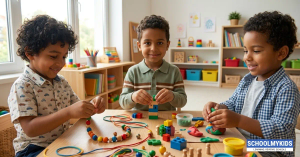
Pasta Pattern Bracelets
Prep Time: 10–15 minutes
Materials: Cooked or uncooked pasta, ribbon or shoelace, tape.
Aim: Patterns, fine motor skills, and color-sorting.
How-to:
String pasta onto a ribbon or shoelace.
Ask kids to make a pattern (e.g., red-blue-yellow, red-blue-yellow).
Tie when complete.
Age-tip: For 4–6, pre-give the pattern; for 7–10, let them invent a pattern and “teach” it to a sibling.
Art, Creativity & Imagination
These are creative indoor learning games that build storytelling, motor skills, and empathy.
Box-to-Toys
Prep Time: 10 minutes
Materials: Cardboard boxes, tape, crayons, markers, stickers.
Aim: Creativity, spatial skills, and fine motor.
How-to:
Save a few cardboard boxes (biscuit, cereal, soap).
Help kids turn them into cars, houses, or masks using tape, colour, and stickers.
After building, “play” with the box creations.
Age-tip: For 4–6, focus on one box; for 8–10, make a “city” with 3–4 boxes.
Story-Draw Books
Prep Time: 10–15 minutes
Materials: Paper, crayons, pens.
Aim: Storytelling, sequencing, and collaboration.
How-to:
Fold paper into a small booklet.
Page 1: Adult draws an opening scene (e.g., moon, house, animal).
Page 2: Child writes or says the next part.
Alternate until the story ends.
Age-tip: For 4–6, parent writes everything; for 10+, add “title page and back-cover blurb.”
Indoor Obstacle Course
Prep Time: 10 minutes
Materials: Pillows, chairs, tape, cords.
Aim: Gross motor skills, planning, and problem-solving.
How-to:
Use pillows, chairs, tape lines, ropes.
Create a simple course (crawl under table, walk on tape line, jump over pillow).
Time or “win-points” for completion.
Age-tip: For 4–6, use simple steps; for 8–12, let them design the course.
Kitchen Instrument Band
Prep Time: 5 minutes
Materials: Spoons, bowls, tins, rubber bands.
Aim: Rhythm, sound, and ear-training.
How-to:
Collect spoons, bowls, tins, rubber bands.
Tune “instruments”; assign rhythms (tap, shake, strum).
Perform a 1-minute “concert.”
Age-tip: Add simple notation: “High pitch / Low pitch” or “Fast / Slow.”
Life Skills & Active Play
These are educational activities kids that blend everyday home tasks with learning.
Mini-Gardening in a Bowl
Prep Time: 10 minutes
Materials: Small bowl or tub, soil, fast-growing seeds (moong, chana).
Aim: Care, science, and patience.
How-to:
Use a small bowl or tub, soil, and fast-growing seeds (moong, chana).
Plant, water, and watch; keep a simple “plant diary” (drawing or writing).
Age-tip: For 4–6, parent records; for 7–10, child writes 1–2 lines every 2 days.
Laundry-Sort Challenge
Prep Time: 5 minutes
Materials: Clean laundry.
Aim: Sorting, categorization, and decision-making.
How-to:
Spread clean laundry on the floor.
Ask kids to sort by type (shirts, shorts, socks) or color.
Give points for speed and accuracy.
Age-tip: For 4–6, separate just 2 categories; for 8–10, sort by “shirt/pant” and then by color too.
Super-Hero Chore-Mission
Prep Time: 5 minutes
Materials: None.
Aim: Responsibility, routine, and motivation.
How-to:
Turn tidying up into a “mission” (e.g., “Save the Room from Mess-Monsters”).
Give 3–4 tasks (books on shelf, clothes folded, toys in basket).
Complete within a time limit to “win.”
Age-tip: For 4–6, use simple 1-step tasks; for 8–10, add “bonus points” for helping siblings.
Kitchen Helper Rounds
Prep Time: 5–10 minutes
Materials: Simple kitchen tools, ingredients.
Aim: Math, measurement, and routine.
How-to:
Let kids help with “easy” kitchen tasks: measuring flour, pouring water, mixing, setting the table (adult supervises stove and sharp tools).
Give verbal instructions in steps (1, 2, 3) and let them repeat.
Age-tip: For 7-year-olds+, add “Write down the steps” after.
Quick Skill-Focus Table (Indoor Learning Games)
Category | Skills Built | Age Range | Top Activities |
|---|---|---|---|
Literacy & Language | Talking, writing, reading, imagination | 4–12 | Story-Jar, Word-Hunt, Sight-Word Hopscotch |
Math & Number Games | Counting, measuring, comparing | 4–12 | Counting the Kitchen, Shape-Hunt, Baking Measure |
STEM Activities for Kids at Home | Science, engineering, inquiry | 4–12 | Sink or Float, Balloon Rocket, Cardboard Boat |
Art & Creativity | Drawing, building, storytelling | 4–12 | Box-to-Toys, Story-Draw Books, Obstacle Course |
Life Skills | Responsibility, routine, fine motor | 4–12 | Mini-Gardening, Laundry-Sort, Kitchen Helper |
This table helps parents quickly match educational activities with the skills they want to strengthen.
How to Adapt Activities by Age
Ages 4–6:
Use simple, concrete language and keep steps short (1–2 max).
Focus on movement, touching, and speaking, and use familiar objects (toys, clothes, food, cups).
Turn activities into short, 10-minute sensory-play-for-focus sessions.
Ages 7–9:
Add basic writing, simple charts, or short notes.
Introduce “challenge” elements such as time limits, scoring, or simple rules.
Use Indian-context examples (common foods, toys, clothes) to build cognitive-development games into everyday life.
Ages 10–12:
Add light “research” questions (e.g., “Why do some objects float?” or “What is the wind speed?”).
Ask for planning: “Design a game and explain the rules” or “Write a short guide for a younger sibling.”
Encourage peer-teaching where older kids lead screen-free to hybrid learning sessions with younger ones.
Safety & Practical Tips
Always supervise science-style activities involving water, small objects, spinning, or height-based play; keep these STEM activities for kids safe and fun, not risky.
Avoid choking-hazard items (small metal parts, magnets, loose beads) for kids under 5; keep these items out of reach.
Use “mess is allowed” zones: cover a table with newspaper, use a large tray, or prepare a small balcony-play area.
Include a “cleanup step” so kids learn responsibility and self-regulation skills.
Follow the latest AAP/WHO guidance: focus on quality and co-play; keep total recreational screen time low for under-12s. This balances screen-free to hybrid learning in a healthy way.
Frequently Asked Questions
What are some good educational activities kids can do at home without screens?
Good educational activities kids can do at home without screens include: word hunts, kitchen-counting games, DIY weather stations, cardboard-boat races, indoor-obstacle courses, and mini-gardening. These are all indoor learning games that build literacy, math, science, and life skills.
Are there STEM Activities for Kids at Home that don’t need many materials?
Yes. STEM Activities for Kids at Home can use only household items: cardboard boxes, masking tape, paper, balloons, cups, beans, and spoons. Examples include “Sink or Float,” “Balloon Rocket Race,” “Cardboard Boat,” and “Shape-Hunt,” all of which need simple, reused, and easily accessible materials.
How can parents use indoor learning games to teach Math and Science?
Parents can embed Math and Science in indoor learning games by counting household objects, making patterns, building towers, and experimenting with sinking and floating. These educational activities kids do at home turn abstract ideas into hands-on experiences, supporting cognitive-development-games and sensory play for focus.
What are simple STEM activities for kids that are safe for 4–6 year olds?
Simple STEM activities for kids for 4–6 year olds include “Sink or Float” with large, safe objects, building cardboard towers with big blocks, making patterns with pasta, and simple baking-measure-play. All are safe when supervised and use non-sharp, non-toxic materials.
How long should each activity last for young kids?
For 4–6 year olds, aim for 10–20 minutes per activity; for 7–10, 15–30 minutes works well. Short, repeated sessions are more effective than long, exhausting stretches, especially for indoor learning games and STEM activities for kids.
Conclusion
Educational activities kids do at home don’t need screens; they need creativity, a few simple items, and a bit of parent time. Whether you want to gently ease your child away from screens, support their school-time learning at home, or simply find meaningful ways to spend time together, these 22 educational activities kids do at home are a great starting point.
From STEM Activities for Kids at Home, like balloon rockets and cardboard boats, to indoor learning games such as word-hunts and kitchen counting, these ideas help parents build screen-free, play-rich learning into daily life. Mix them into your routine, a few minutes of STEM activities for kids in the morning, a quick indoor learning game before lunch, or a fun cognitive-development game in the evening. Over time, these playful moments build confidence, focus, and the kind of skills that stay with your child long after the game is over.



Be the first one to comment on this story.