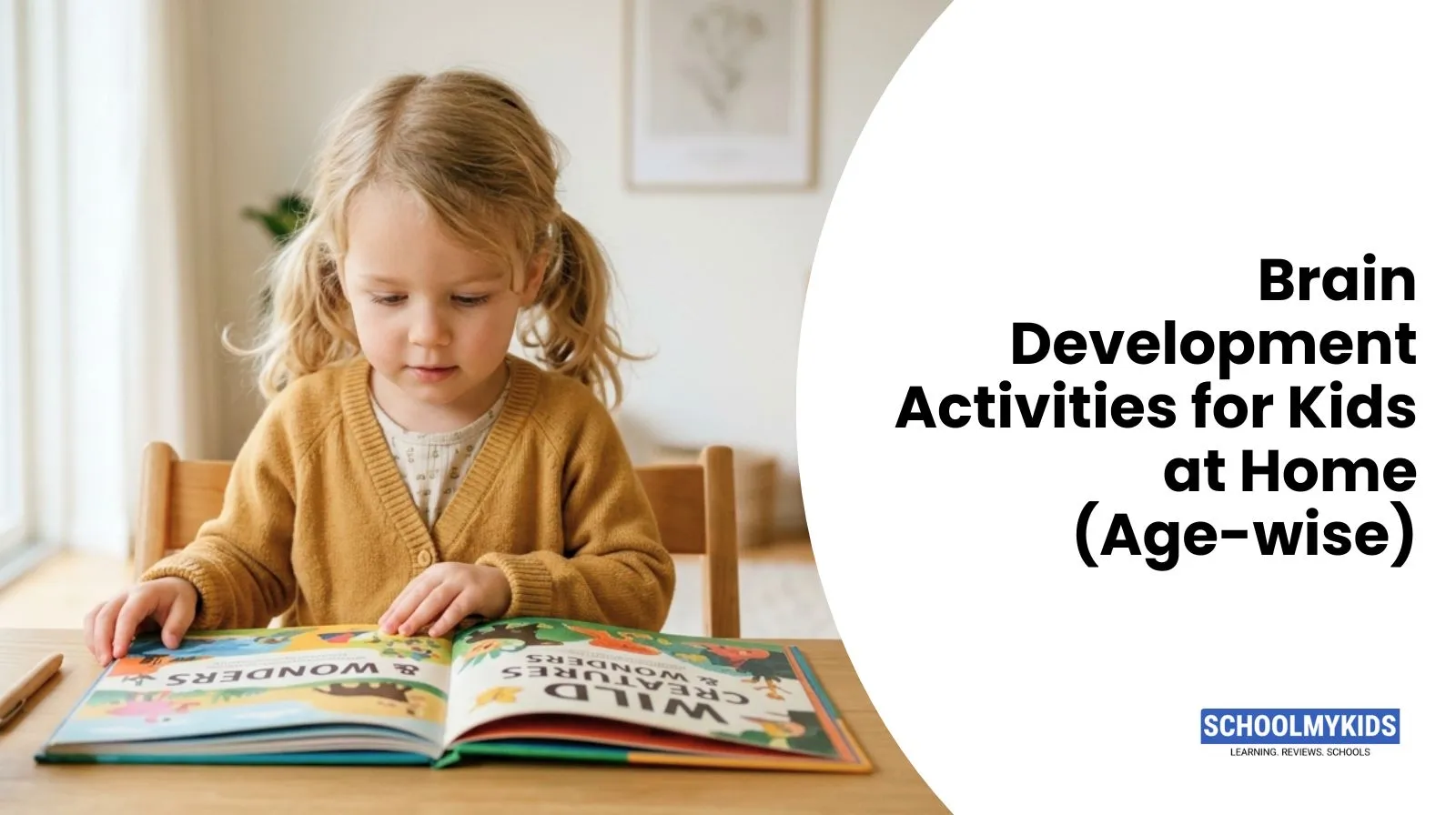
Every parent wants their child to grow smarter, more focused, and confident. But the truth is, optimal brain development doesn’t require expensive gadgets or fancy classes. The most powerful brain development activities for kids happen right at home, through simple, consistent, and engaging interactions.
Modern neuroscience shows that in the early years a child’s brain forms over one million new neural connections every second. By age 3, children have nearly twice as many synapses as adults, making this phase incredibly rich for learning. This process, called neuroplasticity, allows the brain to grow based on experiences, while synaptic pruning removes unused connections and strengthens frequently used ones.
This is why meaningful cognitive activities for children are not just play; they are literally wiring your child’s future potential.
In today’s fast-paced world, where screens often replace real play, it becomes even more important to focus on digital wellness and introduce screen-free learning games for kids that build memory, attention, creativity, and problem-solving skills.
Why Brain Development Activities Matter in Early Childhood
A child’s brain develops most rapidly in the early years, with the brain reaching nearly 90% of its adult size by age 5, and foundational architecture largely established during this period. The first 1000 days (0–3 years) are especially critical.
Serve and Return: A fundamental brain-building interaction where a child initiates (the serve) and a caregiver responds meaningfully (the return). This back-and-forth strengthens neural connections.
According to developmental research, these interactions are the foundation of strong brain architecture.
Key Benefits of Brain Development Activities:
Improves memory and concentration
Enhances executive function skills (focus, self-control, flexibility)
Accelerates vocabulary acquisition and communication abilities
Encourages creativity and imagination
Strengthens emotional intelligence and social skills
Incorporating learning games for kids into daily routines ensures that development happens naturally without pressure or stress.
Age-wise Brain Development Activities for Kids
Different age groups require different stimulation. Along with structured activities, free play, nature-based learning, and family interaction (including fathers and grandparents) play a critical role in child development.
0–2 Years: Sensory and Motor Development Stage
At this stage, babies learn through senses, like touch, sound, sight, and movement. The focus should be on responsive caregiving and safe exploration.
Recommended Activities:
1. Sensory Play (Montessori-Inspired)
Use soft toys, textured fabrics, or rice/dal sensory bins (under supervision)
Supports fine motor skills and sensory awareness
Ensure no choking hazards (avoid very small objects)
2. Talking and Singing
Builds early language pathways
Use both mother tongue and English for bilingual development
3. Peek-a-Boo Games
Helps develop object permanence and early memory
4. Mirror Play
Supports self-recognition and emotional awareness
Development Focus Table
Activity Type | Skill Developed | Example |
|---|---|---|
Sensory Play | Fine motor & sensory skills | Rice/dal or texture play |
Sound Interaction | Language development | Singing rhymes |
Visual Stimulation | Recognition skills | Mirror play |
Responsive Play | Emotional bonding & learning | Serve-and-return interaction |
Free Play | Exploration & curiosity | Child-led play |
Parental Reflection: Which activity made your baby respond the most today?
3–5 Years: Foundation of Learning and Curiosity
This stage builds key cognitive milestones and executive function skills; the brain’s “air traffic control system.”
Recommended Activities:
1. Puzzle Solving
Enhances logical thinking
2. Storytelling Sessions
Use Panchatantra or family stories
Boosts imagination and vocabulary
3. Sorting and Matching Games (Montessori at Home)
Improves classification and memory
4. Role Play
Develops social and emotional understanding
5. Simple STEM Activities for Preschoolers
Encourages curiosity and exploration
Quick Activity Table
Activity | Skill Boosted | Suggested Duration |
|---|---|---|
Puzzles | Logical thinking | 15–20 mins |
Storytelling | Creativity & language | 10–15 mins |
Matching Games | Memory & focus | 10–15 mins |
Free Play | Creativity & self-regulation | Flexible |
Note: Durations are flexible. Focus on engagement and enjoyment rather than strict timing.
These activities strengthen Executive Function, which helps children manage attention, follow instructions, and control impulses.
Parental Reflection: Did your child follow simple multi-step instructions today?
6–8 Years: Skill Building and Logical Thinking
Children now benefit from structured cognitive activities, combined with growth mindset development and nature-based learning.
Recommended Activities:
1. Memory Games
Improves recall and attention
2. Basic Math Games
Strengthens reasoning
3. Reading and Language Play
Rhyming and word games build phonological awareness, critical for reading success
4. DIY Crafts
Enhances creativity and motor skills
5. Growth Mindset Activities
Praise effort, strategies, and persistence
6. Nature-Based Learning
Try a backyard nature scavenger hunt
Encourages observation and curiosity
Brain Skill Mapping Table
Activity | Brain Skill Targeted | Example |
|---|---|---|
Memory Games | Recall & retention | Flashcards |
Math Games | Logical reasoning | Counting exercises |
Reading | Language & comprehension | Storybooks |
Outdoor Play | Physical + cognitive | Nature scavenger hunt |
Parental Reflection: Did your child keep trying after facing a challenge?
9–12 Years: Critical Thinking and Independence
This stage marks a key turning point around age 9 (identified in recent neuroscience as the end of the childhood brain epoch), when the brain completes its phase of rapid growth and heavy synaptic pruning and shifts into a prolonged adolescent phase of refinement and efficiency that supports advanced critical thinking and independence.
Recommended Activities:
1. Strategy Games
Chess, Ludo, and Chor-Sipahi
Improve planning and decision-making
2. Problem-Solving Challenges
Riddles and puzzles
3. Science Experiments at Home
Encourages analytical thinking
4. Journaling
Builds emotional intelligence
5. Focus & Mindfulness Activities
Simple breathing or Pranayama
Advanced Skills Table
Activity | Skill Developed | Type |
|---|---|---|
Chess / Strategy | Strategic thinking | Structured |
Brain Teasers | Problem-solving | Structured |
Journaling | Emotional intelligence | Independent |
Outdoor Play | Physical + cognitive | Unstructured |
Parental Reflection: What problem did your child solve independently today?
Practical Tips for Parents to Boost Child Development
Do’s:
Be consistent with daily interaction
Encourage curiosity and questions
Support bilingual conversations
Prioritize sleep, nutrition, and serve-and-return interactions
Don’ts:
Avoid screen time for children under 18–24 months (except video calls with family)
For ages 2–5, prioritize high-quality, co-viewed content with family conversation; many families find limits under 1 hour per day helpful, but focus on quality and context rather than strict counts.
Avoid over-scheduling
Don’t push academics too early
Human Interaction vs. AI Tools: What Matters Most for Brain Development?
In 2026, AI-powered learning tools are becoming more common. While well-designed AI can support specific skills (such as interactive storytelling for vocabulary), research shows that responsive human interactions remain far more powerful for building strong neural connections, emotional intelligence, and social skills.
AI lacks genuine emotional reciprocity and true “serve and return,” which young brains need most. Young children may struggle to distinguish AI from real human relationships.
Best approach:
Use AI tools only as a limited supplement
Always prioritize real conversations, play, and bonding with caregivers
Common Mistakes Parents Should Avoid
Over-scheduling
Excessive or passive screen use
Ignoring free play
Comparing children
Neglecting sleep and nutrition
Weekly Brain Development Activity Planner
These planners can also act as visual routine charts, helping children reduce cognitive load and build consistency.
Day | Activity Type | Example Activity |
|---|---|---|
Monday | Memory Game | Flashcards |
Tuesday | Creative Play | Drawing |
Wednesday | Logical Thinking | Puzzle solving |
Thursday | Language Skill | Storytelling |
Friday | Outdoor Play | Physical games |
Saturday | Strategy Game | Chess / Ludo |
Sunday | Family + Free Play | Reading + discussion |
Conclusion
Raising smart, confident children doesn’t require complexity; it requires consistency and connection.
By using simple brain development activities for kids, you are building lifelong skills. Daily cognitive activities for children, combined with love and interaction, create the strongest foundation.
Start small. Stay consistent. Make learning joyful.
FAQs
1. What are the best brain development activities for kids at home?
Activities like puzzles, storytelling, and sensory play are effective brain development activities for kids.
2. How often should children do cognitive activities?
Short, engaging sessions (10–20 minutes) daily work best for cognitive activities for children.
3. Are learning games for kids better than mobile apps?
Yes, learning games for kids promote interaction and creativity better than passive apps.
4. At what age should brain development activities start?
From birth, early interaction supports strong child development.
5. Can these activities improve academic performance?
Yes, they improve focus, memory, and reasoning.
6. How can parents balance study and play?
Use learning games for kids to combine fun and learning.







Be the first one to comment on this story.