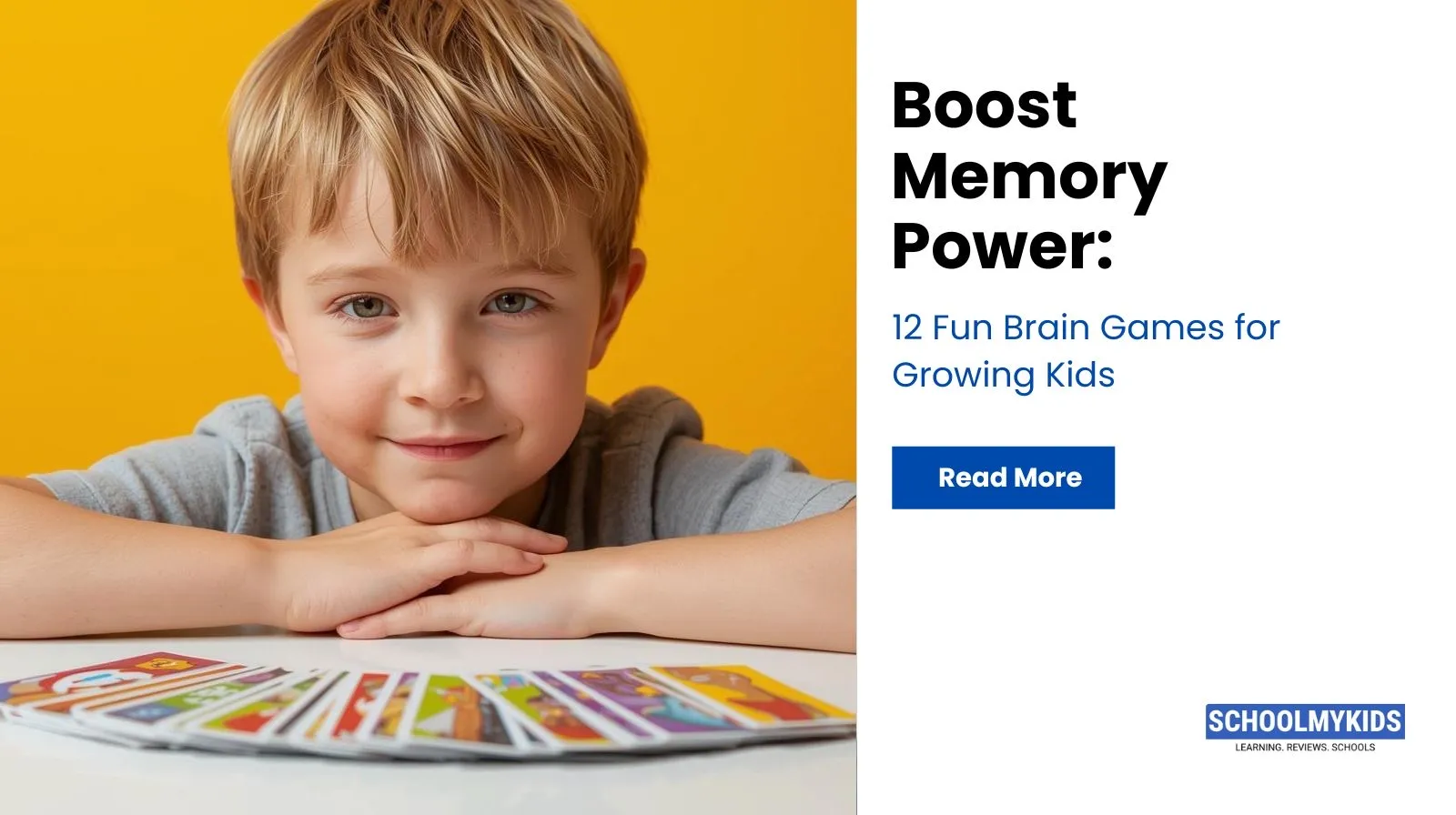
Every Indian parent knows the pressure of a new academic session. With the National Education Policy (NEP 2020) emphasizing critical thinking over rote learning, a child’s ability to focus and retain information is more vital than ever. The good news? Strengthening it does not have to feel like studying. It can look like pure play.
Brain training games stimulate cognitive functions across multiple domains, whether built from repurposed household items or simply played on the living room floor. Most of the best ones cost nothing at all.
This guide walks you through 12 genuinely enjoyable memory games for kids, backed by current research, suited to Indian home settings, and adaptable across different age groups.
Why the Growing Brain Needs More Than Textbooks
When a child engages in mentally stimulating play, their brain actively builds and reinforces connections. Neurotransmitters like dopamine and acetylcholine support motivation, reward, and sustained attention during play. BDNF (Brain-Derived Neurotrophic Factor) is linked to neuroplasticity, helping strengthen connections as part of broader, consistent playful learning rather than any single game in isolation.
It is worth noting that research on brain games shows stronger evidence for near-transfer benefits, meaning improvements on similar tasks, than for far-transfer gains like direct academic performance. While effects can vary by child and activity, consistent, enjoyable mental play supports foundational cognitive skills that indirectly benefit school learning.
Research suggests that regular, engaging mental play may support modest improvements in working memory, attention, and processing efficiency in some children aged 5–12, particularly when activities are varied, enjoyable, and consistent.
Cognitive Skill | Why It Matters for Indian Kids | Games That Build It |
|---|---|---|
Working Memory | May support retention of Maths steps and Hindi grammar | Memory Match, Kim’s Game |
Sustained Attention | Linked to better focus during long lectures and homework | Chess, Jigsaw Puzzles |
Processing Speed | May support quicker information processing during timed tests | Antakshari, Word Chain |
Spatial Reasoning | Promotes stronger geometry and STEM foundations | Tangrams, Rubik’s Cube |
Executive Function | Supports planning and impulse management in class | Chess, Sudoku |
12 Fun Brain Games for Kids to Improve Memory and Focus
1. Memory Match (Concentration Card Game)
Age: 5+ | Difficulty: Beginner
Lay a deck of cards face-down in a grid. Players flip two at a time, trying to find matching pairs. Each failed attempt encourages the brain to update its mental map of card locations. This is one of the most well-supported concentration games for 10 year olds and younger children for building short-term visual memory.
Cognitive benefit: Visual memory, sustained focus, pattern recognition
2. Kim’s Game (The Observation Tray)
Age: 6+ | Difficulty: Beginner to Intermediate
Place 10–15 everyday items on a tray.
Allow 60 seconds for observation.
Cover the tray and ask for a verbal or written list.
Gradually increase the item count as they improve. This game promotes the kind of recall children need for history timelines, science diagrams, and geography maps and costs nothing to set up.
Cognitive benefit: Working memory, recall accuracy, observational sharpness
3. Antakshari
Age: 7+ | Difficulty: Intermediate
One player sings a few lines from any song; the next must begin a song with the last letter of the previous one. Antakshari promotes rapid language retrieval, memory scanning across a wide mental library, and quick decision-making, all under light social pressure that sharpens alertness without stress. A culturally rooted brain booster for kids the whole family enjoys.
Cognitive benefit: Auditory memory, language fluency, quick thinking
4. Chess
Age: 7+ | Difficulty: Intermediate to Advanced
Chess has one of the strongest research bases among strategy-based cognitive games for children. Recent research continues to associate regular chess practice with improvements in visuospatial working memory, planning skills, and aspects of mathematical reasoning in children. Holding multiple possible moves in mind simultaneously makes this one of the most demanding brain exercises for students, with the added benefit of building patience and resilience.
Cognitive benefit: Strategic working memory, foresight, analytical thinking
5. Jigsaw Puzzles
Age: 4+ | Difficulty: Beginner to Intermediate
Start with 24–48 pieces for younger children, scaling to 500 pieces as they grow. Puzzles reward persistence rather than speed. A child who keeps trying when a piece does not fit is building executive function alongside spatial memory. A reliable, screen-free cognitive development game for all ages.
Cognitive benefit: Visual-spatial memory, focused attention, problem-solving
6. Sudoku
Age: 8+ | Difficulty: Intermediate
Begin with a 4×4 grid before moving to the standard 9×9. Sudoku promotes logical reasoning and systematic number recognition skills that align well with the broader problem-solving and numeracy emphasis of NEP 2020 and NCF 2023. An excellent quiet-time concentration activity for 12-year-olds and above.
Cognitive benefit: Logical memory, number retention, systematic reasoning
7. Story Chain
Age: 5+ | Difficulty: Beginner
One person starts a story with one sentence. The next adds a sentence and must first remember everything said before. A natural dinner-table activity that builds sequential working memory while strengthening the parent-child bond through shared creativity.
Cognitive benefit: Sequential memory, creative thinking, listening skills
8. Word Chain (Shabd Khel)
Age: 6+ | Difficulty: Beginner
One player says a word; the next says a word starting with its last letter, with no repeats allowed. Playable in Hindi, English, or any regional language. A fast-paced focus game for kids that works beautifully in the car, on a walk, or at the dining table.
Cognitive benefit: Vocabulary recall, auditory memory, mental agility
9. Tangrams
Age: 7+ | Difficulty: Intermediate
Seven geometric pieces, hundreds of possible pictures. The child recreates silhouettes using all seven shapes, building spatial visualization skills that translate directly to CBSE geometry and STEM reasoning. Like Sudoku, Tangrams align with the broader NEP 2020 emphasis on experiential learning, visual reasoning, and problem-solving.
Cognitive benefit: Spatial memory, geometric reasoning, visual problem-solving
10. Riddles and Brain Teasers
Age: 6+ | Difficulty: Beginner to Intermediate
A good riddle asks a child to hold multiple clues in working memory, test different hypotheses, and resist the urge to guess too fast. It is essentially informal inhibitory control training dressed up as fun. One riddle each morning quietly builds the habit of sitting with a problem rather than immediately asking for the answer.
Cognitive benefit: Working memory, lateral thinking, reasoning under pressure
11. Simon Says
Age: 4+ | Difficulty: Beginner
Children must follow commands only when the correct phrase is used, building impulse control and cognitive flexibility at the same time. One of the most accessible concentration games for 10 year olds and below, especially for children still developing self-regulation.
Note on attention spans: While not a clinical intervention, games like Simon Says and Chess offer enjoyable inhibitory control practice. They are not substitutes for professional support, therapy or specialist guidance, but may complement it. Always consult a child development specialist if you have specific concerns.
Cognitive benefit: Auditory memory, impulse control, listening focus
12. The Rubik’s Cube
Age: 8+ | Difficulty: Advanced
Solving the cube demands memorized algorithms, spatial reasoning between moving parts, and mental persistence through frustration. Some school-based studies suggest that Rubik’s Cube training may improve spatial reasoning and mental rotation skills in children. Start with a 2×2 before the 3×3. Even one learned algorithm builds real sequential memory.
Cognitive benefit: Spatial memory, algorithmic recall, resilience
BONUS. The 5-Letter Word Guess (Wordle Style)
Age: 8+ | Difficulty: Intermediate
Choose a secret 5-letter word and write it on a hidden slip of paper.
Your child writes their first guess.
Mark letters: correct position (✓), wrong position (~), not present (✗).
They use that feedback to narrow the answer across up to 6 attempts.
A trending brain exercise for students that demands deductive reasoning, vocabulary retrieval, and working memory simultaneously, making it an ideal concentration activity for 12-year-olds and older. It teaches children to reason from incomplete information, a skill that serves them well beyond any classroom.
Cognitive benefit: Deductive logic, vocabulary memory, reasoning under constraint
Screen Time vs. Brain Games: Finding the Right Balance
Traditional screen-free activities consistently show advantages in social-emotional development and sustained engagement, primarily because they involve real human interaction, unpredictability, and intrinsic motivation. That said, high-quality educational apps can complement offline play when they are interactive, age-appropriate, and used with parental involvement.
Activity Type | Recommended Daily Time | Examples |
|---|---|---|
Screen-free brain games | 20–30 minutes | Chess, Kim’s Game, Antakshari |
Creative offline play | 30–45 minutes | Tangrams, Story Chain, Puzzles |
Educational screen time | Up to 1 hour | Verified learning apps |
Passive screen time | Limited | TV, casual gaming |
Making Brain Games a Daily Habit
Time of Day | Suggested Game | Duration |
|---|---|---|
Morning (before school) | Riddle or Sudoku | 5–10 min |
After school | Jigsaw or Memory Match | 15–20 min |
Evening (family time) | Antakshari or Word Chain | 15–20 min |
Weekend | Chess, Tangrams, or Rubik’s Cube | 30–45 min |
Three principles that make the biggest difference: consistency beats duration: short regular sessions outperform long infrequent ones every time; let your child choose sometimes because self-directed play drives deeper engagement; and rotate game types to challenge memory, language, spatial thinking, and logic in turns rather than repeating the same activity.
Quick Reference: Games by Age Group
Age Group | Best Games | Primary Skill |
|---|---|---|
4–6 years | Simon Says, Jigsaw (24 pcs), Kim’s Game | Basic memory, listening |
6–8 years | Word Chain, Story Chain, Tangrams | Language memory, sequencing |
8–10 years | Chess, Sudoku, Memory Match | Working memory, strategy |
10–12 years | Rubik’s Cube, Antakshari, Riddles | Spatial memory, retrieval |
12 and above | Wordle-Style, Chess, Sudoku | Deductive logic, concentration |
FAQ: Memory Games and Brain Development for Kids
Q1. At what age should I start memory games for kids?
Simple activities like peek-a-boo and shape-matching work from 18 months. Structured memory games for kids like Memory Match and Kim’s Game are ideal from age 5, with complexity increasing as the child grows.
Q2. How do concentration games for 10 year olds differ from games for younger children?
Older children benefit from multi-rule, strategic games like Chess, Sudoku, and Rubik’s Cube. Younger children do better with simpler, repetition-based games. The key shift is from single-step recall tasks to multi-step reasoning challenges.
Q3. How long should a child play brain games each day?
15–20 minutes of focused play, three to five times a week, is a practical starting point supported by current research. Short and consistent always outperforms long and irregular.
Q4. Can brain games help with ADHD or short attention spans?
Games like Simon Says and Chess offer informal inhibitory control practice in a low-pressure setting. However, they are not clinical treatments and should not replace professional interventions like therapy or specialist support. Consult a qualified child development specialist if you have specific concerns.
Q5. Are these games aligned with CBSE or ICSE curriculum goals?
Yes. Tangrams and Sudoku align with the broader problem-solving and numeracy goals emphasized in NEP 2020 and NCF 2023. Chess is already being adopted in several CBSE-affiliated schools as a recognized tool for cognitive development, reflecting its well-evidenced benefits.
A Final Word for Indian Parents
In a country where curriculum intensity is high and academic competition arrives early, the most resilient learners are those who have built strong cognitive foundations through varied, joyful mental engagement. Memory is not just built through revision and textbooks. It grows game by game, riddle by riddle, move by move, at the dinner table, in the back of an auto, on a quiet Sunday afternoon.
Start with just one game from this list this week. The results may well surprise you.
If you have ongoing concerns about your child’s memory, attention, learning, or behavior, consult a qualified pediatrician, child psychologist, or educational specialist for individualized guidance.





Be the first one to comment on this story.