Every Indian parent has sat across from their child during exam season, watching them struggle to recall a formula they studied just the night before. You wonder, is my child not trying hard enough?
The answer often has nothing to do with effort. It has everything to do with how the brain is being trained.
Modern neuroscience confirms that the brain is neuroplastic. It physically reshapes itself based on stimulation. Targeted brain exercises for kids don’t just improve test scores; they build the mental architecture for lifelong learning. And in 2026, with India’s shift toward NEP 2020 competency-based learning, this matters more than ever.
Why Brain Training Matters for Children in the Indian Education System
India has over 250 million school-going children navigating CBSE, ICSE, and state boards and eventually competitive exams like JEE, NEET, and CUET. What separates children who thrive from those who burn out is rarely raw talent. It is cognitive resilience and research consistently shows it can be built through structured cognitive development activities.
Multiple peer-reviewed reviews confirm that varied cognitive stimulation during childhood produces lasting improvements in working memory, attention, and fluid reasoning. Crucially, these gains are most meaningful when activities are consistent, varied, and enjoyable, and not when chasing a number on an IQ test.
Two things parents often overlook: You cannot train a malnourished or sleep-deprived brain. Ensure your child gets adequate Omega-3s (walnuts, flaxseeds, fatty fish) and stays well-hydrated, as mild dehydration can noticeably impair attention and cognitive performance in children. In 2026, digital hygiene also matters deeply: unmanaged screen time directly undermines memory consolidation. Use the 20-20-20 rule (every 20 minutes, look 20 feet away for 20 seconds) and limit blue light exposure before bedtime.
Quick Overview: 15 Best Brain Exercises for Kids
# | Exercise | Primary Benefit | Best Age | Time Needed |
|---|---|---|---|---|
1 | Dual N-Back Training | Working Memory | 8+ | 15 min/day |
2 | Feynman Technique (Teach-Back) | Deep Retention | 7+ | 15 min/day |
3 | Memory Palace | Long-term Recall | 10+ | 10 min/day |
4 | Chess | Executive Function | 6+ | 45 min/week |
5 | Mindful Box Breathing | Attention Control | 5+ | 5–10 min/day |
6 | Jigsaw Puzzles | Spatial Reasoning | 4–14 | 20 min/day |
7 | Learning an Instrument | Verbal IQ + Memory | 5+ | 20 min/day |
8 | Bilingual Word Challenges | Cognitive Flexibility | 4+ | 5 min/day |
9 | Logic Riddles & Lateral Thinking | Analytical Reasoning | 6+ | 10 min/day |
10 | Physical Exercise | Memory Consolidation | All ages | 30 min/day |
11 | Cooking Together | Executive Function | 5+ | 30 min/week |
12 | Drawing From Memory | Visual Recall | 5–13 | 15 min/day |
13 | Strategy Board Games | Working Memory | 6+ | 45 min/week |
14 | Reflective Journaling | Comprehension + EQ | 8+ | 10 min/day |
15 | Scavenger Hunts With Logic Clues | Applied Reasoning | 6+ | 20 min/week |
15 Cognitive Development Activities for Kids: Explained
1. Dual N-Back Training
A working memory task where your child tracks a sequence of visual and auditory stimuli and identifies matches from steps back. Research originating from the University of Michigan’s Jaeggi Lab established this as one of the most studied cognitive games for children. It primarily enhances task-specific working memory, a foundational skill for academic performance. It is worth noting that while working memory gains are consistent, the transfer to broader fluid intelligence or general IQ remains debated among researchers and should not be overstated.
How to do it: Use free tools like N-Back 10. Start at the 1-back level and move up only when your child reaches an 80% accuracy rate. Age: 8+
2. The Feynman Technique (Teach-Back Method)
Known in cognitive psychology as the Protégé Effect, this is the gold standard for deep retention. Research in cognitive psychology and learning sciences consistently shows that teaching concepts to others leads to substantially better retention than re-reading alone, with studies comparing teaching to passive methods often finding meaningful differences in how deeply material is encoded and recalled.
How to do it: After every study session, ask your child: “Explain this to me like I’m five years old.” The moment they struggle to explain something simply is the moment they discover exactly what they haven’t truly understood. Age: 7+
3. The Memory Palace Technique
Children mentally place information inside a familiar location, like their bedroom, school corridor, or your home. The method of loci is one of the most well-documented mnemonic strategies in cognitive science, supported by studies in learning and memory spanning decades. Research, including more recent work through 2025, continues to confirm its effectiveness for improving recall of sequential and abstract information, though child-specific longitudinal data remains an area of ongoing study.
How to do it: Ask your child to mentally place each chapter event in a different room of your home. To recall during exams, they simply take a mental walk through the space. Age: 10+
4. Strategic Chess Play
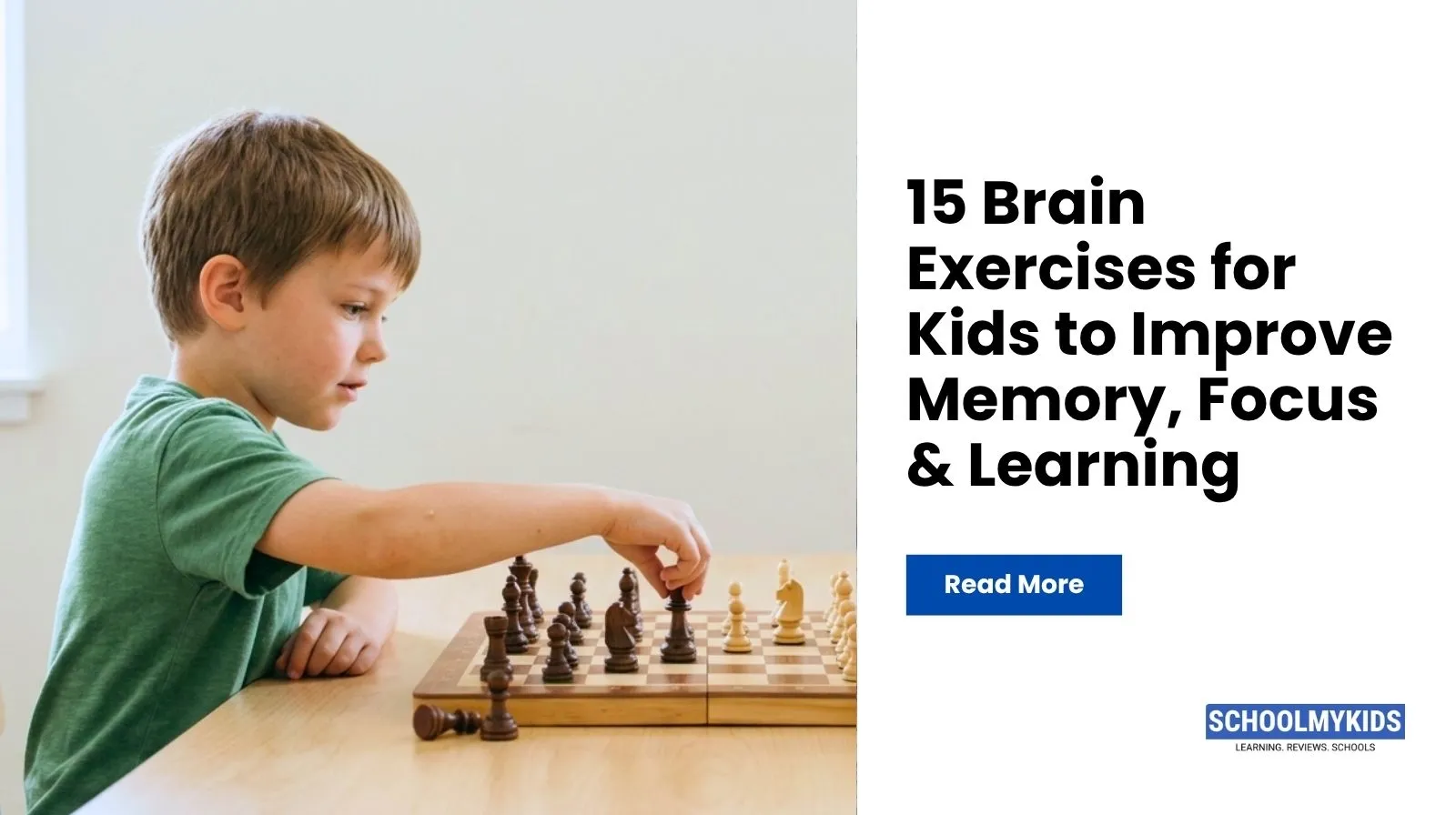
Chess is a structured lesson in executive function as it includes planning, impulse control, consequence evaluation, and adaptive thinking. Studies supported by research in developmental psychology and Indian academic contexts show that regular chess play improves inhibitory control in children, the ability to think before acting, alongside visuospatial working memory and attention. Recent studies from 2023–2025 on chess in school-age children support these findings.
How to do it: Use a free chess app or a physical board. The goal is not winning. It is thinking several moves ahead. Even two 45-minute sessions per week produce measurable gains. Age: 6+
5. Mindful Box Breathing
Stress actively suppresses memory formation. Breathing practices, including box breathing and diaphragmatic techniques, are supported by research showing improvements in attention, mood, physiological arousal, and stress reduction in both children and adults. Studies including those published in Frontiers in Psychology confirm that short mindful breathing sessions before cognitive tasks improve sustained attention and reduce errors, making this one of the simplest and most accessible memory boosting activities available to any family.
How to do it: Before homework, practice together: inhale for 4 counts, hold for 4, exhale for 4, hold for 4. Eight to ten cycles. Make it a non-negotiable pre-study ritual. Age: 5+
6. Jigsaw Puzzles and Spatial Reasoning
One of the most underrated cognitive development activities for young children. Research, including well-cited findings in Psychological Science, consistently links early spatial play such as puzzles and building blocks to stronger spatial reasoning, which in turn correlates with mathematics and STEM performance in later years. The evidence base here is among the most consistent across developmental psychology literature.
How to do it: Match complexity to age. 60 pieces for a 6-year-old, 500+ for a 12-year-old. Resist helping too quickly. The productive struggle is where the growth happens. Age: 4–14
7. Learning a Musical Instrument
Music is among the most comprehensive brain workouts available to a child. It increases the volume of the corpus callosum, the bridge between the brain’s two hemispheres, improving coordination between analytical and creative thinking. Longitudinal and cross-sectional research on music training in children, including studies published through 2025, consistently shows gains in verbal memory, working memory, and auditory processing. Broader executive function benefits are also well-supported.
How to do it: Indian classical instruments like the tabla, harmonium, or sitar are exceptional choices. Even a keyboard works. Three 20-minute sessions weekly is enough, as consistency matters far more than duration. Age: 5+
8. Bilingual Word Challenges
India’s multilingual environment is a natural cognitive asset. Research, including work from the University of Edinburgh and multiple cross-linguistic studies, confirms that children who regularly switch between two or more languages demonstrate stronger cognitive flexibility, attention switching, and executive function. These advantages extend to theory of mind and academic adaptability. This is one of the most culturally natural memory boosting activities for Indian families.
How to do it: Each morning, introduce one new word in English and your regional language. Use it in conversation three times during the day. Ask your child to form a sentence at dinner. Zero cost, high impact. Age: 4+
9. Logic Riddles and Lateral Thinking
Focus always on the process, never just the answer. Try: “A man pushes his car to a hotel and tells the owner he’s bankrupt. Why?” (He’s playing Monopoly.) These exercises build divergent thinking and train children to consider multiple solution pathways simultaneously, a skill increasingly valued in NEP 2020’s competency framework and directly relevant to competitive exam reasoning sections.
How to do it: Ten minutes before bedtime. Discuss the reasoning aloud. If your child gets it wrong, ask: “What made you think that?” The metacognitive reflection is the real exercise. Age: 6+
10. Physical Exercise: The Brain’s Most Powerful Tool
The most overlooked brain exercise for kids is also the most evidence-backed. Aerobic physical activity releases BDNF (Brain-Derived Neurotrophic Factor), often described as “Miracle-Gro” for the brain, which directly supports neuron growth and memory consolidation. Reviews in respected journals including The Lancet Child & Adolescent Health consistently confirm that 30 minutes of daily aerobic movement produces meaningful cognitive benefits in growing children. This is non-negotiable.
How to do it: Skipping, cycling, dancing, or any activity that raises the heart rate consistently. Age: All
11. Multi-Step Cooking Together
Cooking is a genuine executive function workout. Following a recipe requires working memory (remembering the steps), inhibitory control (waiting for the right moment), and cognitive flexibility (adapting when something goes wrong). Harvard’s Centre on the Developing Child identifies real-world multi-step tasks as among the most effective builders of executive function; the cluster of skills governing planning, self-regulation, and problem-solving in children.
How to do it: Let your 7-year-old measure ingredients. Ask your 10-year-old to follow a simple recipe independently. Encourage your teenager to plan and cook one meal per week. Age: 5+
12. Drawing From Memory
Show your child a detailed image for 60 seconds. Remove it. Ask them to draw everything they remember. This is a practical application of retrieval practice, one of the most robust findings in memory science, where actively reconstructing information from memory produces significantly stronger long-term retention than passive re-exposure. It strengthens what psychologists call the visual-spatial sketchpad.
How to do it: Use photographs, maps, or diagrams from their textbooks. Debrief together. What did they capture? What did they miss? Track improvement over weeks. Age: 5–13
13. Strategy-Based Board Games
Games like Catan, Blokus, or Indian classics like Aadu Puli Aattam (Goat and Tiger Game) require long-term planning, resource management, and Theory of Mind, the ability to anticipate what an opponent will do next. Research in child development supports that regular strategy board game play strengthens working memory and social-cognitive skills simultaneously, making these among the most enjoyable cognitive games for children available to Indian families.
How to do it: Elevate your existing family game nights intentionally. Discuss strategies before and after. Let children lose and reflect on why. Age: 6+
14. Reflective Journaling
Expressive writing clears mental clutter, freeing up working memory for academic tasks. Research supported by the American Psychological Association indicates that regular journaling in children improves working memory, emotional regulation, and academic comprehension, particularly in language-based subjects. The act of writing by hand also engages neural pathways that typing does not.
How to do it: Give your child a dedicated physical notebook. Ten minutes every evening. No grammar corrections, no parental reading unless invited. The privacy is part of what makes it work. Age: 8+
15. Scavenger Hunts With Logic Clues
Instead of “Find the spoon,” try “Find the object that reflects light but cannot create it.” This forces children to retrieve semantic knowledge and apply it to their real environment, bridging classroom learning with applied reasoning. It builds cognitive flexibility and supports exploratory learning and cognitive flexibility, all in a completely screen-free format.
How to do it: Design weekly home scavenger hunts using curriculum-linked clues. Science, geography, and language concepts all work beautifully. Age: 6+
Brain Exercises by Age Group
Age Group | Top Recommended Activities | Key Skill Targeted |
|---|---|---|
3–5 years | Puzzles, Storytelling, Drawing | Visual memory, language |
6–8 years | Chess, Cooking, Logic Riddles | Reasoning, planning |
9–12 years | Memory Palace, Journaling, Feynman Technique | Retention, comprehension |
13–15 years | Dual N-Back, Bilingual Challenges, Exercise | Fluid reasoning, focus |
Cognitive Benefits Mapped to Best Activities
Cognitive Skill | Best Exercise | Evidence Base |
|---|---|---|
Working Memory | Dual N-Back Training | Jaeggi Lab, University of Michigan |
Long-term Recall | Memory Palace + Feynman Technique | Memory and learning sciences literature |
Spatial Reasoning | Chess + Jigsaw Puzzles | Psychological Science + developmental research |
Sustained Attention | Mindful Box Breathing | Frontiers in Psychology + breathing studies |
Memory Consolidation | Physical Exercise | Lancet Child & Adolescent Health reviews |
Cognitive Flexibility | Bilingual Challenges + Board Games | University of Edinburgh + cross-linguistic research |
What Most Parents Get Wrong
Most parents focus exclusively on study hours while neglecting the brain’s need for varied stimulation, physical movement, and adequate recovery. These memory boosting activities are not distractions from academics; they are the foundation that makes academic learning stick.
Results vary by child, consistency, and baseline ability
Many benefits are near-transfer initially; task-specific gains build toward broader reasoning improvements over months, not days
For children with diagnosed learning difficulties, consult a child psychologist or pediatrician before introducing a new cognitive program
No exercise on this list replaces professional support where it is genuinely needed
Start with two or three exercises that fit naturally into your family’s routine. The child who uses the Memory Palace for history, plays chess on weekends, and uses the Feynman Technique after studying is receiving deeper brain training than hours of passive revision could ever provide.
Pick one exercise. Start this week. Your child’s brain will do the rest.
Frequently Asked Questions
Q1. At what age should brain exercises for kids begin?
Cognitive development activities can begin as early as age 3 with puzzles and storytelling. The brain is most neuroplastic in early childhood, but meaningful gains are achievable well into adolescence with consistent practice.
Q2. How long before cognitive development activities show results?
Most research on cognitive training in children points to noticeable improvements in attention and working memory within 4–8 weeks of consistent practice. Broader reasoning gains typically emerge over three to six months.
Q3. Can these cognitive games for children genuinely improve IQ?
Structured training improves specific cognitive skills, particularly working memory and fluid reasoning. However, IQ is a narrow measure of intelligence. The more meaningful goal is building a more adaptable, resilient thinker. Focus on building consistent habits rather than chasing a score.
Q4. Are digital apps effective for memory-boosting activities, or is offline better?
Both work when used intentionally. Offline activities carry the added benefit of reducing screen dependency, which is a growing concern among Indian pediatricians and increasingly relevant in managing digital detox for children in 2026.
Q5. My child has a learning difficulty. Are these exercises still appropriate?
Many of these activities are used in therapeutic and school support settings. Always consult your child’s psychologist or pediatrician before introducing a new cognitive program if professional support is already in place.
Explore more expert parenting resources, child development guides, and learning strategies built for the Indian education system, right here on SchoolMyKids.







Be the first one to comment on this story.