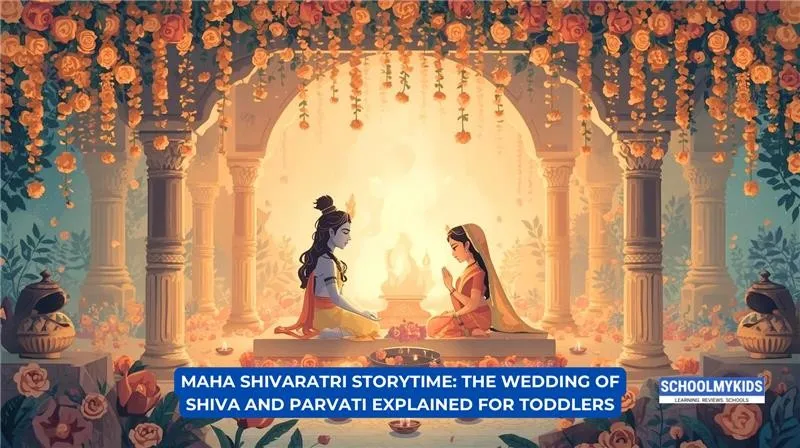
Maha Shivaratri is not just a festival. It is a night filled with faith. With devotion. With quiet prayers. It is the night we remember Lord Shiva. It is also the beautiful day when Shiva and Parvati were united in marriage.
When we tell this story to our kids, we are not just sharing a tale. We are passing on our roots. Our values. Our culture.
So, let us explore how to tell it in a way they can feel. And remember.
What Is Maha Shivaratri?
Maha Shivaratri means “The Great Night of Shiva.” On this night, devotees pray to Lord Shiva. They stay awake. They chant his name. Some visit temples. Some fast. Some simply sit quietly and pray from the heart.
It is believed that on this night, Lord Shiva performs his divine dance, called Tandav. This dance shows that life has three parts: creation, preservation, and destruction. Everything in the world follows this cycle.
Many also believe this is the sacred night when Shiva and Parvati got married. It is the union of strength and kindness. Of calmness and love.
The First Story: Sati’s Love
Long ago, there was a king named Prajapati Daksha. His daughter was Sati. Sati was a form of Goddess Shakti. From a young age, she loved Lord Shiva deeply.
But Daksha did not like Shiva. He thought Shiva was strange. Shiva lived simply. He wore ashes. He sat in deep meditation in the Himalayas. He did not care for gold or grand palaces.
Still, Sati chose Shiva. She married him and went to live with him on Mount Kailash.
One day, Daksha held a big yagya. A grand prayer ceremony. He invited everyone. But he did not invite Shiva or Sati.
Sati felt hurt. She went to the ceremony anyway. But there, her father insulted Shiva in front of everyone.
Sati could not bear the disrespect toward her husband. She felt deeply sad and gave up her life in the fire of the yagya.
This is a heartbreaking moment where you get to teach your kids, “Never insult someone. Words can hurt deeply.”
Shiva was heartbroken. He went into deep meditation. He withdrew from the world.
The Birth of Parvati
Time passed.
Sati was born again as Parvati, the daughter of the mountain king Himavan. From childhood, Parvati felt a deep love and devotion for Shiva.
A wise sage, Narada, told her that she was born to marry Shiva. But Shiva was still in meditation.
Parvati decided she would pray and do tapasya. Tapasya means deep prayer and discipline. She waited. She stayed patient. She did not give up.
For years, she prayed with full faith.
Shiva Tests Parvati
The gods needed Shiva to return. A powerful demon named Tarakasura was troubling the world. It was said that only Shiva’s son could defeat him.
The gods even sent Kamadeva, the god of love, to wake Shiva from meditation. Shiva opened his third eye in anger, and Kamadeva was burnt to ashes.
Later, Shiva decided to test Parvati’s devotion.
He came to her disguised as a simple hermit. He spoke badly about Shiva. He tried to change her mind.
But Parvati did not listen. She stood firm. She said she trusted Shiva.
Shiva smiled. He showed his true form. He was pleased. He agreed to marry her.
The Divine Wedding
The wedding day arrived.
Shiva came to the palace with his unique wedding procession. He had snakes around his neck. His body was covered in ash. His hair was long and matted. His companions were ghosts and sages.
Parvati’s family was shocked at first. They were scared.
Seeing this, Parvati gently prayed to Shiva to appear in a softer form so her family would not be afraid. Shiva agreed. He appeared as a handsome groom.
And so, Shiva and Parvati were married with joy and blessings.
This day is celebrated as Maha Shivaratri.
A Beautiful Message About Balance
There is also a story that when everyone rushed to the Himalayas to see the wedding, the earth tilted because of the crowd.
So Shiva asked Sage Agastya to go to the south and balance the earth.
Even in celebration, there must be balance. That is another gentle lesson.
What Values Can We Teach Our Toddlers?
When we sit with our kids and tell this story, here are the simple values they can carry:
- Respect: Never insult others.
- Patience: Good things take time.
- Faith: Believe in what is right.
- Simplicity: Shiva lived simply. That is a strength.
- Devotion: Parvati never gave up.
- Balance: Life needs harmony.
You can even make it easy for them: “Shiva teaches us to stay calm. Parvati teaches us to stay strong.”
How to Make It Memorable for Toddlers
Keep it short. Use soft voices. Repeat key lines.
You can say: “Who stayed patient?” Let them answer: “Parvati!”
“Who stayed calm?” They will smile and say: “Shiva!”
Light a small diya together. Offer a flower. Chant “Om Namah Shivaya” slowly with them.
Let them feel the peace.
Conclusion
Our children may not remember every detail. But they will remember the feeling. The warmth. The faith in your voice.
Maha Shivaratri is not about fear. It is about love. It is about devotion. It is about the union of two divine energies for the good of the world.
When we tell this story with respect and emotion, we are planting seeds. Seeds of culture. Seeds of faith. Seeds of values.
And one day, those seeds will bloom.
Har Har Mahadev.


Be the first one to comment on this story.