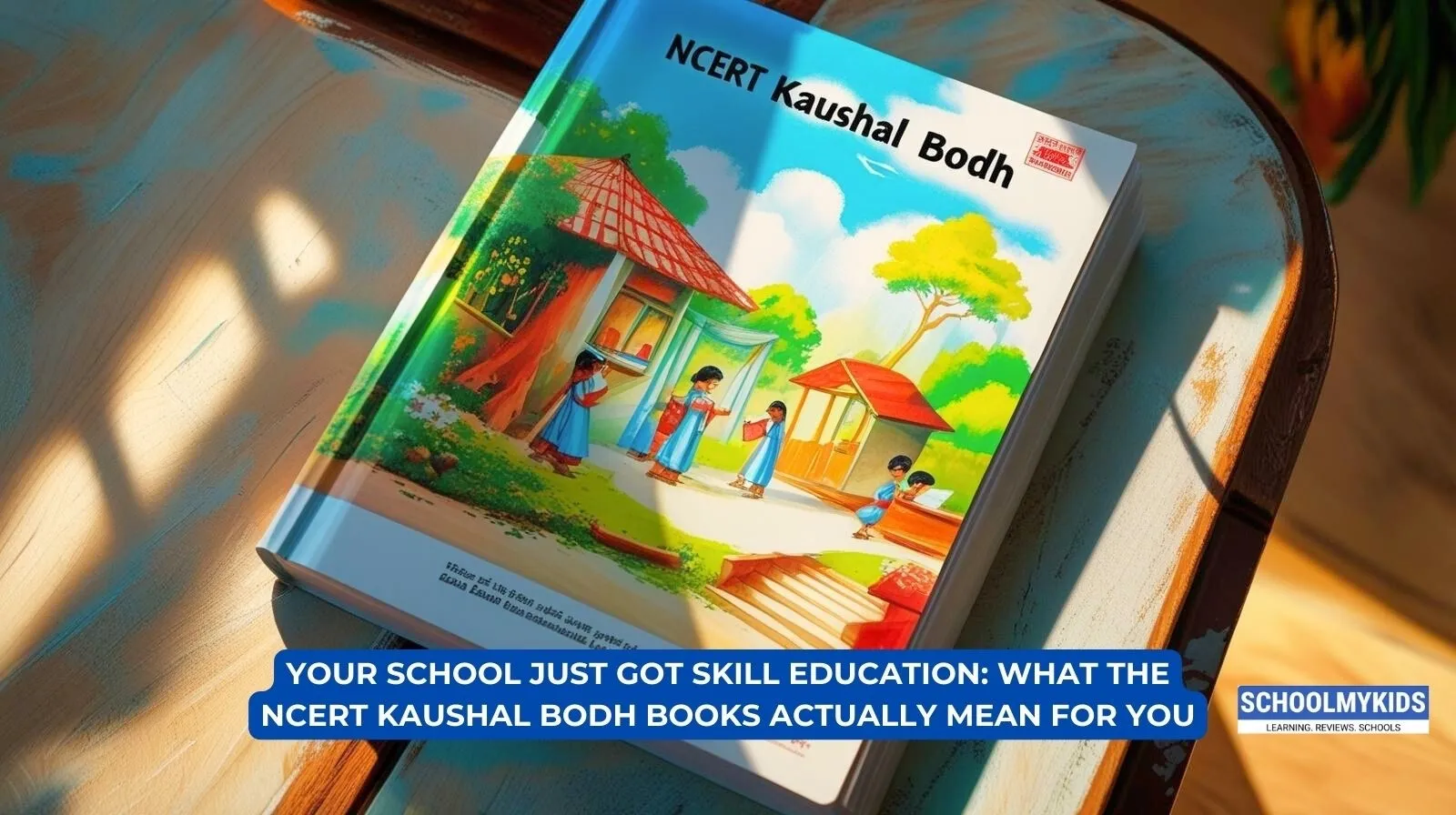
If you're in Class 6, 7, or 8 right now, there's a good chance your school has started talking about something called "Kaushal Bodh." Maybe a teacher mentioned it. Maybe you saw a new textbook sitting on the shelf. Maybe you have absolutely no idea what's going on, and that's okay.
What Is Kaushal Bodh?
Kaushal Bodh is a set of activity-based textbooks developed by NCERT, the same organisation that makes your regular school textbooks. There's one book each for Classes 6, 7, and 8.
The name itself gives you a hint. "Kaushal" means skill. "Bodh" means understanding or awareness. So together, it's basically a structured way to learn skills, not through reading chapters and memorising answers, but through actually doing things.
Think of it less like a textbook and more like a guided project workbook.
Why Is This Happening Now?
This is directly connected to the National Education Policy (NEP) 2020, which pushed for a big shift in how Indian schools teach. The idea is simple: school shouldn't just be about sitting, listening, and writing exams. It should also prepare you for the real world.
For years, "skill education" was something schools said they'd do but often didn't prioritise. CBSE has now made it mandatory for Classes 6 to 8 starting from the 2025–26 academic session. To make sure schools actually implement it properly, CBSE rolled out teacher training programmes (called Capacity Building Programmes or CBPs) from January 5, 2026, onwards, so your teachers have been getting prepared for this too.
What Will You Actually Do in These Classes?
Forget worksheets. Kaushal Bodh is about projects. Each student is expected to complete three projects per year, one from each of these three areas:
1. Working with Life Forms: This includes things like growing a kitchen garden, maintaining a nature journal, working with medicinal plants, or setting up a plant nursery.
2. Working with Materials and Machines: Think carpentry, home automation, tie-and-dye, animation, game creation, or even hydroponics (growing plants without soil).
3. Working in Human Services: This covers projects like cooking without fire, creating a family health handbook, storytelling with puppets, or water audits in your community.
By the time you finish Class 8, you'll have completed nine projects across these three areas. That's nine real, hands-on experiences and not just nine chapters read and forgotten.
What Does Each Class Focus On?
Each Kaushal Bodh book has a slightly different flavour:
- Class 6 is about creativity and green skills. You'll be introduced to things like kitchen gardens, school museums, and basic digital projects.
- Class 7 adds layers of ecological awareness, gender sensitivity, and digital skills. Projects like creating an AI assistant, tie-and-dye, or storytelling with puppets sit alongside more traditional skills.
- Class 8 goes deeper into real-world problem solving, including hydroponics, carpentry, home automation, and water audits. You're expected to build things, fix things, and think through actual challenges.
All three books also weave in India's traditional knowledge systems and local cultural context, so the learning feels connected to where you actually live, not some faraway classroom example.
How Much Time Will This Take?
Your school is expected to set aside about 110 hours a year for Kaushal Bodh; roughly five periods a week. The suggested format is two back-to-back periods, twice a week.
This isn't meant to be squeezed into random free periods. It's a proper, scheduled part of your timetable, just like Maths or Science.
Will This Be Graded?
Yes, and here's how:
| Assessment Type | Weightage |
| Written test | 10% |
| Viva / Presentation | 30% |
| Activity book | 30% |
| Portfolio | 10% |
| Teacher observation | 20% |
Notice that the written test is the smallest part. Most of your marks come from what you actually do, like your activity book, how you present your work, and how your teacher observes your process. This is a very different kind of evaluation.
Many schools are also expected to end the year with a Kaushal Mela. It is basically a skill fair where students showcase their projects. Think science exhibition, but for all kinds of skills.
Who Will Teach These Classes?
Your existing subject teachers will most likely take these classes, especially those whose subjects connect to the project themes. Schools can also bring in local artisans, farmers, or industry experts for demonstrations. If your school has a vocational teacher, they'll support the work too.
This isn't an add-on subject dumped on one teacher. The model is designed so that multiple teachers can jointly run these activities.
A Few Common Questions Students Have
"Do I have to carry a separate book?" Yes. You'll need the NCERT Kaushal Bodh textbook for your class. Teachers have been asked to bring theirs to training sessions too, so the whole system is built around the actual book.
"What if my school doesn't have the resources for some of these projects?" The books are designed keeping local resources in mind. Schools can also design their own projects as long as they follow NCERT's guidelines.
"Is this just for government schools?" No. CBSE has sent this mandate to all affiliated schools, both private and government.
Conclusion
For a long time, skill-based learning in Indian schools was treated like optional extra credit; nice to have, but not really serious. Kaushal Bodh is CBSE and NCERT's way of saying that this is serious now.
If you're in Classes 6 to 8, you're actually part of the first generation of students for whom this is a real, graded, structured part of school. That's worth understanding, and maybe even getting a little excited about.
Because learning to grow something, build something, or present your own work to an audience is going to matter a lot more in life than most things that are covered in exams.



Be the first one to comment on this story.