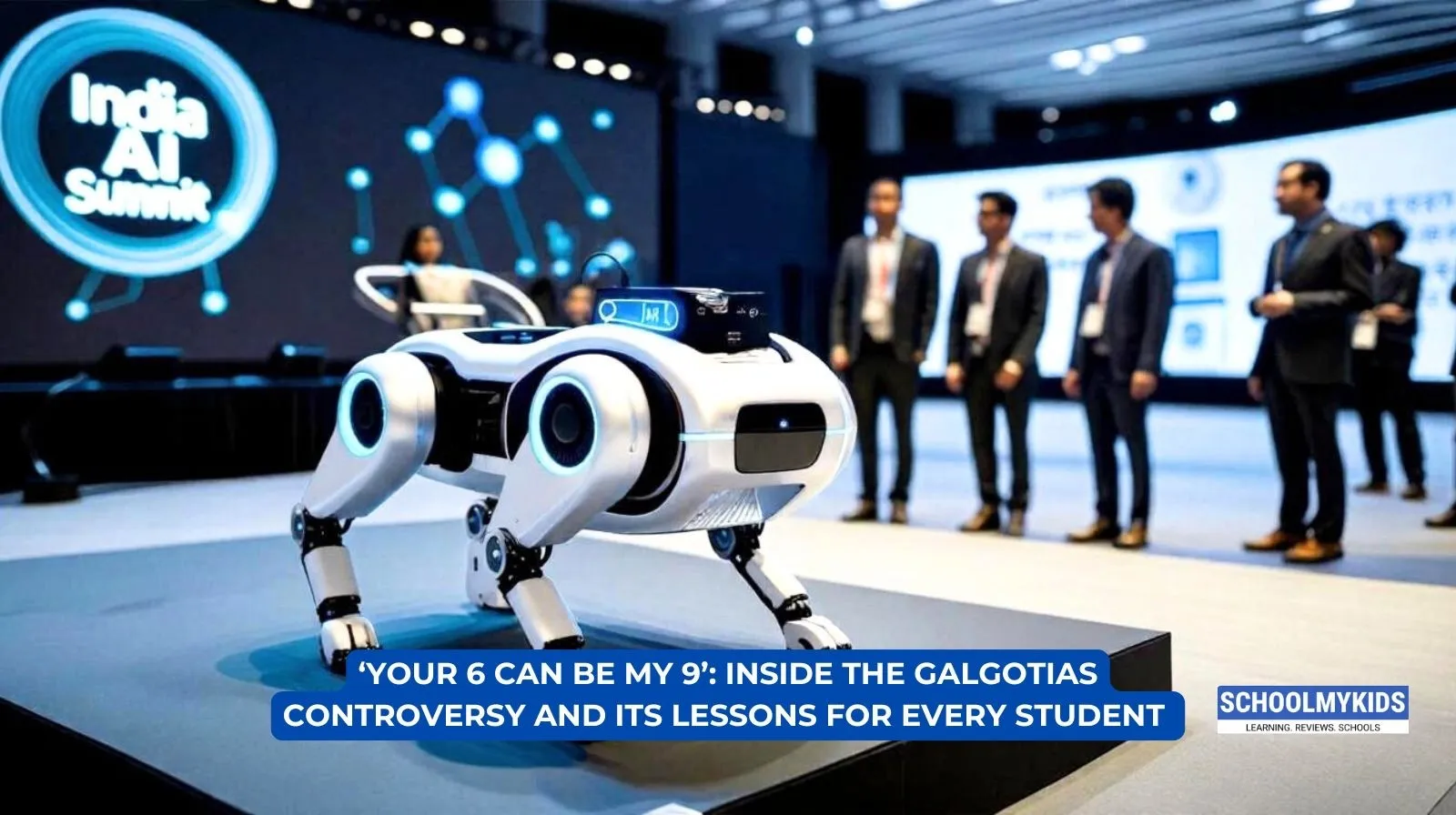
If you've been anywhere near Instagram, X (Twitter), or YouTube Shorts, you've definitely seen the memes. You've seen the reels. You've probably even sent one to your friends. The Galgotias University robo dog drama absolutely took over the internet, and there are some really important lessons hiding inside all that chaos.
India's Biggest AI Summit and One Viral Video
The India AI Impact Summit 2026 was a big national event held at Bharat Mandapam in New Delhi. Tech companies, startups, research labs, and universities from all over came to show their AI-related work. It was supposed to be India's big moment to showcase homegrown innovation in artificial intelligence.
Galgotias University, a private university based in Greater Noida, set up a pavilion there. And at their stall? A cool-looking four-legged robot dog, which they named "Orion."
Prof. Neha Singh was representing Galgotias at the event. She spoke to DD News on camera and said that Orion was developed at the university's Centre of Excellence, and she connected it to the university's big ₹350 crore investment in AI.
And things went sideways.
The internet is fast. And people online quickly figured out that "Orion" was actually the Unitree Go2, a commercially available robotic dog made by a Chinese company called Unitree Robotics. You can literally buy it online for around ₹2.5 to 3 lakh. It's used by universities and research labs across the world, but as a tool for learning, not as something they built themselves.
A Chinese account even recognized the robot and called it out. Screenshots spread. Memes followed. Reels followed. The whole thing went massively viral.
The Line That Broke the Internet: "Your 6 Can Be My 9"
When the backlash hit, Prof. Neha Singh spoke to reporters and tried to explain what happened. She said things might not have been communicated clearly, and that her intent may have been misunderstood. And then she said those now-famous words:
"Your 6 can be my 9. Maybe what I wanted to say I was not able to say because of the scarcity of time or the noise around us."
She meant it as a philosophical point that the same thing can look different from different angles. But the internet? The internet absolutely ran with it. Memes flooded the timeline. The phrase became a pop culture moment overnight.
She also acknowledged, to be fair, that she takes accountability for not communicating properly.
Three Statements, Three Different Stories: How the University Handled the Crisis
This is where things got really messy, and this is actually the most important part for you to understand.
Round 1: The university said they never claimed to have built the robot. They said it was purchased for student learning and research, and that exposing students to global technology is part of their academic mission.
Round 2: The university then called the whole controversy a "propaganda campaign" against them. They said they were being targeted unfairly.
Round 3: After being asked to vacate their pavilion at the summit, the university did a full U-turn. They issued an apology and blamed Prof. Neha Singh entirely, calling her "ill-informed" and saying she gave "factually incorrect information" even though she wasn't authorized to speak to the media.
The university was asked to vacate the expo. The pavilion's power was cut. Galgotias left the AI Summit under a huge cloud of embarrassment.
As for Prof. Neha Singh? Reports say she put an "Open to Work" frame on LinkedIn (which then disappeared quickly). She later deactivated her LinkedIn profile entirely. The university clarified she was not suspended but that an internal inquiry was underway.
Six Lessons Every Student Can Take From This Situation
This whole thing isn't just entertainment. It's actually a really powerful real-world classroom lesson. Here's what every student should take away:
1. Honesty Is Not Just a Value; It's Your Reputation
The moment false information goes public, it becomes almost impossible to take back. The university tried three different versions of their story. Each new version made things worse. If they had been upfront from day one, "We bought this robot to help our students learn," there would have been no controversy. Being honest upfront is always cheaper than damage control later.
2. Know What You're Talking About Before You Speak
Prof. Neha Singh is a communications professional, not an AI or robotics expert. She was put in front of a camera to speak about a technical product she didn't fully understand. This is a lesson for everyone: before you make any claim, publicly or privately, make sure you actually know the facts. If you don't know, say, "I'm not sure, let me check." That's strength, not weakness.
3. The Internet Always Finds the Truth
In this age, information travels faster than ever. The Unitree Go2 was identified within hours. People cross-checked specs, photos, and product listings in minutes. Whether it's a robot dog at a summit or a copied project submitted at school, the truth has a way of coming out. Build habits of originality and transparency now.
4. Don't Be a Bystander to Misinformation
You saw this story on your reels. You maybe laughed at the memes (totally fair). But when you see something going viral, can you tell what's real, what's exaggerated, and what's completely made up? The ability to check facts before sharing is one of the most important skills you can build right now. Always ask, “Where did this come from?” and “Is this verified?”
5. Accountability Matters and So Does the Way You Handle Mistakes
Prof. Neha Singh did say she takes accountability. That part matters. But notice how the university kept shifting blame, by first denying, then calling it propaganda, then blaming her entirely. That kind of behavior destroys trust. When you make a mistake, in school, at work, or in life, own it clearly and early. People respect that far more than a complicated excuse.
6. Showcasing Isn't the Same as Creating
There's absolutely nothing wrong with using technology built by others, but only for learning, research, or inspiration. Universities around the world use Unitree Go2 dogs for robotics courses. The problem wasn't using the robot. The problem was presenting it as original innovation at a national platform meant to showcase domestic invention. Know the difference between learning from something and claiming it as your own.
Conclusion
The Galgotias robo dog story is funny as a meme. But if you look past the laughs, it's actually a story about what happens when shortcuts replace substance, when communication replaces honesty, and when image matters more than integrity.
In a world full of fake news, viral half-truths, and carefully curated social media moments, your most powerful tool is the ability to think clearly, speak honestly, and know the difference between what's real and what's just a good-looking story.
Because at the end of the day? Your 6 should actually be your 6.






Be the first one to comment on this story.