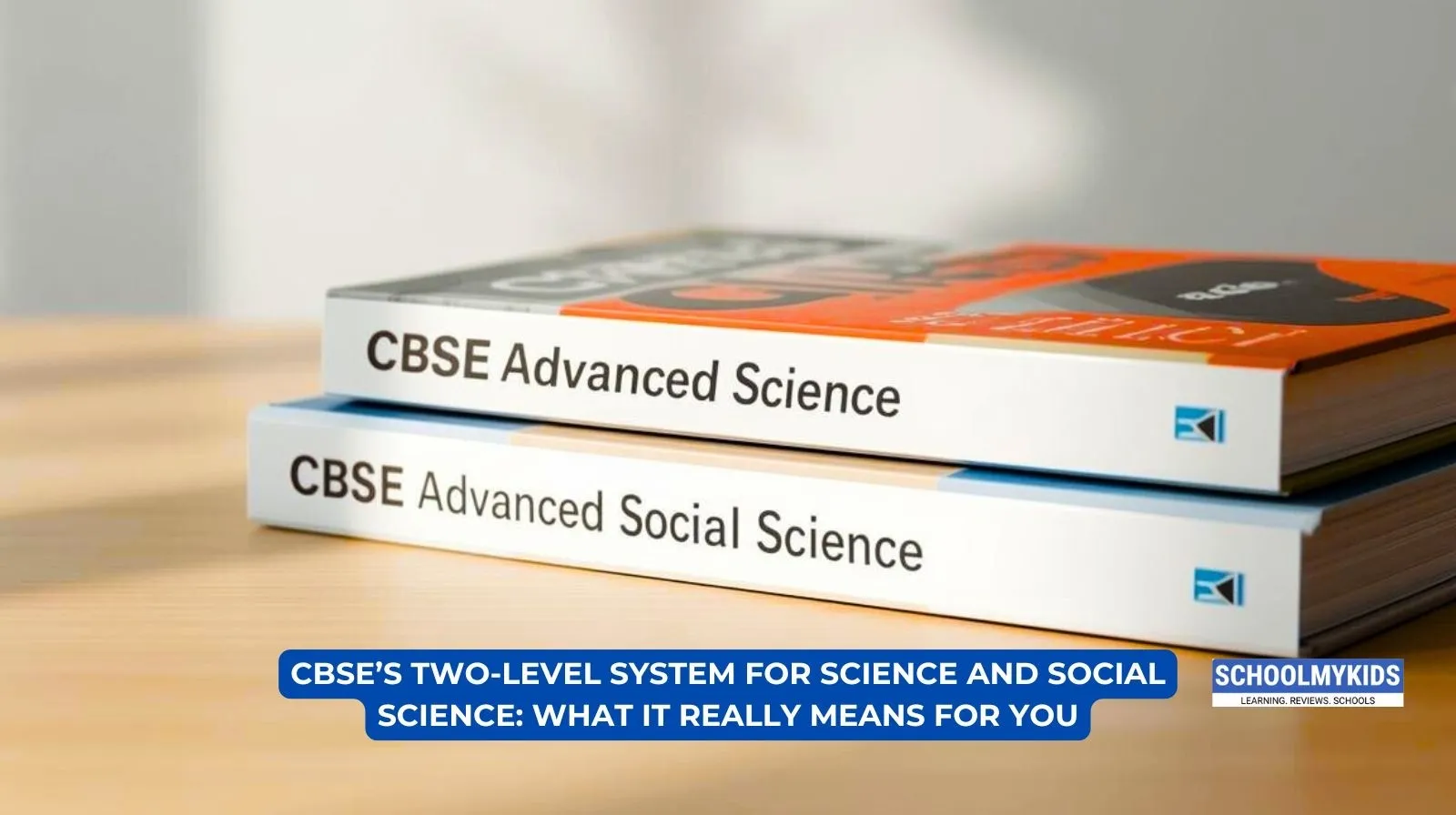
If you are in Class 8 right now, or moving towards Class 9 soon, you might have heard something new. CBSE is planning to introduce two levels for Science and Social Science. Naturally, this brings questions.
Is the syllabus changing? Will the exam get tougher? Will this affect your future? Is this like Basic and Standard Maths?
Let’s slow down and understand everything clearly.
Is This Official?
The Central Board of Secondary Education (CBSE) has proposed introducing a two-level system for Science and Social Science, and it is awaiting final official notification.
Here’s the possible timeline:
- For Class 9: It will start from the 2026–27 academic session.
- For Class 10 Board Exams: It is expected to apply for students appearing in the 2028 Board examinations.
This plan has been discussed and approved in principle by CBSE’s curriculum committee. It will move forward once new textbooks are ready.
Why Is CBSE Doing This?
This change is linked to the National Education Policy (NEP 2020) and the National Curriculum Framework for School Education (NCFSE) 2023.
The goal is to reduce pressure, to give students more choice, and to focus more on understanding and less on memorising.
Many students study Science or Social Science only because it is compulsory. Not everyone wants to become a doctor, engineer, historian, or civil servant. Some students plan to move towards commerce, humanities, arts, sports, or vocational fields.
So why should everyone study at the same difficulty level?
That’s the thinking behind this change.
What Is the Two-Level System?
Like Mathematics, which already has Basic and Standard levels in Class 10, CBSE is planning a similar model for Science and Social Science. However, the final names and structure will be confirmed only after an official circular is released.
1. Standard Level
This will be for students who may want to continue these subjects in higher classes or pursue related careers.
For example:
- If you want to take Science in Class 11.
- If you are thinking about fields like medicine, engineering, research, or certain competitive exams.
- If you are serious about Social Science subjects for future studies.
This level may include a better understanding and slightly more challenging questions.
2. Basic Level
This will be for students who do not plan to study these subjects in depth later.
The focus will be on core concepts. The aim is that any student who attends school regularly and studies properly in class should be able to pass comfortably without extreme coaching.
It is not about “weak” or “strong” students. It is about different future goals.
Will the Syllabus Be Different?
CBSE has not yet released the final structure. Media reports suggest that options like separate question papers or differentiated content are being considered. However, no final model has been officially published yet.
CBSE Chairperson Rahul Singh has said that the system will be implemented once the new NCERT textbooks are ready.
So yes, things are still being finalised. But the direction is clear: flexibility.
What About Board Exams?
There is another important update.
CBSE is allowing students to take Class 10th Board exams twice in a year:
- One main exam.
- One improvement attempt (if needed).
This means the exam will not feel like a one-shot, high-pressure event.
Over time, CBSE may also move towards more flexible systems like modular or semester-based exams. But that will happen gradually.
What Can You Learn From Maths Basic and Standard?
When CBSE introduced two levels in Mathematics, many students chose according to their comfort and future plans.
In the 2023–24 Board exams:
- Over 15 lakh students chose Mathematics Standard.
- Around 6.7 lakh chose Mathematics Basic.
This shows students do think seriously about their future plans. And the system worked smoothly. Science and Social Science are expected to follow a similar model.
Will Choosing Basic Affect My Future?
This is the biggest worry. It depends on your stream choice after Class 10.
If you plan to take Science in Class 11, choosing the Standard level in Class 10 will likely be better for you.
If you are sure you want Commerce, Humanities, or vocational courses, the Basic level may be completely fine.
But before choosing, talk to:
- Your school teachers
- Your parents
- Your school counsellor
Don’t choose based on fear. Don’t choose because your friend chose something. Choose based on your own plan.
Is This Change Good or Bad?
It depends on how you see it. For students who struggle under pressure, this can be a relief. For students who want deeper learning, the Standard level will still challenge them.
The aim is not to lower standards. The aim is to make learning more suitable for different students. And not everyone learns at the same pace or has the same goal. That is normal.
Conclusion
If you are feeling confused right now, that is okay. Change always feels uncertain at first.
But remember this:
- Nothing is being removed suddenly.
- The changes will start from 2026 onwards.
- You will get time to choose.
- Your teachers will guide you.
- Official circulars will clearly explain everything.
Do not rely on rumours or social media posts. Always check official updates from CBSE.
Most importantly, do not panic. This system is being introduced to reduce stress, not increase it. And at the end of the day, your effort, understanding, and consistency will matter more than whether you choose Basic or Standard.
Take your time. Stay informed. Ask questions. That’s how smart students move forward.
Note: Please remember that while the proposal has been approved at the curriculum level, CBSE has not yet released a detailed public circular explaining the final structure.



Be the first one to comment on this story.