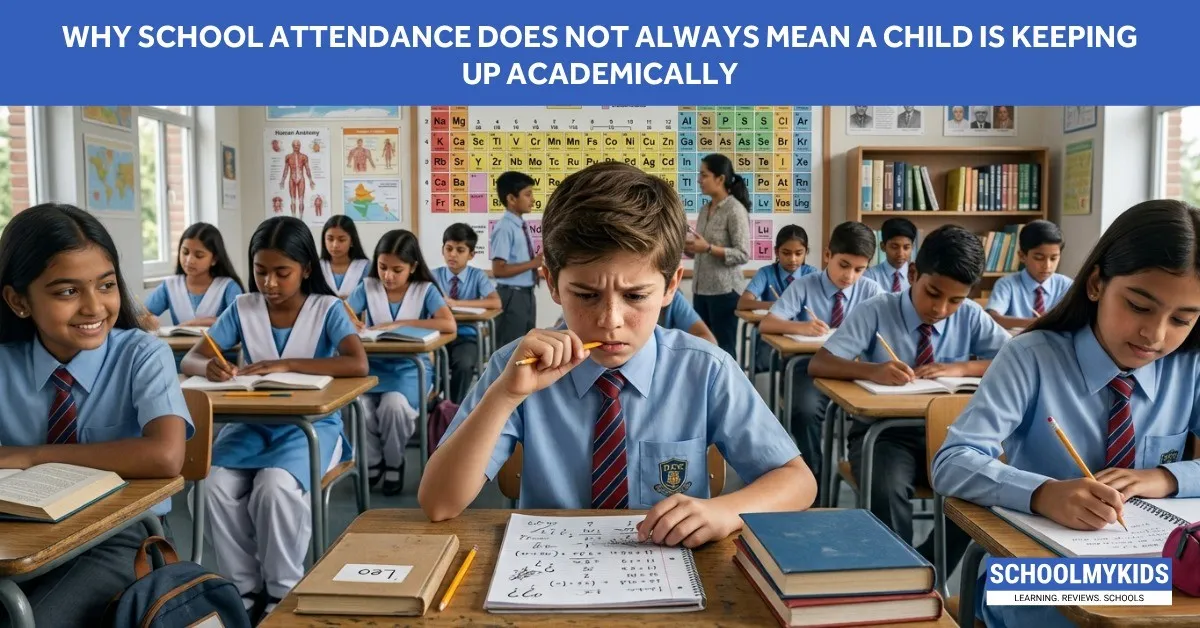
Your mom keeps pointing out you haven’t missed a single day of school. Then your report card comes, and it’s still bad. She doesn’t get how you can show up constantly but still be failing.
You get it. Being there is different from actually learning. You can sit in a chair for six hours and absorb basically nothing. Happens all the time.
Your brain can be somewhere without actually being there. You’re sitting in class. You’re physically present. Roll is taken. Attendance marked. But your mind? Off somewhere else. Or trying to be there but not actually connecting with what the teacher’s saying.
That’s just reality. And schools count that as “attending.”
What’s Actually Happening (The Numbers That Don’t Sound Right)
In rural government schools across India, average student attendance on a given day sits around 75-76 percent (ASER 2024). Private schools run higher. But the weird part is that even where attendance is solid, learning levels stay low.
Most Indian students are still underperforming in core foundational skills. ASER 2024 shows only about 27 percent of Class 3 children can read a Class 2-level text and roughly 34 percent can do basic subtraction. They’re showing up. They’re getting marked present. And a large share are not actually learning the material at grade level.
Research looked at what happens when you miss school. For every day you’re absent, your achievement drops a tiny bit. Like 0.0057 of a standard deviation (2025 analysis of post-COVID North Carolina data). Small right? But add that up over a semester, and the gap becomes huge.
What’s messed up is if you’re present but checked out mentally? That doesn’t get measured. Your brain’s doing its own thing while your body’s at a desk. Roll gets marked. Learning doesn’t happen.
Why Just Showing Up Doesn’t Work (The Obvious Reason Everyone Ignores)
Class is fast. The teacher explains something. Moves on. Explains the next thing. Moves on again. You’re supposed to absorb all of this while sitting still while thirty other kids are doing the same thing and the classroom smells weird and your chair is uncomfortable and you’re hungry.
If you miss that explanation because you weren’t paying attention or because you were lost on the previous concept, you’re stuck. You can’t rewind the teacher. Can’t ask her to repeat it slower. You just have to sit there while everyone else somehow gets it and you don’t.
So you keep coming. But you’re getting further behind. Each day the gap widens. And technically you never skipped. You’re “keeping up” with attendance. You’re just not keeping up with the actual content.
The Passive Presence Problem That Nobody Talks About
Teachers notice this. They tell students off the record. A kid who comes every day but doesn’t do homework. Doesn’t pay attention. Doesn’t participate. They mark attendance. What they don’t mark is the actual learning.
The student got credit for being there. The system moved on. But that student left without understanding the material. Now they’re two lessons behind. Then three. Then they’re completely lost.
By the time anyone notices something’s wrong, the kid’s so far back they can’t catch up. They’ve been present the whole time. Just not actually learning.
The System’s Weird Incentive Problem
Schools and schemes face strong pressure to keep enrolment and attendance numbers high (mid-day meals, retention drives, and some state grant rules link support to presence). So there’s pressure to get kids to show up. Parents get penalized if their kid misses too much school. The system is basically built around butts-in-seats, not brains-engaged.
That’s not a teacher thing. That’s a system thing. Teachers would prefer kids actually learn. But if they’re forced to choose between a kid who’s present-but-lost and a kid who’s absent but would learn if they showed up, the system rewards the first one.
So students learn that being somewhere is enough. You’re not actually required to absorb anything. Just be there.
What Actually Matters (And It’s Not Showing Up)
Learning happens when you actually process information. When your brain is working on the concept, not just hearing words.
That could happen at school. Probably should happen at school. But it depends on whether you’re actually engaged or just passing the time.
You could miss three days and learn more in two hours at home than in a week at school if you’re actually focused.
Or you could attend fifty days straight and not learn anything because your brain was elsewhere the whole time.
The attendance number tells you where a body was. It doesn’t tell you anything about what the brain was doing.
Why This Matters Right Now
Schools in India are still dealing with the aftermath of learning gaps. Not mainly because of absences. Because of the quality of learning that’s happening when kids are present.
Teachers are stressed. Resources are stretched. Lots of kids are lost but nobody notices because their attendance is fine. They keep coming. Keep failing. Keep getting further behind.
By the time you get to higher grades, you’re so far behind you can’t catch up. You’ve been attending the whole time. You’ve just learned almost nothing.
Key Takeaways
Attendance marked doesn’t equal learning happening
Most Indian students still lag in foundational skills even with regular attendance (ASER 2024)
Passive presence in class doesn’t transfer to actual knowledge
Each missed day drops achievement by about 0.0057 SD (US post-COVID data), but mental disengagement is not measured
System incentivizes showing up, not learning
One day absent can affect grades more than months of being there mentally checked out
Learning requires brain engagement, not just physical presence
Schools measure attendance easily, but learning outcome tracking is weak
Frequently Asked Questions
Q1: So if I go to class but don’t pay attention, am I actually “attending”?
Technically yes. The school marks you present. Actually no. Your brain didn’t attend. And that’s what matters for learning.
Q2: Does this mean I should just skip school if I’m going to zone out anyway?
No. Being in the room gives you some chance of learning even if you’re unfocused. Not being there gives you zero chance. Show up. But actually show up mentally.
Q3: My attendance is perfect but my grades suck. What do I do?
The attendance thing isn’t the problem. The learning thing is. Figure out why you’re not absorbing in class. Are you lost on basics? Bored? Distracted? Fix that. Attendance won’t help if your brain isn’t engaged.
Q4: Can teachers actually tell who’s mentally present vs just sitting there?
Yeah usually. It shows up in participation, homework, tests, interaction. Teachers know which kids are really there and which are just occupying space.
Q5: If I’m struggling but attending, will the system eventually help me catch up?
Not automatically. You have to actually ask for help. Attend AND engage. Attend AND do homework. Attend AND ask questions. Just showing up isn’t enough.








Be the first one to comment on this story.