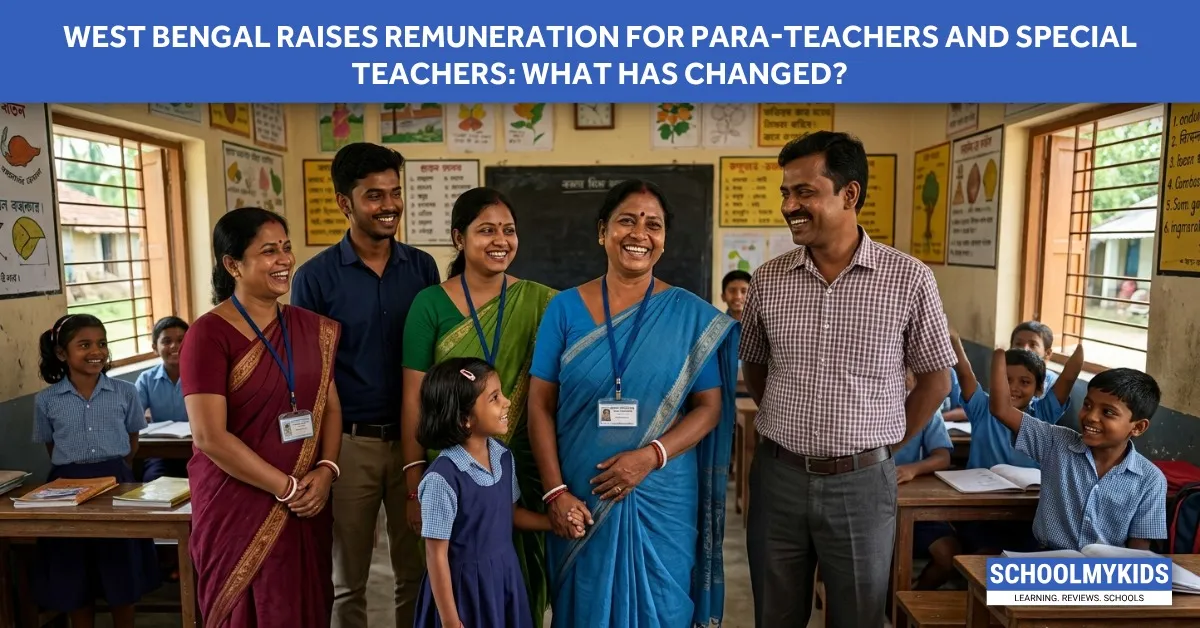
The West Bengal government has announced a revision in the monthly remuneration of para-teachers, special teachers and other contractual school-education workers.
The decision covers more than para-teachers. It also includes Shiksha Bandhus, management staff, SSK assistants, MSK instructors, academic supervisors, PM POSHAN education volunteers and other contractual workers.
What does this actually mean? Why does it matter? Will your child's school run differently now?
These are questions parents have. Teachers have. Students wonder about. But not many people explain clearly what's actually changing.
At A Glance
Category | Earlier monthly remuneration | Revised monthly remuneration | Monthly increase |
|---|---|---|---|
Primary para-teachers | ₹11,941 | ₹16,941 | ₹5,000 |
Upper-primary para-teachers | ₹15,523 | ₹20,523 | ₹5,000 |
Shiksha Bandhus | ₹9,954 | ₹14,954 | ₹5,000 |
Special teachers | ₹14,924 | ₹19,924 | ₹5,000 |
PM POSHAN education volunteers | ₹11,000 | ₹16,000 | ₹5,000 |
The figures are based on the School Education Department notification of 30 September 2026 (effective 1 October 2026).
The figures above are monthly remuneration amounts. They should not be treated as the same thing as the gross salary or take-home salary of a regular government teacher.
Who Is Covered By The Revision?
The decision covers several categories of contractual workers linked to school-education programmes.
These include primary and upper-primary para-teachers, Shiksha Bandhus, special teachers, SSK assistants, MSK instructors, academic supervisors, district programme managers, selected-subject contractual teachers and PM POSHAN education volunteers.
It does not automatically apply to every teacher working in West Bengal. Regular government teachers and private-school teachers follow separate service or employment arrangements.
What Exactly Changed: The Actual Numbers
The West Bengal government revised the monthly remuneration of several categories of contractual workers linked to school-education programmes.
These are the specific changes:
Primary Para-Teachers:
Were making ₹11,941 per month. Now making ₹16,941. Raise of ₹5,000.
About 20,343 people are affected.
Upper-Primary Para-Teachers:
Were making ₹15,523 per month. Now making ₹20,523. Again, ₹5,000 raise.
About 21,849 people are affected.
Shiksha Bandhus:
Were making ₹9,954 per month. Now making ₹14,954. Raise of ₹5,000.
About 2,280 Shiksha Bandhus are expected to benefit.
Special Teachers:
Were making ₹14,924 per month. Now making ₹19,924. Raise of ₹5,000.
Other Staff:
Management staff, SSK assistants, MSK instructors, academic supervisors, district programme managers, selected-subject contractual teachers and PM POSHAN education volunteers also received revised remuneration.
Management staff got different increases based on their current remuneration. Those receiving up to ₹25,000 got ₹5,000 more. Those receiving more than ₹25,000 and up to ₹40,000 got ₹7,000 more. Those receiving more than ₹40,000 and up to ₹55,000 got ₹10,000 more.
Education volunteers under PM POSHAN will now receive ₹16,000 per month, up from ₹11,000.
The wider package is reported to involve additional annual government expenditure of approximately ₹390 crore. This figure covers the broader package and not only para-teachers and special teachers.
Why West Bengal Did This: The Context
Para-teachers are contractual education workers. Their remuneration and service conditions are different from those of regular government or government-aided teachers.
This is not a regularisation order. It is not a pay-parity order either. It is a revision in monthly remuneration for the categories covered by the notification.
Nobody can say from the available reports that the decision was made specifically because para-teachers were leaving, schools lacked permanent posts or the state had a documented teacher shortage.
The government's move appears to:
Increase the monthly remuneration of contractual education workers.
Provide better financial support for para-teachers and special teachers.
Support the continuation of staff working under different school-education programmes.
What This Actually Means For Your Child's School
Your child may not notice an immediate change in the classroom.
More Teachers May Stay:
Better remuneration may help some contractual workers remain in their roles. But it does not guarantee that your child's teacher will stay longer.
Teachers also consider workload, working conditions, location, job security, professional growth and other employment opportunities.
School Continuity May Improve:
When a teacher leaves during the academic year, schools may need to reorganise classes or find replacement staff.
If the revision helps schools retain experienced staff, students may benefit from greater continuity. But nobody can say yet that it has improved student outcomes.
Special Education Support May Benefit:
Special teachers now receive ₹19,924 per month, up from ₹14,924.
This may make the role more financially attractive. But better pay alone cannot solve recruitment problems. Qualifications, training, workload, supervision and the number of available positions matter too.
Students with disabilities may benefit if schools are able to retain qualified special teachers and provide regular support.
But Also: This Is Not Pay Parity
Para-teachers now earn ₹16,941 at the primary level and ₹20,523 at the upper-primary level.
These amounts are not the same as the salary structure of regular government or government-aided teachers.
This revision does not establish pay parity.
What This Revision Does Not Change
The revision increases monthly remuneration. It does not give contractual workers regular government-employee status.
Para-teacher organisations have raised demands relating to regularisation, pay parity and service security. But this decision does not itself create permanent posts.
It also does not automatically answer questions about pension, dismissal protection, compensation or other service benefits. Those matters depend on the relevant appointment orders, programme rules, government instructions and applicable law.
So while the revision helps financially, it does not solve the longer-term questions about job security, career progression or regularisation.
Key Takeaways
West Bengal revised the monthly remuneration of several categories of contractual school-education workers.
Primary para-teachers now receive ₹16,941 per month, up from ₹11,941.
Upper-primary para-teachers now receive ₹20,523 per month, up from ₹15,523.
Shiksha Bandhus now receive ₹14,954 per month, up from ₹9,954.
Special teachers now receive ₹19,924 per month, up from ₹14,924.
The wider package is reported to involve approximately ₹390 crore in additional annual expenditure.
The School Education Department notification of 30 September 2026 states that the revised remuneration is effective from 1 October 2026.
This is a remuneration revision. It does not automatically create permanent government posts or establish pay parity.
What Parents Should Watch For
Parents may not notice an immediate change in the classroom. That is normal. A remuneration revision does not change teaching overnight.
The practical effect will depend on whether schools can retain staff, fill vacancies quickly and provide consistent support for students with disabilities and other additional learning needs.
Parents can look for practical changes:
The same teacher continues with the class.
Vacancies are filled without long interruptions.
Students receive regular support from special teachers.
The school communicates staffing changes clearly.
Eligible workers receive the revised amount from the applicable effective date.
FAQs
Q1: Does this mean my child's para-teacher will definitely stay longer?
No. Better remuneration may help some teachers remain in their roles. But it does not guarantee that your child's teacher will stay longer. Working conditions, workload, location, job security and other opportunities also matter.
Q2: Are para-teachers now earning as much as regular teachers?
No. Primary-level para-teachers now receive ₹16,941 per month. Upper-primary para-teachers now receive ₹20,523. These amounts are not the same as the salary structure of regular government or government-aided teachers. Regular teachers' earnings vary according to cadre, pay level, allowances, seniority and deductions. This revision does not establish pay parity.
Q3: Will my child's school quality improve because of this?
It may help indirectly, but not immediately.
If the revision helps schools retain staff and reduce disruption, children may benefit from greater continuity. But there is no evidence yet that this revision has already improved school quality or student achievement.
Teacher preparation, workload, school leadership, resources and support for students with additional needs will also matter.
Q4: What about para-teachers who want permanent positions instead of just raises?
This is a remuneration revision. It is not a regularisation policy.
The government has increased the monthly amount for the categories covered by the notification. It has not, through this decision alone, created permanent government posts or established the same service benefits as regular teachers.
Pension, dismissal protection and compensation depend on the relevant appointment terms and official rules.
Sources: School Education Department notification of 30 September 2026 (reported by The Telegraph and Careers360); Cabinet announcement of 7 September 2026 by Chief Minister Suvendu Adhikari (Times of India and Outlook Money).


Be the first one to comment on this story.