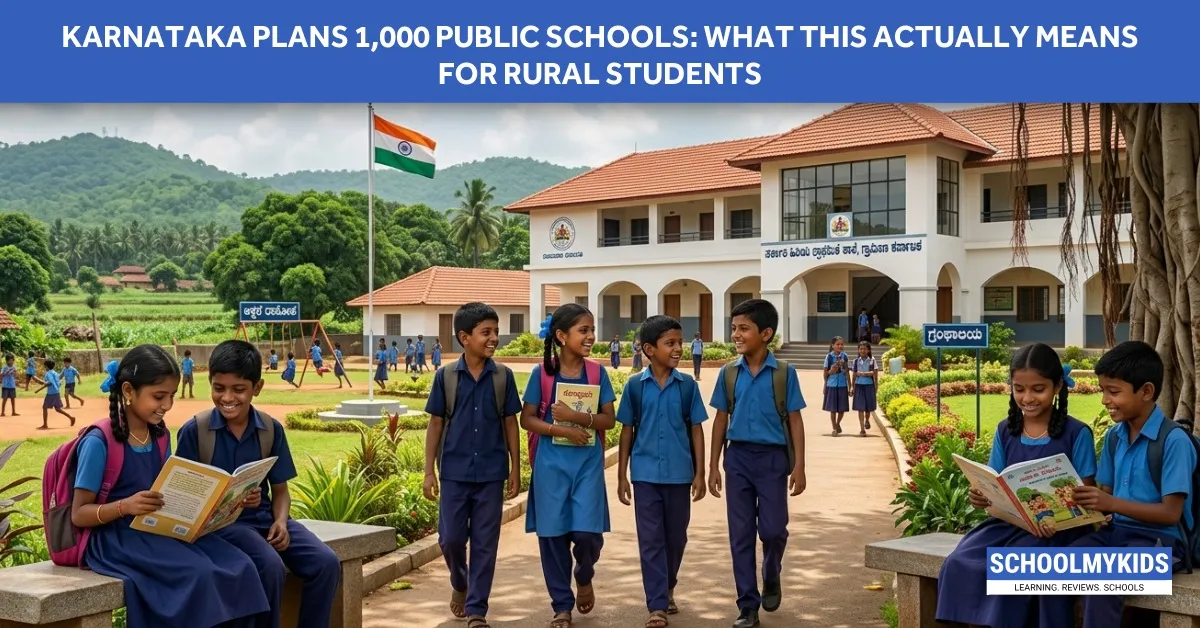
Earlier in 2026, Karnataka's School Education and Literacy Minister, Madhu Bangarappa, announced that 1,000 Karnataka Public Schools would be established across the state in phases. Unified campuses. Pre-primary through pre-university, all on one campus.
Sounds impressive. More schools. Better infrastructure. Right?
But something’s happening on the ground that the announcement doesn’t mention. Students in villages are being moved away from their local schools. Families are struggling. And nobody’s being clear about what’s actually going on.
This matters if you’re a rural student. If your parent is a farmer wondering where your child goes to school. If you’re in a village and suddenly your neighbourhood school is closing.
Let’s see what’s actually happening and what it means for you.
The Plan Explained: What They’re Actually Building
Karnataka Public Schools (KPS) is a new model. One campus. Multiple levels.
Instead of separate primary school, middle school, high school, and pre-university college scattered across different locations, everything is in one place.
This consolidation appeals to government officials for obvious reasons. One principal. One infrastructure. One management. Simpler administratively.
The Minister's statement: 1,000 of these KPS campuses will be established across Karnataka. Phased over time. Not all at once.
Each KPS is meant to bring LKG to II PUC together on one campus, with Kannada and English medium sections. Reports say the plan includes around 800 campuses under the School Education Department and 200 under the Minorities Department, with an estimated cost of ₹3,900 crore over three years.
Sounds organized. Planned. Professional.
KPS vs Local Village Schools
Aspect | Karnataka Public School | Local village school |
|---|---|---|
Classes | LKG to II PUC on one campus | Usually one or a few levels |
Location | Often larger, centralized campus | Usually closer to the child’s home |
Facilities | Shared labs, libraries, and larger campus resources | May have fewer facilities |
Transport | May be needed if the campus is far | Often walkable for nearby children |
Community connection | Larger student group | Smaller, familiar school community |
KPS is not automatically better or worse. Its value depends on whether a child can reach it regularly and whether the transition is handled well.
What’s Actually Happening On The Ground: The Reality
Now, let’s see the gap between the announcement and what’s happening.
Students in villages are being shifted to these new KPS campuses. These campuses can be far from their homes. In some cases, families may need to arrange transport that they did not need before.
Think of a child who has always walked to the local village school. A short walk. Familiar teachers. Familiar classmates.
Now imagine that school being merged into a KPS campus several kilometers away. The child may need a bus. A parent may need to arrange transport. And the family may need to find money for it.
That is the concern many rural families are raising.
The Specific Problems This Creates
Distance Problem:
The Right to Education framework says governments and local authorities must ensure neighbourhood schools for children aged 6 to 14. Under the Central RTE Rules, 2010, a primary school should be within 1 km and an upper primary school within 3 km.
KPS campuses may not work as neighbourhood schools for every child. They are centralized. This means distance can become an issue.
A student who once walked to school may now need a bus, a parent’s help, or another transport arrangement. If that is not reliable, attendance becomes harder.
This is not just a policy debate. It affects daily routines, family budgets, and attendance.
Economic Problem:
Bus fare adds up. Especially when a child has to travel every school day.
For low-income rural families, even a small recurring transport cost can affect whether a child attends regularly.
When school becomes harder or costlier to reach, families under financial pressure may find it difficult to maintain regular attendance. Activists have warned that this kind of disruption can increase the risk of children dropping out or being drawn into work.
The Attendance Problem:
When students have to travel far, attendance drops. Naturally. Bad weather. Too tired. Bus doesn’t come.
Schools with low attendance get marked as “underperforming.” Then they justify closure.
But the low attendance isn’t because school is bad. It’s because the KPS model made it inconvenient.
The Community Problem:
Local schools were community centers. Parents knew teachers. Teachers knew families.
KPS campuses are designed for around 1,200 students. Much larger than many village schools.
For young children, this matters. Moving from a small, familiar school to a large campus can be unsettling.
Especially without proper transition support.
What Government Officials Say
The Minister said in the state legislature that not a single government school will be closed.
But activists and some department officials say local schools are being closed or merged as part of the KPS push. Students are being shifted.
Local administration explains it as “consolidation” or “merger.” Not closure. But from a student’s perspective, their school is gone.
Officially, the explanation is: the KPS model provides better infrastructure. A unified campus benefits students. More resources.
But it doesn’t solve the distance and cost problem.
What Parents Should Watch For
If a local school is being merged or shifted, parents should ask for the official government order. They should also ask for the list of schools involved, the distance to the proposed KPS, and the transport plan.
School Development and Monitoring Committees can raise concerns with local education officers. Keeping written copies of complaints, school records, and any assurances given by officials can help families seek clarity before a child's schooling is disrupted.
What Actually Needs To Happen
If Karnataka wants KPS and rural students, these are the actual solutions needed:
1: Keep Local Schools Open
Build KPS in towns. But don’t close village schools. Both systems can coexist.
Students who want to use KPS can. Students in villages stay in local schools.
This is possible. Requires more funding. But solves the problem.
2: Free Transport
If KPS is far, provide free bus service. Not paid by families.
The government provides buses. Fuel. Drivers. No cost to students.
Families and activists say transport remains a major concern in several areas. The government’s transport arrangements for affected students need to be clear and consistently implemented.
3: Hostel Facilities
If distance is unavoidable, provide a free hostel.
Students stay at KPS during the week. Goes home on weekends.
This is expensive. But solves the problem of distance.
Only feasible for older students (Class 8+). Not for primary.
4: Distributed KPS Model
Instead of relying only on large centralized campuses, build smaller KPS campuses closer to villages where needed.
This requires more investment. But maintains walking distance while providing KPS benefits.
What Activists And Educators Are Saying
School Development and Monitoring Committee members from different districts have raised concerns.
Their main points:
A functioning village school is part of a child’s daily routine. Closure or merger creates unnecessary disruption.
They also point to the RTE neighbourhood-school norms discussed earlier.
Children do better when transitions are handled carefully. A sudden shift from a familiar village school to a large campus can be difficult for young children.
Activists warn that disrupted schooling can increase dropout and child work risks.
These are serious concerns. They affect access, attendance, and family confidence in the system.
Educational experts who study community-based learning make similar points. Small schools embedded in communities have different outcomes than large centralized campuses.
Why This Matters Beyond Karnataka
Karnataka’s decision will likely influence other states. If KPS works, states copy it. If it fails, other states avoid it.
This isn’t just a Karnataka issue. It’s a model that could expand.
How Karnataka handles rural student concerns will influence education policy nationally.
Also, this highlights tension between infrastructure improvement and accessibility. Sometimes these conflict.
Building better schools on a central campus improves buildings. But centralizing reduces accessibility for rural students.
Policymakers need to solve both, not choose one.
Timeline: What Has Happened So Far
May 2026: Karnataka announced plans to establish 1,000 Karnataka Public Schools across the state.
June 2026: The KPS scheme was launched, with foundation stones laid for KPS campuses.
October 2026: Reports raised concerns that the KPS push could affect rural schools, despite the Minister’s assurance that existing government schools would not be closed.
The key issue now is implementation. Families need clarity on school mergers, distances, transport, and support for younger children.
For rural families, the immediate questions are practical. How far is the new campus? Who pays for transport? Will younger children be safe and able to attend every day?
Until those questions have clear answers, uncertainty itself becomes a problem.
What Rural Parents Can Ask the School
Is my child’s school being merged, shifted, or closed?
Where exactly will my child study after the change?
How far is the new KPS campus from home?
Is transport provided? Is it free?
What happens to younger children if transport is not available?
Will teachers and classmates change?
How can parents raise concerns through the SDMC?
These questions help parents get specific answers instead of vague assurances.
Key Takeaways
Karnataka announced plans for 1,000 KPS campuses in phases
KPS model: unified pre-primary to pre-university campus
Activists and some officials say students are being shifted from local village schools to distant KPS campuses
Distance creates accessibility problems for rural students
Transport costs can make regular attendance harder for some families
Attendance drops due to distance and cost
Concerns that disrupted schooling may increase dropout or child work risks
RTE norms recognise neighbourhood schools, though the impact depends on distance and class level
Solutions exist but require government commitment
Other states may watch Karnataka’s approach closely
FAQs
Q1: Will all government schools in Karnataka close and become KPS?
No. The Minister said in the legislature that not a single government school will be closed. But activists and some officials say closures or mergers are happening in some places as part of the KPS push. It’s not uniform across the state. Some areas maintain local schools. Others are consolidating. The policy isn’t completely clear, which creates confusion for families.
Q2: Is KPS actually better than local schools?
In terms of planned facilities and shared resources, KPS campuses are designed to offer more. But accessibility-wise, it creates problems for rural students. “Better” depends on whether a student can actually attend. A better school far away may still be out of reach if transport is unaffordable or unreliable.
Q3: What should rural parents do if their child’s school is being closed?
Document it. Ask the school what’s happening. Contact local SDMC member. Appeal if necessary. Check if alternative schools exist within a reasonable distance. Also ask the government about free transport if KPS is the only option. Don’t accept closure silently. Access to a neighbourhood school is protected under the RTE framework for children aged 6 to 14.
Q4: Could KPS model work for rural areas?
Theoretically, yes, if done correctly. With free transport. Or hostels. Or smaller KPS campuses in rural areas. But the current implementation isn’t solving rural accessibility. So while the model has potential, execution needs improvement to actually serve rural students.







Be the first one to comment on this story.