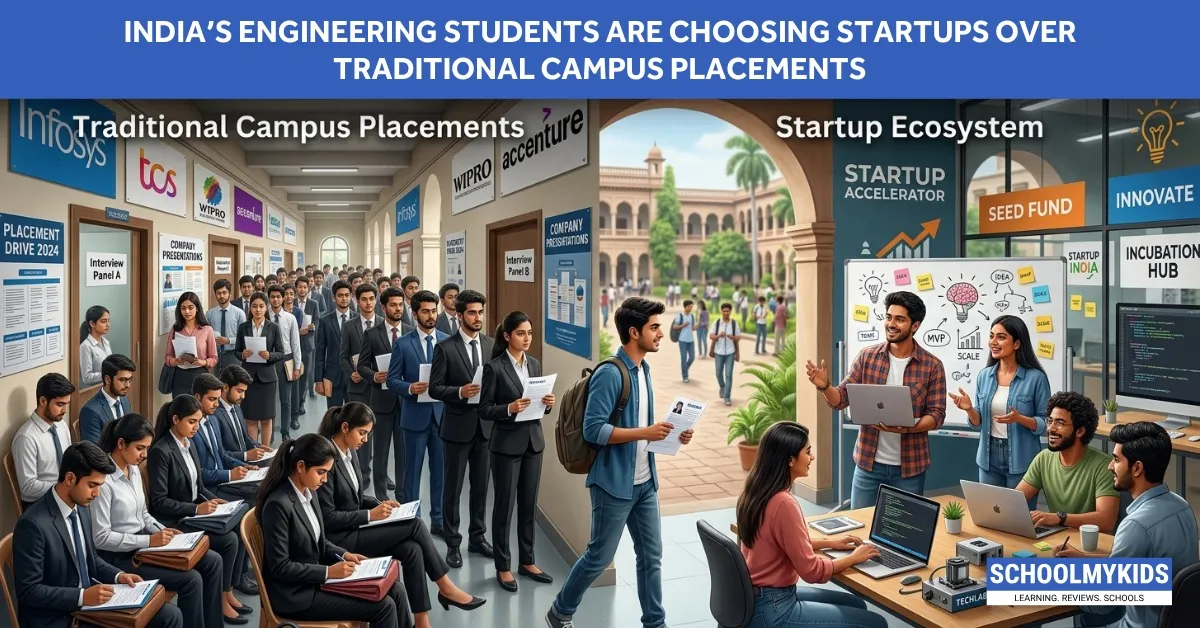
Your placement season arrives. Big companies show up. Infosys. TCS. Tech Mahindra. They're offering decent salaries. Standard packages sit around ₹3.5-7 lakhs for most freshers (higher digital or specialist tracks reach ₹7-12 lakhs at select campuses). Stable jobs. But fewer students are saying yes.
Instead, they’re joining early-stage startups. Companies with 50 people, not 50,000. Companies working on problems nobody’s solved yet.
This shift started during the pandemic. It’s accelerating now in 2026. Placement officers at IITs and NITs are noticing it. Not everyone’s taking the offers anymore.
Why The Shift Is Happening: The Actual Reasons
Salary Isn’t As Big A Deal Anymore
Your parents worried about salary. Secure income. That made sense in 2010. In 2026, salary isn’t everything for students graduating now.
A startup often offers ₹8-15 lakhs plus equity. Stock options. That means if the company succeeds, you can make serious money, sometimes far more than a standard IT-services package.
A stable job at TCS, Infosys or similar offers ₹3.5-7 lakhs for most freshers (higher specialist tracks reach ₹7-12 lakhs). That is predictable. But growth is slower without promotions or switches.
The math is: risky startup with upside potential versus safe job with limited upside.
Working On Something That Matters
A 23-year-old engineer at TCS writes code for banking systems. They follow processes. They follow guidelines. They solve problems someone already solved.
A 23-year-old at a three-person AI startup writes code that nobody’s written before. They’re solving a problem that matters to millions of people. Their work actually exists because of them, not because they fit into a process.
This matters to students psychologically. They want their work to mean something.
Learning Happens Faster
At a big company, you get training. Certifications. Career development programs. It’s structured.
At a startup, you learn by doing. In 6 months at a startup, you’ve probably handled problems that would take 2 years to encounter at a big company.
You wear multiple hats. You’re not just an engineer. You’re part of product decisions. You talk to users. You understand why the product exists.
This accelerated learning appeals to ambitious students.
Freedom To Experiment
Big companies have rules. Code review processes. Approval workflows. Change management. It takes three weeks to change a button on a website.
Startups move fast. You deploy code today. You get user feedback tomorrow. You adjust the next day. The speed is addictive once you experience it.
The Actual Job Market: What Numbers Show
Campus placement outcomes remain uneven. According to the Unstop Talent Report 2026 (survey of over 37,000 students and 500 HR leaders), only about 15% of engineering students from the 2026 batch had secured campus offers by early 2026, leaving roughly 85% still unplaced. Top campuses (IITs, NITs, BITS) continue to report far higher conversion rates, often 70-95% depending on branch and institute.
Where students who do not take campus offers go varies. Some start their own ventures. Others take off-campus roles or pursue higher studies. At premier institutes, reports indicate 10-15% of graduates now choose entrepreneurial or early-stage startup roles (up from lower single digits a few years earlier). This concentration is strongest at tier-1 colleges where students have more options. Tier-2 and tier-3 campuses still show higher placement conversion because alternatives remain limited.
What Companies Are Paying: The Real Numbers
Big Tech / IT Services (TCS, Infosys, Accenture and similar):
Freshers: ₹3.3-4.5 lakhs for standard tracks (TCS Ninja about ₹3.36 LPA; Infosys SE about ₹3.6-4.5 LPA). Digital or specialist tracks reach ₹7-12 LPA (and up to ₹21 LPA for a small number of high-skill AI or cloud roles at Infosys).
Packages for mass hiring have stayed relatively flat for several years.
Job security high.
Growth potential limited in the first 2-3 years without role or company switches.
Mid-Size / Product Tech (Zerodha, Razorpay, PhonePe-stage companies):
Freshers: ₹15-22 lakhs per year at strong product firms
Plus stock options (value depends heavily on stage and eventual outcome)
Job security medium
Learning curve steep
Early-Stage Startups (20-100 people):
Freshers: ₹8-15 lakhs per year
Plus stock options (worth ₹0-50 lakhs depending on if company succeeds)
Job security low
Learning opportunity high
The salary looks lower at startups until you factor in equity. Equity is a lottery ticket. Most startups fail. Some succeed massively.
The Risk Part: Nobody Talks About This Enough
Startups fail. A lot. Industry analyses commonly note that a large majority of early-stage Indian startups do not survive beyond the first few years. You join, get excited, work 60-hour weeks. Funding dries up in 18 months. Company shuts down. You’re out of a job.
Your resume says “joined startup that failed.” That’s not as bad as it sounds, but it’s not as good as “worked at TCS for 2 years.”
Salary is inconsistent. Your startup might run out of cash and not pay full salary for two months. That happens.
Your skills might not transfer. You spent two years building a mobile app for a food delivery startup. The startup dies. Your specific skills aren’t valuable elsewhere. You’re back at square one.
Job security is low. No severance. No gratuity. If the company decides to downsize, you’re gone.
Reality Check on Overall Numbers
Most engineering graduates in India do not get campus offers at all. The Unstop Talent Report 2026 found 85% of engineering students still unplaced early in the cycle, even though 88% of employers said they were hiring. Access is heavily skewed: campuses that host 150+ companies see far higher placement rates than those with fewer than 30. The “rejecting offers for startups” story is mainly a tier-1 phenomenon. For the majority of students, the bigger problem is simply securing any offer.
The Parents’ Perspective: What They’re Worried About
Your parents are scared. They paid for engineering education expecting you to land a stable job.
Instead, you’re saying: “I’m joining a startup with an uncertain future and lower fixed salary.”
This is a legitimate concern. Your parents’ perspective makes sense. But the world changed.
A TCS job in 2006 was a golden ticket for many families. In 2026, a standard IT-services role remains stable, but growth is slower than in product or high-growth startups. Most people stay solidly middle-class unless they switch roles or companies.
A startup in 2026 is risky but also potentially life-changing. If you pick the right startup, you could make serious wealth by 30.
Neither path is “right.” They’re just different risks.
How To Actually Decide: Practical Framework
Ask yourself:
Do I have a safety net? If your family can support you for one year without income, startup risk is manageable. If you need a paycheck immediately, don’t join a startup.
How much do I learn from this role? Talk to the founder. What will you actually do? Will you build products or maintain existing stuff? Will you talk to users? Learning potential matters.
Is the problem important to me? You’ll work 60 hours a week. Better if you care about what you’re solving. A boring stable job beats a boring startup.
What’s the funding situation? Ask the founder directly: “How much runway do we have?” Runway means “how many months can we operate before we run out of money.” Anything less than 12 months is risky. 18+ months is safer.
Who are the founders? First-time founders are risky. Founders who’ve built companies before are safer. Look at their track record.
How To Evaluate the Equity Part
Equity is the biggest variable. Ask these questions before you accept:
How much equity (or ESOPs) am I getting as a percentage or number of options?
What is the current valuation or last funding round?
What is the vesting schedule (usually 4 years with a 1-year cliff)?
Is there an exercise price and will I need to pay cash to buy the shares later?
Most early employees at seed or Series A startups receive 0.05% to 0.5% depending on role and stage. The number looks small on paper. It only becomes meaningful if the company grows significantly. Treat equity as upside, not guaranteed income.
The Career Path Reality: What Actually Happens
If You Join Big Tech:
Year 1: Learn processes and tools
Year 2-3: Get comfortable with the job
Year 3-5: Maybe get a promotion and salary bump
Year 5+: Get promoted to senior roles if you’re good
The path is predictable. Growth is steady but not explosive. By year 5, many who perform well and take promotions or switches reach ₹18-25 lakhs.
If You Join A Startup That Fails:
Year 1: Learn like crazy
Year 1.5: Company runs out of money
Now what? You’re back on the job market
You’ve learned a ton but have no paycheck
Takes 3 months to find a new job
You join another startup or a bigger company
Career looks jagged on resume
If You Join A Startup That Succeeds:
Year 1: Learn like crazy
Year 2: Company gets investment, growth accelerates
Year 3-4: Company is valued at billions
Your equity is now worth ₹50-100 lakhs
You’re earning ₹25-30 lakhs salary plus equity vesting
By year 4-5, you’re significantly wealthier than a TCS person
The startup path is high risk but also high reward. The TCS path is low risk, low reward.
What Actually Matters For Your Future: Skip The Noise
Employers care about what you can do. Not where you worked.
If you spent 2 years at a startup building products, you have skills. If you spent 2 years at TCS following processes, you also have skills. Different skills.
The market values startup experience more now. It shows initiative. Problem-solving. Ownership.
Your next job will pay more if you can show “I’ve shipped products” than “I’ve followed procedures.”
Key Takeaways
Overall campus placement rates for engineering remain low (around 15% placed per Unstop Talent Report 2026); tier-1 campuses are the exception
Shift toward startups or early-stage roles is real at premier institutes (reports cite 10-15% choosing entrepreneurial paths) but still a minority overall
Startups pay less salary but offer equity upside
Big companies offer security but limited growth
Startup failure rate is high
Parents have legitimate concerns about startup risk
Career paths diverge but the startup path is increasingly valuable
Your skills matter more than company name
FAQs
Q1: My parents want me to take the TCS offer. I want a startup. What do I do?
Have a real conversation with them. Show them the numbers. Standard TCS or Infosys packages are around ₹3.5-7 lakhs (higher tracks reach ₹7-12 lakhs) versus ₹8-15 lakhs plus equity at a startup. Explain what you’ll learn. But also be honest about risk. If the startup fails, you have a plan. Maybe agree to work at the startup for 18 months, then reassess. Most parents are okay with calculated risk if you’ve thought it through.
Q2: How do I know if a startup is actually viable?
Ask direct questions: How much money in the bank? How many months of runway? How many customers? Is revenue growing? What’s the business model? A founder who can’t or won’t answer these questions is a red flag. A founder who explains clearly is more trustworthy. Also check if they’ve raised money from recognized investors. That’s at least some validation.
Q3: What if the startup fails? Will employers judge me for it?
Not really. “Worked at startup that didn’t succeed” is pretty common now. Employers understand this. They actually respect founders and startup employees because they tried something hard. Problem is the gap on your resume (no income during transition). That’s the real issue, not the failure itself.
Q4: Should I do startup or big company based on salary alone?
No. If salary is your only concern, take the TCS job. But if you care about learning, equity potential, working on interesting problems, startup makes sense despite lower salary. Don’t take a startup job for less money if you hate the problem you’re solving. That’s just self-sabotage.
Sources:
Unstop Talent Report 2026
Public 2025-26 campus salary disclosures for TCS Ninja/Digital and Infosys SE/DSE/Power Programmer tracks
IIT alumni and entrepreneurship reports showing 10-15% choosing early-stage or entrepreneurial paths at top institutes







Be the first one to comment on this story.