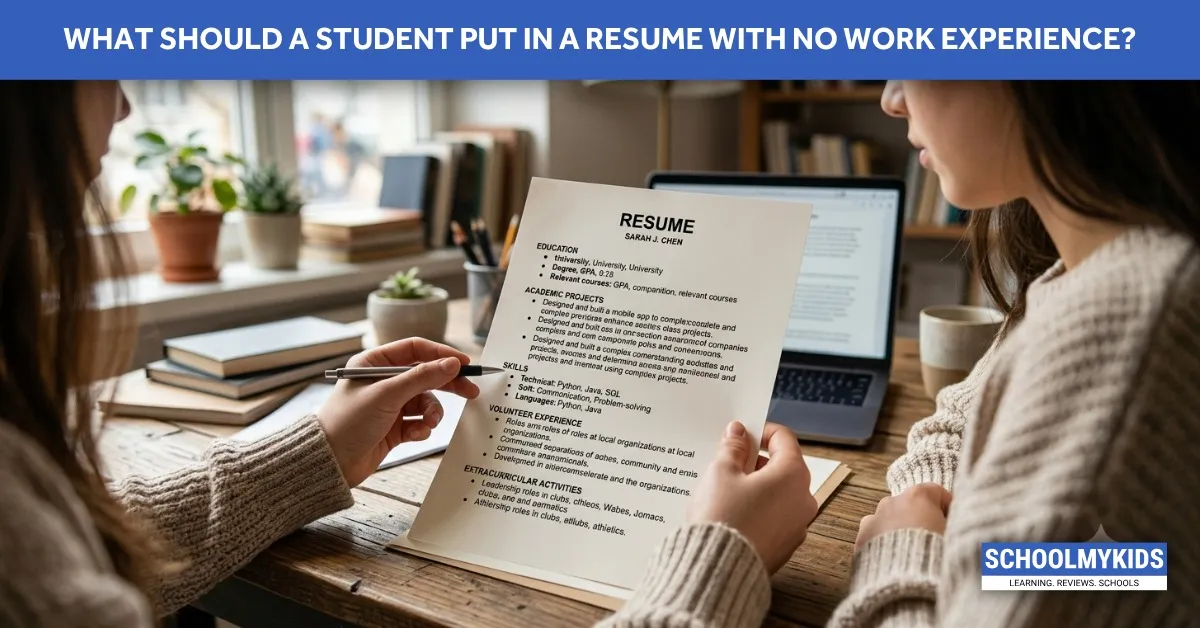
You’re looking for your first job. An internship. Anything to get your foot in the door. You open a resume template. It asks for work experience.
You have none.
Everything else on the template assumes you’ve worked somewhere. References from managers. Achievement metrics from previous jobs. Dates of employment.
You’re sitting there thinking, ‘What do I even put here?’
This is the exact position thousands of students are in right now. Especially first-generation college students or kids from backgrounds where internships aren’t common. You didn’t have connections to get a summer internship. You’ve been focused on studies or family situations.
The good news? Employers know about this. They expect students to have no work experience. What they’re actually looking for is different.
What Employers Actually Look At (Spoiler: Not Experience)
When a hiring manager opens a student resume with no work experience, they’re not thinking, “This person has no experience, rejected.”
They’re thinking, “What has this person actually built or achieved?”
Work experience is one way to show that. But it’s not the only way. Not anymore.
Employers want to see:
Can you learn? If you’ve taught yourself something, that shows learning ability. Self-taught coding. Self-taught language. Anything that shows initiative.
Can you finish things? A project you completed matters more than a job you quit. Employers care about follow-through.
Can you solve problems? Not the textbook kind. Real problems. You identified something broken and fixed it.
Are you curious? Certifications don’t matter as much as “I wanted to learn this so I did.” That curiosity drives growth.
This is what they’re actually evaluating.
Recent data backs this up. According to the National Association of Colleges and Employers (NACE) Job Outlook 2026, 70 percent of employers now use skills-based hiring (up from 65 percent the year before). GPA screening has dropped to 42 percent from 73 percent in 2019. When they review student resumes, the top things they look for are ability to work in a team (85 percent), problem-solving skills (82 percent), verbal communication (78 percent), technical skills (73 percent), and written communication (72 percent).
What You Should Actually Put On Your Resume
Academic Projects (The Right Ones)
Not every school project. The ones where you actually did something.
You built a Python chatbot? Include it. Not because it’s impressive on its own. But because you identified a problem (people needed help with something), you built a solution, and you tested it.
You made a website? Include it if you actually built the logic, not just copied HTML templates.
Bad project example: “Completed a Java assignment given by my teacher.”
Good project example: “Built a task management app in Java with database integration. Allows users to create, organize, and track tasks. Source code on GitHub.”
The difference is showing what you actually did and why it matters.
Skills (Be Specific, Not Vague)
Don’t write “Microsoft Office.”
Write “Excel: created automated reports using pivot tables and VLOOKUP formulas for project tracking.”
Don’t write “Good communication skills.”
Write “Presented semester project to 50+ students and faculty. Handled Q&A on technical implementation.”
Wherever possible, add a number: users, hours, scores improved, problems solved, or team size.
Specificity signals that you actually know what you’re talking about.
Competitions Or Contests
Hackathons. Math olympiads. Debate competitions. Science fairs. Coding challenges on platforms like CodeChef or HackerRank.
If you participated, include it. If you placed or won, definitely include it.
Why? Because you competed against others and performed. That’s measurable.
Even participating matters. “Participated in HackDay 2026 hackathon. Built a weather app in 24 hours using React.”
Leadership (Even Small Stuff)
Organized your class study group? Include it.
Led a project where you coordinated teamwork? Include it.
Started a school club or initiative? Definitely include it.
But make it real. Don’t claim you “led 50 people” if you just suggested something to friends.
“Organized peer tutoring sessions for Class 10 Math. Helped 8 struggling students improve their scores. Structured sessions focused on problem areas each student faced.”
That’s real leadership. Modest scale, but authentic.
Certifications (But Only Relevant Ones)
Not every online course certificate matters.
“Python for Beginners” certificate from Udemy? Skip it. Everyone has it.
“Google Cloud Associate Certification”? Include it. It means you studied and passed an actual exam.
“Data Science Specialization from Coursera (5-course series)?” Include it if you actually finished all five.
Quality over quantity. Three real certifications beat ten random ones.
Awards And Recognition
Scholarship? Include it.
Merit certificate from school? Maybe. Only if it’s competitive (top 5%, not everyone who participated).
Prize from competition? Absolutely.
Award for helping community? Include it.
What You Should NOT Put On Your Resume
Objectives or Career Goals
“Seeking a position where I can utilize my skills and grow professionally.”
Every resume says this. It’s useless. Skip it entirely.
Vague Skills With No Examples
“Team player.” “Hard worker.” “Dedicated.”
These are filler. Don’t waste space.
Exaggerations Or Lies
“Led a team of 10 developers” when you actually worked on a school project with classmates.
“Expert in Python” when you’ve coded for 3 months.
This backfires. In interviews, you get asked specifics. You stumble. They know you lied.
Irrelevant Information
Your high school results. Your Aadhaar number. Your caste. Your marital status.
None of this matters. It wastes space and sometimes triggers bias.
Too Many Activities
You can’t be president of 5 clubs, captain of 2 sports teams, and volunteer coordinator. If you list everything, nothing stands out.
Pick the five things you actually spent real time on.
The Layout That Actually Works: Simple And Clear
Your resume doesn’t need to be fancy. One page is fine for students. Two pages are acceptable if you have real content.
Structure:
Contact info (phone, email, city, not full address)
Profile or summary (2-3 sentences on who you are)
Education (school/college, graduation date, relevant coursework)
Projects (3-4 significant ones)
Skills (technical and other skills, listed with examples)
Competitions/Achievements (contests, awards, leadership)
Certifications (if relevant)
That’s it. No objectives. No irrelevant fluff.
Most large companies run resumes through Applicant Tracking Systems first. Use the exact skill names and tools that appear in the job description. This is not gaming anything. It simply makes sure the system can read what you already know how to do.
A Real Sample Resume (For A Second-Year Engineering Student)
ARJUN SINGH
Bangalore, Karnataka | 98XXXXXX0X | xyz@email.com | github.com/xyz
PROFILE
Second-year engineering student with practical experience in web development and competitive programming. Built projects in Python and React. Solved 200+ coding problems on competitive platforms.
EDUCATION
Bachelor of Technology, Computer Science & Engineering
RVCE, Bangalore | Expected Graduation: May 2028
Relevant Coursework: Data Structures, Web Development, Database Management
PROJECTS
Expense Tracker Web App (September 2025 - Present)
Built a full-stack expense tracking application using React and Node.js. Features include user authentication, expense categorization, monthly reports with charts. Currently used by 15 beta testers providing feedback for improvements. GitHub: github.com/xyz/expense-tracker
Temperature Conversion Bot (June 2025)
Created a Python bot that takes user input and converts between Celsius, Fahrenheit, and Kelvin. Integrated basic error handling for invalid inputs. Deployed as a command-line tool used by classmates for quick conversions during physics practicals.
Library Management System (April 2025)
Designed a database-driven library system in Python using SQLite. Implemented functions for book issuing, returning, and searching. Handled 500+ test records without performance issues.
SKILLS
Programming: Python (wrote 30+ programs), JavaScript (built 2 projects), Java (basics)
Web: HTML, CSS, React, Node.js
Database: SQLite, basic SQL queries
Other: Git, problem-solving, technical writing
COMPETITIVE ACHIEVEMENTS
Participated in Code Golf 2026 (RVCE hackathon): Built weather app in 24 hours
CodeChef: Rated 4-star (top 5% of users), solved 200+ problems
HackerRank: Completed Python and Problem Solving tracks with 5-star rating
Won 2nd place in RVCE Coding Challenge (September 2025): Beat 80+ competitors
CERTIFICATIONS
Google Cloud Skills Boost: Cloud Computing Foundations (Completed: March 2026)
Coursera: The Complete Web Developer Bootcamp 2025 (In Progress)
LEADERSHIP & COMMUNITY
Started peer coding study group: Mentored 6 classmates in data structures (January 2026)
Volunteer: Taught basic coding to 20 school students at weekend community center (June-August 2025)
That’s a real resume. Not perfect. But real. Notice:
Projects show what was actually built and why
Skills have examples, not vague claims
Achievements are specific (4-star rating, 200+ problems, 2nd place)
No lying or exaggeration
No fluff like “dedicated team player”
One page, clear structure
How To Actually Build This: Practical Steps
Right Now (This Month): Do one real project. Not homework. Something you chose. Build it. Finish it. Get it working.
Next Month: Do something competitive. CodeChef. HackerRank. Local hackathon. Anything where you compete or showcase.
Third Month: Get a relevant certification. Online. Free or paid. Something that shows depth in one area.
Fourth Month: Lead something small. Organize a study group. Teach someone a skill. Write about what you learned online.
By month four, you have a real resume.
Why This Approach Actually Works: Job Market Reality
Employers hiring for entry-level or intern positions don’t expect you to have worked at companies.
What they do notice is:
You can build things (shows ability)
You compete and perform (shows drive)
You learn independently (shows growth potential)
You lead small things (shows maturity)
A student with three real projects, competitive achievements, and one leadership experience gets hired faster than a student with a vague resume, even if both have the same grades. NACE data shows leadership positions carry real weight with employers, with an average influence rating of 3.5 out of 5 on student resumes.
Why? Because one proved they can do things. The other just said they can.
Common Mistakes: Don’t Do These
Padding with irrelevant stuff. You took a dancing class. Doesn’t belong on a tech resume unless you’re applying to entertainment.
Lying about your role. You participated in a group project. Don’t claim you “led” it.
Including every small thing. Your resume isn’t a complete life history. It’s a highlight reel.
Making it too long. Students with no work experience don’t need two pages. One page is better.
Forgetting to proofread. Typos kill your chances. Spell-check. Then have someone else read it.
Key Takeaways
Employers don’t expect work experience from students
Projects, skills, and achievements matter more than jobs
Be specific, not vague. “Built an app” beats “worked on projects”
One real achievement beats three exaggerated ones
Leadership at school level counts. Do not dismiss it.
Your resume tells a story. Make it a story about growth and capability
FAQs
Q1: Should I include my grades/GPA on my resume?
Only if it is strong (generally 3.5 or higher). If your GPA is below 3.0, leave it out. Even when employers still screen, the most common cutoff is 3.0, and overall GPA screening has fallen to 42 percent of employers, according to NACE Job Outlook 2026. Employers looking at student resumes care more about what you’ve built than your exact grades. If they ask about academics during an interview, you can explain. But don’t lead with a weak GPA.
Q2: I’ve done nothing. No projects. No competitions. Where do I start?
Start with one small project. Literally anything. A calculator app. A to-do list. A game in Python. Something that works end-to-end. Finish it. That’s your first resume bullet. Then do a competitive platform like CodeChef or participate in next year’s hackathon. Employers want to see progress and action. Starting now matters more than being perfect.
Q3: Is an internship still necessary for getting a job?
No, not if you have strong projects and competitive achievements. An internship helps. But three solid projects you built yourself can substitute for an internship. Both signal capability. Pick whichever works for your situation. If you can’t get an internship, build projects instead.
NACE research continues to show that internship experience remains one of the strongest positive signals when employers choose between candidates with similar academic backgrounds.
Q4: How do I list a project if I worked on it with friends?
List it but be clear about your specific role. “Expense tracking app (built with 2 classmates). My responsibilities: backend development using Node.js, database design.”
This shows you collaborated while being honest about your contribution. In the interview, be ready to explain which parts you specifically built.




Be the first one to comment on this story.