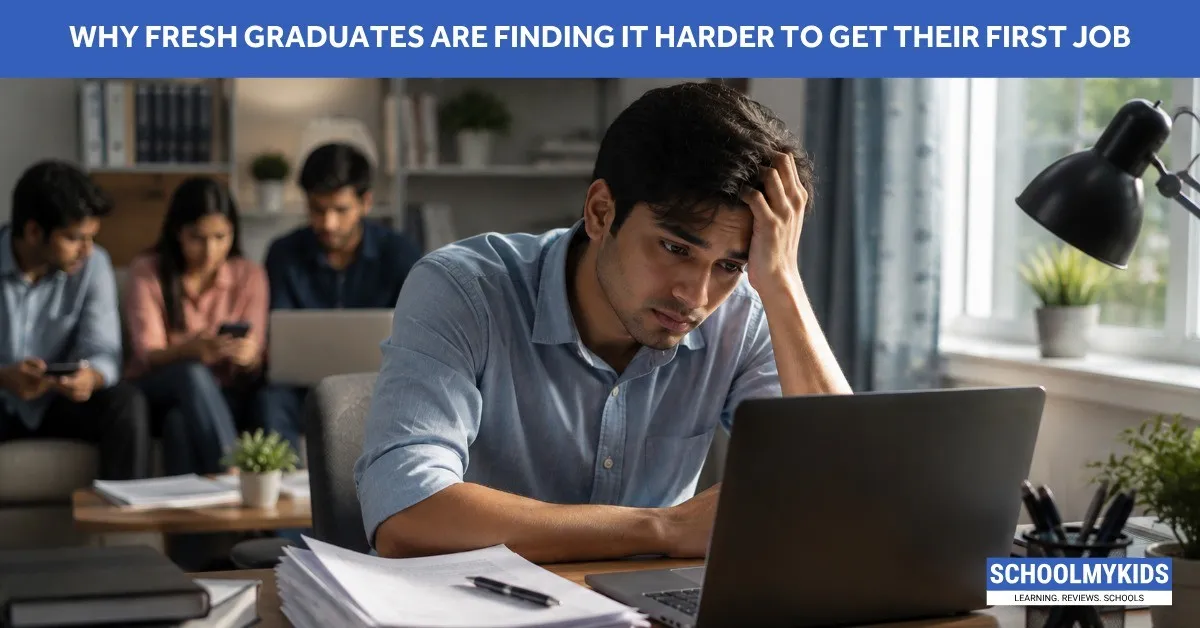
You open LinkedIn. Fifty people from your college have posted “Excited to join” announcements this month.
Seems like everyone got placed. Then you try to apply somewhere, and suddenly you’re competing with 2,000 other people for one position.
Technically there are job openings. Around 2.3 crore vacancies have been mobilised through the National Career Service portal (crossed 2.3 crore by September FY26). That sounds massive until you realize companies can’t find the right people to fill them. So jobs exist. But they’re not matching who graduates are.
The numbers tell this story bluntly. Graduate unemployment sits at 11.2 percent according to PLFS data for calendar 2025. That's more than triple the national average of 3.1 percent (usual status, PLFS annual report for 2025). If you’re a graduate looking for work, you’re in a harder position than someone without a degree. That’s backwards from how it’s supposed to work.
Worse, fewer than 7 percent of male graduates land permanent salaried jobs within a year of finishing college. Only 3.7 percent get white-collar work in that timeframe (State of Working India 2026, Azim Premji University). These numbers sound like failures, but they’re actually what’s happening across the country right now.
Why The Numbers Are This Bad
Start with volume. India’s education system produces engineers at scale. Unstop's Talent Report 2025 found 83 percent of engineering graduates finish college without a job offer or even an internship lined up. For MBA graduates, it's 46 percent. Nearly half leave business school with nothing locked in.
That’s not because companies aren’t hiring. It’s because companies are selective. They’re hiring for specific skills. When 83 percent of engineering graduates don’t have internships, it means they haven’t done practical work. Internships are where you build what employers actually want.
A study measuring graduate skills found only 42.6 percent of Indian graduates possess what employers need (Mercer-Mettl India Graduate Skill Index 2025). The gap between what colleges teach and what companies require is widening. Programming languages change every few years. Your college teaches old versions. Emerging technologies like AI and data science are taught theoretically. Companies want people who’ve actually built something with these tools.
What’s Missing | What Companies Want | Gap |
Practical project experience | 52% of employers demand it | Most graduates have zero projects |
AI and ML fundamentals | Critical skill for tech jobs | Rarely taught in colleges |
Problem-solving through coding | Day-to-day requirement | Graduates can explain theory, not code |
Database management | Basic requirement | Not covered adequately |
Cloud platforms | Industry standard | Most colleges don’t have access |
The supply-demand number is telling. Around 74 to 80 percent of companies and recruiters report struggling to find suitable fresher or skilled candidates. They’re hiring. They’re advertising. They’re not finding people who fit. That mismatch hurts everyone.
Job Creation Itself Slowed Down
In the unorganised sector alone, over 74.5 lakh new jobs were created in 2025 (ASUSE data). Formal and overall net additions have shown mixed momentum compared with stronger earlier periods. Fewer quality openings for graduates means more competition for those entering the market. Fewer quality openings for graduates means more competition for those entering the market.
When Diwali hiring happens, companies post positions. Freshers apply by the thousands. The same person competing in 2024 would get called for interviews. The same person in 2026 barely gets noticed because 5,000 others applied.
The timing sucks. If you graduated in 2024, job creation was strong. Graduate in 2026 and you’re fighting in a tighter market.
The Gender Piece That Nobody Talks About Enough
Female youth unemployment (ages 15 to 29) sits at 17.7 percent (PLFS January to March 2026). The gap with male rates exists at every level. Women face discrimination in hiring even when they’re equally qualified. Some companies have unspoken preferences for male hires. Some have policies about “career break” potential. Some just have bias.
A woman from Tamil Nadu finished her engineering degree with good marks. Got zero internship offers. Applied to 73 companies. Got calls from three. Two rejected her citing “cultural fit.” One offered substantially less salary than the male candidate who got the same job.
That’s one person’s story, but the statistics suggest it’s happening repeatedly.
What Graduates Are Actually Doing
Some are taking jobs paying 20,000 rupees monthly. Entry-level nothing. But it’s work. They figure experience beats unemployment.
Others are doing freelance work. Building portfolios on their own. Taking free courses. Trying to make themselves hireable through effort since college didn’t.
Some go for further education. Master’s degrees. Certifications. Anything to delay entering the job market while hoping conditions improve.
And honestly, many are still living with parents. Not jobless by choice. Just stuck. Checking job portals. Networking. Waiting for something to change.
What Actually Increases Your Chances
Internships during college increased chances significantly. Graduates with internship experience get far more callbacks than those without.
Building projects people can see helps. A portfolio on GitHub. A website you built. A data analysis you did. Something that proves you can do more than pass exams.
Learning specific tools companies use matters more than generic knowledge. If you know Python, that’s basic. If you know Python, TensorFlow, and how to build recommendation systems, that’s marketable.
Networking gets minimized in discussions, but it’s real. Someone who talks to people in their target company, attends meetups, gets coffee with industry professionals, gets calls before the LinkedIn job posting even goes public.
What Helps | Impact | Reality Check |
Internships during college | 3x more callbacks | 83% don’t have any |
Personal projects with code | Gets recruiter attention | Most have nothing to show |
Networking in target company | Often gets role before public posting | Requires effort most don’t do |
Certification in trending tech | Helps but not sufficient alone | Proves some effort was made |
Strong fundamentals in one language | Basic requirement | Most have weak fundamentals |
The Uncomfortable Truth
Universities are treating education like a credential factory. Get the degree, move on. Companies are treating hiring like a filter. We need someone specific. Graduates are treating the job search like a numbers game. Apply to 500 positions, hope someone calls.
This breaks when the three don’t align. Nobody wins. Graduates get rejected. Companies can’t hire. Universities keep producing graduates anyway.
The fix requires actual change. Colleges redesigning curricula. Companies being willing to train freshers instead of demanding five years of experience. Graduates taking responsibility for learning beyond what’s taught.
Key Takeaways
Graduate unemployment rate stands at 11.2 percent (PLFS calendar 2025), more than triple the national usual-status average of 3.1 percent for 2025.
Fewer than 7 percent of male graduates secure permanent salaried positions within the first year. Only 3.7 percent land white-collar work (State of Working India 2026).
83 percent of engineering graduates leave college without job offers or internships, according to Unstop Talent Report 2025.
Female youth unemployment reaches 17.7 percent (PLFS January to March 2026).
Only 42.6 percent of Indian graduates possess skills employers actually demand (Mercer-Mettl 2025).
Large shares of companies report difficulty finding suitable fresher candidates.
Over 74.5 lakh new jobs created in the unorganised sector in 2025.
Employers demand AI, data, and related skills that remain uneven in graduate training.
Internship experience increases callback rates by approximately 3 times for graduates
Frequently Asked Questions About Getting Your First Job
Q1: Should I take a low-paying job just to get experience?
It depends on your situation. A 20,000 rupee job at a decent company teaching you real skills beats sitting at home. A 20,000 rupee job at a place where you’ll do data entry for two years wastes time. Judge based on what you’ll actually learn.
Q2: Is a master’s degree worth it if I can’t find a job?
Only if you’re genuinely interested in that field. Don’t do it as an escape from job searching. You’ll still face the same skills gap with a master’s degree if you haven’t built practical experience.
Q3: How important are internships really?
Critical. They’re the difference between “I learned this in class” and “I actually did this.” Companies see internships as proof you can handle real work, not just exams.
Q4: Does my college name actually matter for getting hired?
It helps, but it’s not the main thing. An IIT graduate without projects loses to a tier-three college graduate with a strong portfolio. Companies care more about what you can do than where you studied.
Q5: What if I’m still unemployed three months after graduation?
Start building something. Learn something new. Contribute to open source projects. Do freelance work. Waiting for the perfect job to come won’t work. You need to make yourself valuable first.







Be the first one to comment on this story.