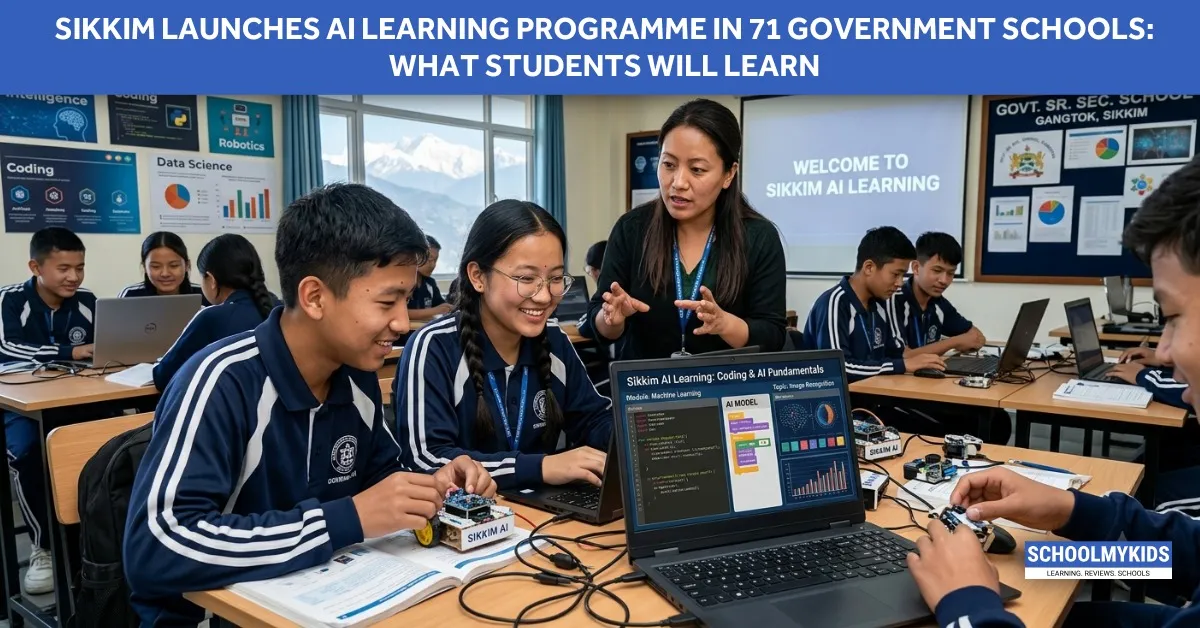
Sikkim started something new in government schools. Not replacing teachers. Just adding a 60-minute class per day where students practice reading and math using AI.
The programme is running in 71 government schools across three blocks of Gangtok district: Khamdong, Nandok and Martam. Right now it’s for Classes 3, 4 and 5 and covers around 2,100 students. The system is called AI-FunZone.
This isn’t some futuristic sci-fi thing. It’s practical. A student sits at a computer. The AI listens to them read. It notices they’re struggling with certain words. Then it gives them practice with those specific words. For math, it identifies mistakes and creates problems focused on fixing that mistake.
How It Actually Works: Not Some Mystery Box
Picture this. You’re learning English. The AI-FunZone programme has you read a passage aloud into a microphone. The system actually listens. Not judges. Just listens and identifies where you stumbled.
Your teacher (the actual person in the classroom) sees a report showing “This student struggles with words ending in -ing” or “This student reads too fast and misses punctuation.” The teacher uses that information during regular class to help you specifically.
For math. You’re solving problems. You make a mistake. Not a stupid mistake. Just a mistake. Maybe you always forget to carry over numbers. The system notices this pattern. It gives you more problems like this one until you get it. It’s like having a tutor who knows exactly where you’re stuck.
The whole thing is designed so you’re not embarrassed. No rankings. No comparing your score to other kids. Nobody’s watching and judging. You just practice until you get better.
Why Sikkim Did This: The Actual Problem They’re Solving
Many students in Classes 3, 4, and 5 are still struggling with basics. Reading fluently. Understanding what they read. Basic math. These are foundation skills. If you don’t nail them now, everything else becomes harder.
National data from ASER 2024 shows that even after recent recovery, only about 23 to 27 percent of Class 3 children in government schools can read a Class 2-level text, and roughly two-thirds still struggle with simple subtraction. By Class 5 the gaps remain wide. Sikkim is not immune to these foundational shortfalls, which is why the state is acting early.
Traditional teaching can’t address this easily. A teacher has 40 students. They can’t give each one individual attention for reading struggles. AI-FunZone does this automatically.
The EkStep Foundation partnered with the Education Department under a Memorandum of Understanding signed in April 2026 to make this happen. They built the system. Sikkim’s government decided to try it. EkStep Foundation is a Bengaluru-based non-profit that works with state governments on foundational literacy and numeracy solutions.
What Each Subject Covers: What Students Actually Do
English Class:
The AI listens to you read stories, paragraphs, and simple passages. It notices if you skip words, mispronounce, or read too fast. Then it gives you more passages with similar words or patterns to practice.
This helps because reading practice with immediate feedback actually improves reading speed and comprehension. You’re not just reading randomly. The system adapts to what you specifically need.
Nepali:
Same concept but in your mother tongue. Reading practice, listening comprehension, simple writing exercises.
The advantage here is that many students are comfortable learning in Nepali. Some find English intimidating in Class 3. Practicing in Nepali builds confidence first.
Mathematics:
You solve problems on screen. The AI tracks your mistakes. Maybe you consistently subtract incorrectly. Maybe you forget to add the decimal point. Whatever your pattern is, the system notices and gives you targeted practice.
This is different from homework where you might just get 10 problems and do them randomly. Here, the problems are chosen specifically for your weak areas.
What Teachers Actually Do: They’re Still The Core
Teachers aren’t replaced. They’re using AI data to teach better.
After students finish their 60-minute AI session, the teacher gets a report. Student A is struggling with word pronunciation. Student B understands the concept but reads too fast. Student C needs help with confidence.
The teacher uses this information during regular class. They can help Student A with targeted pronunciation drills. They can slow down Student B. They can build Student C’s confidence.
Around 300 resource persons and teachers from these three blocks have already completed training on how to use this system. It’s not complicated. But they needed to understand how the data helps them teach better.
The Honest Challenges: What Might Not Work
Internet connectivity is shaky in some areas. Some standalone primary and junior high schools have reported shortages of computers, tablets, headsets or reliable high-speed internet. The department has acknowledged this and is working on it. If your school does not have reliable internet yet, the AI system cannot work, and that school will not be part of the pilot for now.
Not every student has used computers before. Some are nervous. They need time to get comfortable.
Some teachers might worry the AI is judging their teaching. It’s not. It’s just identifying where students need extra help. That’s useful information, not criticism.
Why This Actually Matters: Not Just Tech For Tech’s Sake
By Class 6, many students have already fallen behind because foundation skills are weak. Class 6 teachers assume students can read fluently and do basic math. If they can’t, Class 6 becomes impossibly hard.
AI-FunZone addresses this gap now. Before it becomes a huge problem.
Plus, it’s low-stress practice. Non-examination-based means students can practice without fear. No marks. No rankings. No teacher watching. Just practice and feedback.
How You Benefit If You’re In Classes 3-5: The Student Angle
You get personalized practice. Not one-size-fits-all. Your weak areas get attention. Your strong areas get challenged more.
You get feedback instantly. Not waiting until the test to find out you got it wrong. You know immediately and can fix it.
You get confidence. Practicing in a safe space (no judgment, no public ranking) actually builds skill.
You free up your teacher’s time. They spend less time on rote teaching and more time on real understanding.
What Happens Next: Timeline
Right now it’s a pilot in 71 schools in Gangtok. The government is watching results. If it works, it’ll probably expand to other districts.
According to the Education Department, teachers have responded positively to the technology, graphics, audio and interactive activities, and students have shown enthusiasm for the play-way approach. School heads find the programme relatively straightforward to implement.
Key Takeaways
AI-FunZone is a 60-minute practice class in English, Nepali, and Math
It’s for Classes 3-5 in 71 Sikkim government schools
The AI listens, identifies weak areas, gives targeted practice
Teachers use the AI data to help students better
No public rankings, no examination pressure
Aims to strengthen foundation skills before Class 6
Teachers remain central; AI is support tool
Around 300 resource persons and teachers trained; positive feedback so far
Covers around 2,100 students in the current pilot
FAQs
Q1: Is AI-FunZone replacing regular Math and English classes?
No. It is a 60-minute AI-FunZone class built into the regular school day. Regular classes continue as before. The AI-FunZone is pure practice and remedial help. Your regular teacher still teaches concepts in class. AI-FunZone helps you practice what you learned.
Q2: What if my school is in one of the three blocks but doesn’t have good internet?
The government acknowledged this problem. Some schools reported infrastructure shortages. They’re working on improving internet connectivity. If your school doesn’t have it yet, you might get access later when infrastructure improves. For now, if your school doesn’t have it, you won’t be in the pilot.
Q3: Will my scores improve immediately?
Not overnight. But consistent practice over weeks and months definitely builds skills. You’ll notice you’re reading faster or making fewer math mistakes. Your regular teacher will notice your improvement. Exam scores usually improve once foundation skills are strong.
Q4: Is this only for students who struggle?
No. It’s for all Class 3-5 students in participating schools. Even strong students get more challenging practice. The AI adapts to your level, so everyone benefits whether they’re struggling or advancing quickly.
Q5: What should parents know or do?
Nothing extra is required at home right now. The practice happens in school. You can simply ask your child what they practised that day and encourage them to keep trying without pressure. The system is designed so children improve at their own pace.





Be the first one to comment on this story.