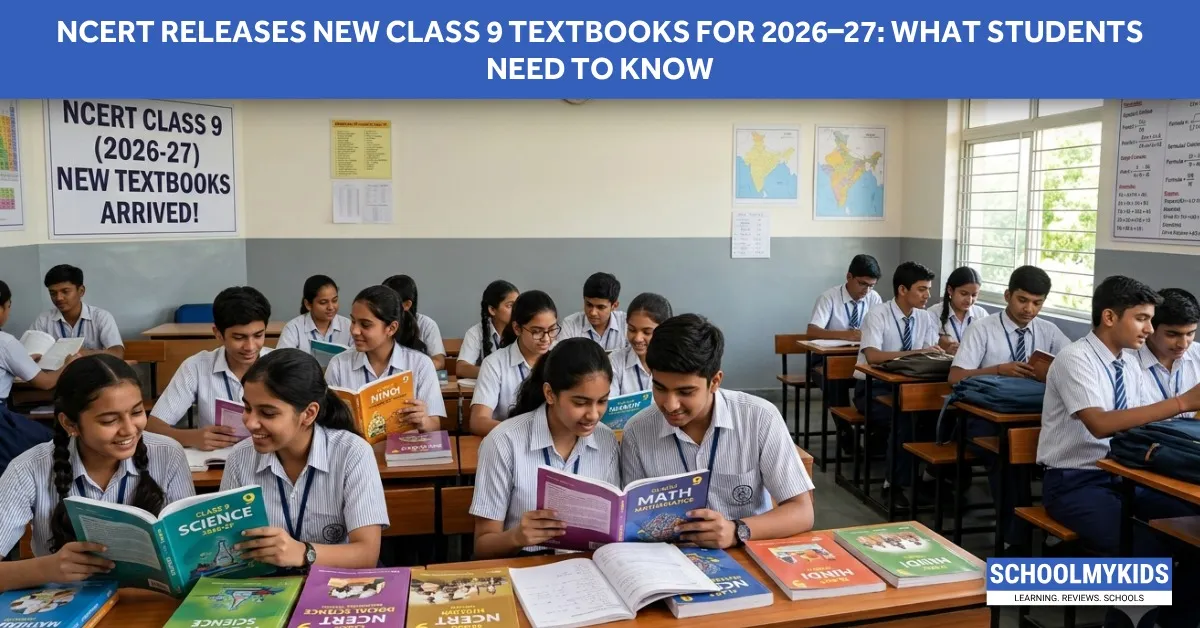
NCERT just released two new Class 9 textbooks. Ganita Manjari Part 2 (that’s Math) came out on September 21. Understanding Society: India & Beyond Part 2 (Social Science) comes out on September 30.
If you're in Class 9 right now, there's a good chance your school will be using these books this year. Schools that follow the NCERT for CBSE usually switch to the official editions once they are released.
Why NCERT Changed The Books: The Real Reason
New Education Policy 2020 happened. Then the National Curriculum Framework came out in 2023. Both of these changed what students should actually learn and how teachers should teach.
The old books were designed for rote learning. Memorize facts. Answer questions. Get marks. That approach was fine when that’s what exams wanted. But exams changed. Teaching style changed.
The new books reflect this. Less “remember this date” and more “why did this happen.” Less “solve this problem the way I showed you” and more “try different approaches and see what works.”
It’s not a total overhaul. Same subjects. Same general topics. But the approach is different.
Ganita Manjari Part 2: The Math Book
This is the second part of your math textbook. Part 1 covered the first half of Class 9 math. Part 2 covers the rest.
Part 2 completes the Class 9 Mathematics syllabus for 2026-27. The exact chapter list will be clear once the printed book is in hand. The overall approach stays the same as Part 1: more visual explanations, practical examples and less pure formula memorisation.
The new books put stronger weight on understanding why a concept works and how it shows up in real situations.
Does this help you score better? Depends.
If you understand why something works, you remember it longer. If you just memorize formulas, you forget them after the exam.
Understanding Society Part 2: The Social Science Book
This covers the second half of Class 9 social science. Geography, history, civics stuff.
The shift is the same one already visible in Part 1: more focus on understanding causes, connections and how systems work than on pure memorisation of dates or lists.
Questions lean toward "why" and "how" rather than only "what". Geography, history and civics are presented in an integrated way so students see links between places, events and everyday systems.
This matters because Class 9 concepts in civics feed directly into Class 10 board questions. If you actually understand how voting works or how laws get made, you can answer questions even if you’ve never seen them before. If you just memorized definitions, any question phrased differently stumps you.
Where To Buy These Books: Very Practical
NCERT sales counters. That means go to your nearest bookshop or your school’s bookshop. They stock NCERT books.
NCERT’s official website. You can order online directly from them.
Amazon. Just search “Ganita Manjari Part 2 NCERT” and it shows up.
The price is reasonable. Part 1 of Ganita Manjari has been selling in the ₹100–180 range on official channels and Amazon. Expect Part 2 and the Social Science book to sit in a similar band once they are fully listed. Not cheap, not expensive.
Your school will probably order in bulk and distribute. But if they’re slow or if you want your own copy early, you can buy independently.
Digital versions of Part 1 books are already free on the NCERT website, DIKSHA and ePathshala. Official PDFs for Part 2 are expected to follow once print stocks settle. Avoid unofficial “Part 2 PDF” links floating online.
Will This Affect Your Marks: The Real Question
Yes and no. If your exam follows the new curriculum framework (which it should), knowing the book helps. If your school is stuck using old teaching methods, you’ll be learning the new content but studying the old way. Mismatch.
Class 9 isn’t the board exam. It’s Class 10 that counts for marks on your transcript. Class 9 is about building a foundation.
If the new books help you understand concepts better, you’ll do better in Class 10. If they don’t change anything for you, well, you’ll study the same way anyway.
What Teachers Are Thinking: From Schools’ Perspective
Teachers are probably mixed on this. Some are excited. New content means new teaching. Keeps things fresh. Some are worried. They learned to teach the old way. Now they need to adjust.
Your teacher might not have fully adapted yet. The book just came out. Give them time. If your teacher is still teaching old-style from the new book, that’s annoying. But it’ll work out eventually.
Practical Stuff You Should Do
Get the book early if possible. Don’t wait till October. Having it now means you can start reading ahead.
Don’t stress if you haven’t started Class 9 yet. The first few weeks are usually easy reviews anyway.
If your school hasn’t switched to these books yet, don’t panic. They will. Or they won’t. Either way, the exam will test you on what you studied.
Mid-term exams for many schools are starting around now. If your school has not yet received Part 2, ask your teacher what portions will actually be tested. Focus on the chapters already covered from Part 1 and any notes your school has shared. Do not panic over the missing book.
The NEP and NCF Thing: What Actually Changed At A Bigger Level
National Education Policy 2020 is India’s big education overhaul. It wants less rote learning, more critical thinking. More practical skills. More career options.
The National Curriculum Framework 2023 is basically the rulebook for how schools should implement NEP.
NCERT books are one tool for this. So the new Class 9 books are part of this larger shift.
Does this mean India’s education system is suddenly perfect? No. But it’s trying to get better. The textbooks reflect that effort.
Key Takeaways
Ganita Manjari Part 2 available from 21 September 2026; Understanding Society Part 2 from 30 September 2026
Books aligned with NEP 2020 and NCF-SE 2023
More focus on understanding than memorizing
Available at NCERT counters, official website, Amazon
Price expected in the ₹100–180 range based on Part 1 pricing
Class 9 marks don’t count for the board transcript, but foundation matters for Class 10
FAQs
Q1: Do I need to buy both parts or just Part 2?
You need both. Part 1 covered the first set of chapters (exact list is in the book itself). Part 2 covers the rest. Your school course requires both parts. You can't just study Part 2 and skip Part 1. Your teacher will be teaching from both throughout the year.
Q2: Will my Class 10 board exams use these new books?
Possibly. If you’re taking the board exam from a school that uses the NCERT curriculum, yes. If your school follows a different board (ICSE, state board), then no. But by the time you reach Class 10, any new changes will have settled. The 2026-27 books are for this year. Next year might have updates.
Q3: My school hasn’t switched to the new books yet. Should I buy them anyway?
Depends. If your school is using old books, buying the new ones means you’re studying different material than your classmates. That’s confusing during exams because your teacher will focus on old book content.
Better to ask your school, “Are we switching to the new books?” If yes, buy them. If no, stick with what everyone else is using. Don’t create extra work for yourself.
Q4: Is the new curriculum harder or easier than the old one?
Different, not necessarily harder. The old curriculum had lots of memorization. The new one asks you to think more. Some students find thinking harder than memorizing. Some find it easier because they actually understand things.
Math problems might be worded differently. Social Science questions will ask “why” more than “what.” If you’re good at understanding concepts, you’ll find it easier. If you’re good at memorizing, it’ll feel harder at first.
Sources
NCERT official announcement, 21 September 2026 (Facebook)







Be the first one to comment on this story.