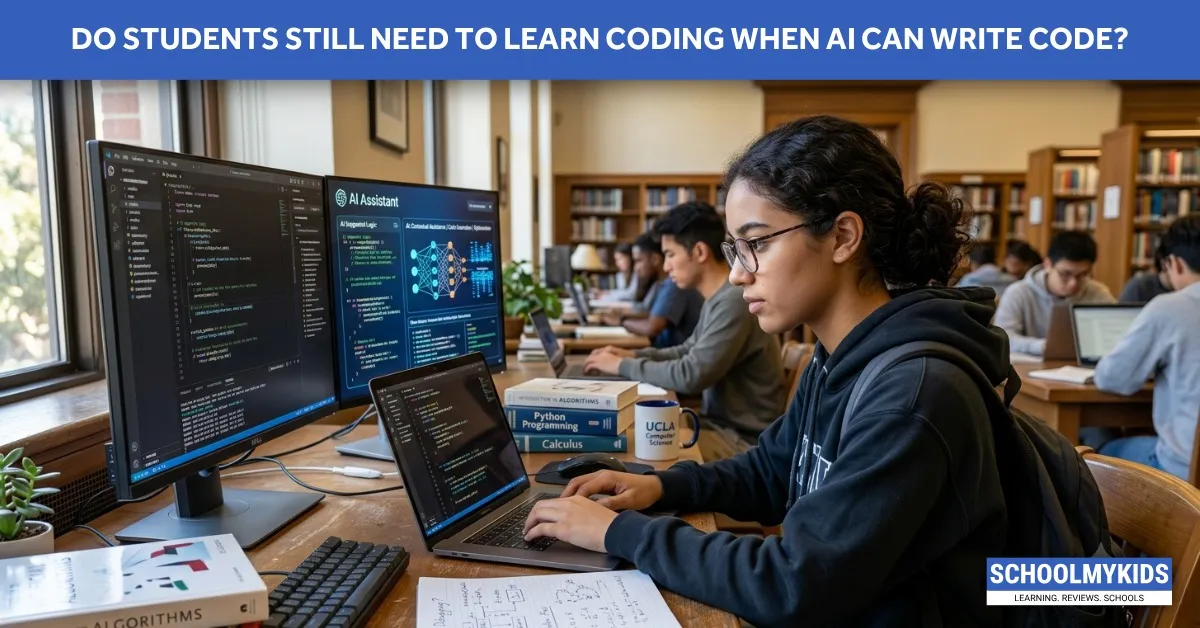
You’re in Class 11. Your school is pushing coding. Online courses cost money. Everyone says, “Learn to code; it’s the future.”
Then you see ChatGPT write perfectly functional Python code in seconds. Claude generates an entire app. You think: why spend months learning something an AI can do in minutes?
Fair question. Lots of students are asking it. Some are skipping coding because of this.
The answer is more nuanced than “yes” or “no.”
What Coding Actually Teaches: Beyond Writing Code
When you learn to code, you’re not just learning syntax. You’re learning how to think about problems systematically.
A student learning Python doesn’t just memorize functions. They learn:
How to break down a big problem into smaller pieces
How to test if their solution works
How to debug when something breaks
Why certain approaches are efficient and others are wasteful
These skills transfer everywhere. Not just programming.
An AI can write code. But an AI can’t tell if that code actually solves your problem. It can’t decide if the approach makes sense. It can’t prioritize what matters.
That’s the human part. That’s what you learn.
What AI Coding Tools Actually Do: The Reality
ChatGPT writes code. It’s impressive. But it has blind spots.
Ask it to write code for something very specific to your company’s system, it struggles. Ask it to write code that integrates with five different APIs you’re using, it gets confused. Ask it to write code that’s secure and efficient, it writes code that’s functional but not great.
A coder looks at the AI output and thinks: “This won’t work with our database. This is inefficient. This has security issues.”
The coder fixes it. The AI didn’t solve the problem. It provided a starting point.
This is already clear. AI code generation is a tool, not a replacement.
Even the strongest 2026 tools still struggle with large proprietary codebases, multi-system integrations, and security edge cases that need human judgment.
The Job Market Reality: What Employers Actually Want
Companies still hire programmers. A lot. Salaries are still high.
What changed is what they’re hiring for. They’re not hiring people who just write code. They’re hiring people who understand problems and can direct AI to write code.
A junior programmer’s job in 2026 isn’t “write code.” It’s “figure out what code is needed, use AI to generate it, test it, optimize it, make sure it works.”
That requires understanding coding deeply enough to know if AI output is correct.
Think of it like this: AI can write essays. That doesn’t mean writers are obsolete. Writers who can direct AI, edit AI output, and ensure quality are more valuable now, not less.
What Skills Matter Now: Practical
Understanding How Systems Work
You need to know how databases work. How APIs work. How networks work. Not at a deep theoretical level. But conceptually.
AI can write code to query a database. But if you don’t understand how databases work, you won’t know if that query is efficient. Or if it’s going to crash under load.
Problem Decomposition
Breaking down a problem into steps. This is something AI is mediocre at. A student needs to say: “Here’s the problem. Break it into parts: part A handles data, part B handles logic, part C handles output.”
Then you tell AI: “Write code for part A.” It does. You check it. You move to part B.
The decomposition is the skill. The code writing is the tool.
Testing And Verification
AI writes code. Is it correct? How do you know? You need to test it. Write test cases. Verify the output.
This requires understanding what correct output looks like. That comes from understanding the problem, not from AI.
Security And Ethics
AI generates code without thinking about security. Is this code vulnerable to attacks? Does it handle user data safely? Does it have bias?
These questions require human judgment. You can’t ask AI if its own output is secure. It’ll say yes even if it’s not.
Career Paths For Coders In 2026: What Actually Exists
The Specialist Programmer
Someone who knows a specific domain deeply. Healthcare systems. Aerospace. Financial trading. These are complex domains where understanding the domain matters more than raw coding speed.
Salary: High. Scarcity: High. Competition: Lower because fewer people explore specific domains.
The Product Engineer
Someone who understands the full product. From user needs to how to build it. They use AI tools but also understand when AI output doesn’t match product requirements.
Salary: High. Scarcity: Medium. Competition: High because it’s appealing.
The Systems Architect
Someone who designs how systems work. They don’t write much code themselves. They design it. Then teams implement.
Salary: Very high. Scarcity: High. Competition: Lower because it requires 5-10 years of experience first.
The AI Training Specialist
Someone who fine-tunes AI models for specific tasks. Trains code-generating AI to work better for their company’s needs.
This is new. The job didn’t exist three years ago. Growing fast now.
Salary: High. Scarcity: Very high. Competition: Relatively low because few people have these skills.
The Actual Job Market Data: What’s Happening Now
Programmer salaries in 2026 (approximate CTC ranges, India):
Fresher, generalist or services track: ₹3.5–6.5 lakhs
Fresher with strong skills or product or specialist track (cloud, security, AI/ML): ₹8–18 lakhs (top product or FAANG-equivalent offers can go higher)
3-year programmer with specialization: ₹15–30 lakhs
5+ year senior with specialization: ₹30–55+ lakhs (and higher at top product firms)
Sources: Talpro India IT Salary Guide 2026, Pathvio and EventBeep 2026 reports, AmbitionBox company data.
Service-company fresher packages have stayed largely flat for years. Specialized skills still command a clear premium.
The job market is bifurcating. Either you specialize and get high pay. Or you’re generic and compete with AI.
What You Should Actually Do: Practical Advice
If You’re In Class 9-10:
Learn coding basics. Python or JavaScript. Spend 6 months. Get comfortable with syntax and logic.
Don’t try to become an expert. Just get literacy. Understand how code works.
This matters because coding and computational thinking now appear in several competitive exams and olympiads. You need the basics.
Parents and schools should treat coding literacy the same way they treat basic digital skills: useful for every student, essential for those who want tech careers.
If You’re In Class 11-12:
Learn coding properly. Not just the basics. Actually build projects.
Build something small. A chatbot. A note-taking app. A game. Something that works end-to-end.
The project matters more than the language. You learn more from building something than from courses.
What does a good student project look like?
A solid Class 11-12 project does not need to be complex. Examples that work well in interviews and portfolios:
A simple expense tracker that stores data locally
A chatbot that answers questions from a small custom dataset
A basic quiz app with score tracking
The goal is one complete, working thing you can explain end-to-end. That carries more weight than certificates.
If You’re In First-Year Engineering:
Pick a specialization. Don’t just take whatever coding course your college offers.
Think about what interests you:
Web development? Learn full-stack development.
Mobile apps? Learn app development.
Data? Learn Python for data science.
Systems? Learn C++ and operating systems.
AI? Learn machine learning frameworks.
Depth matters now. Generalist coding is becoming less valuable.
For Everyone:
Learn how to use AI coding tools. ChatGPT, GitHub Copilot, Claude. Understand how to prompt them effectively. Understand their limitations.
This is a real skill now. Like learning to use Google was a skill 20 years ago.
Free starting points that still work well in 2026:
freeCodeCamp (Python or JavaScript)
CS50 (Harvard’s free introduction)
Official Python or JavaScript documentation + small personal projects
Six months of consistent practice on free resources is enough to reach the literacy level most students need.
The Honest Truth: No Sugarcoating
Entry-level coding jobs are disappearing. Why hire a junior programmer to write standard CRUD applications when AI can do it?
But jobs requiring coding expertise are growing. Companies need people who understand systems deeply enough to direct AI, validate it, and optimize it.
If you want a coding career, you need to go deep. Pick something. Become really good at it. Not just “I know how to code.” But “I’m really good at backend systems” or “I understand cloud architecture” or “I can build scalable databases.”
Generic coding is being automated. Specific expertise is not.
Key Takeaways
Learning coding still matters, but not for writing code
Employers want problem solvers who can direct AI, not people who just write code
Specialization is crucial now; generalist programmers face competition
AI code generation is a tool coders use, not a replacement for coders
Coding teaches systematic thinking, not just syntax
Entry-level generic coding jobs shrinking; specialized jobs growing
Career path requires depth, not breadth
FAQs
Q1: If I learn coding now and AI gets better, will my skills be useless?
No. Understanding how systems work doesn’t become obsolete. The tools change, but the thinking doesn’t. Someone who understands databases deeply will adapt to whatever tools exist in five years. Someone who just memorized Python syntax might struggle more. Learn concepts, not just syntax.
Q2: Should I skip coding and learn AI instead?
No. You need a coding foundation to understand AI. AI is built on top of coding concepts. You can’t understand how to prompt AI effectively or validate its output if you don’t understand coding. Learn coding first. Then specialize in AI if you want.
Q3: What if I’m not good at coding? Should I give up?
Not everyone needs to be a programmer. But everyone benefits from coding literacy. If you’re not loving it after giving it a genuine try (6+ months), maybe programming isn’t your path. That’s fine. There are many careers. But don’t give up after 2 weeks because it’s hard.
Q4: Is coding going to be like math, something everyone learns but few use professionally?
Possibly. In 10 years, coding literacy might be like algebra, something everyone learns in school, but only specialists go deep. But right now in 2026, coding skills still have direct job market value. That’s probably true for another 3-5 years at least.






Be the first one to comment on this story.