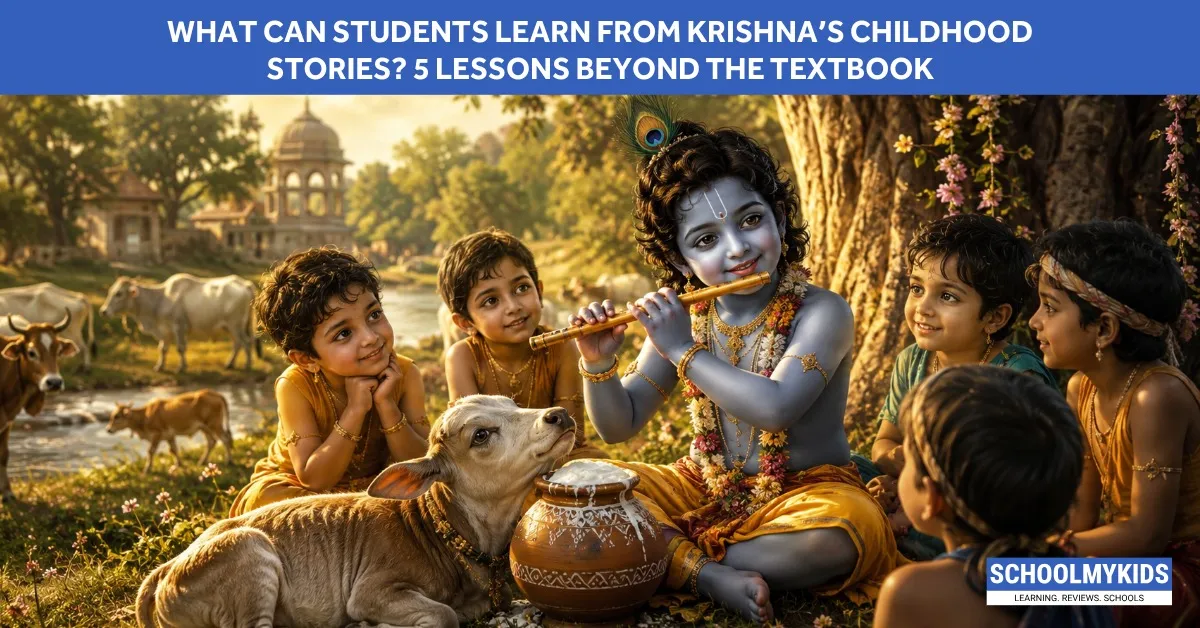
Janmashtami is here. Your kids will hear Krishna stories. They may see pictures of little Krishna with a pot of butter. They may hear about Govardhan Hill. They may even dress up as Krishna at school or at home.
Maybe you'll visit a temple. Maybe you'll tell them a Krishna story before bed.
These stories come from old traditions. But the things they talk about still feel familiar.
Krishna's stories include:
Getting into trouble
Finding a way out of a problem
Helping people around you
Knowing when something is dangerous
Standing up when something is wrong
Being a good friend
The world around your child is very different from Vrindavan. But some of the questions are still the same.
What do you do when things don't go as planned?
How do you help when someone needs you?
Who can you trust?
When should you speak up?
What makes someone a good friend?
That's why these stories can be interesting for students. Not because children need to memorise five lessons. But because they can talk about the stories, ask questions and think about what the characters did.
1. The Butter Stealing Kid (Makhan Chor)
Young Krishna is living with Nanda and Yashoda in Vrindavan. The gopis complain that he repeatedly steals butter and curd from their homes.
One day, Krishna breaks a pot, climbs onto an overturned mortar, reaches a hanging pot of butter, and shares the butter with monkeys before Yashoda catches him.
It's a simple story about a mischievous child.
He sees what he wants. He looks at what's around him. Then he figures out a way to reach it.
What Your Child Can Learn
Creativity isn't always about doing something big. Sometimes it means looking at a problem in a different way.
Krishna's butter stories can help children think about:
Looking at a problem from another angle
Trying a different way when the first one doesn't work
Using what is available
Thinking before giving up
The lesson isn't that children should copy Krishna and break rules. It's about the way he thinks.
Your child may have a school project to finish. They need to work with friends, but talking during class isn't allowed.
They could:
Talk during lunch
Meet before class
Write down ideas
Use a shared document
Ask the teacher when they can work together
That's creative thinking too.
The Modern Connection
Adults often tell kids, "This is how you're supposed to do things." Sometimes that's needed.
But students also need to know what to do when there isn't one clear answer. The first solution may not work. So try another one.
2. The Lifting Of Govardhan Hill
Indra, the god associated with rain, becomes angry. He sends heavy rain, hail and strong winds over Vrindavan.
The villagers and their cattle are in danger.
Krishna responds by lifting Govardhan Hill and using it as shelter. He holds it up for seven days, until the storm stops. It's a huge moment in the story.
But the part students can think about is simple. Krishna sees that people around him are in danger and takes action.
What Your Child Can Learn
When something goes wrong, you can ask, "What can I do right now?"
You can:
Panic
Blame someone
Wait for somebody else
Or look for a way to help
Krishna chooses to act.
Your child's group is struggling with a school project. One person didn't finish their part.
Instead of spending the whole time blaming them, your child could ask:
What is still missing?
Can we divide the work again?
Can I help with one part?
Should we ask the teacher for more time?
They don't have to fix everything alone. Sometimes helping means asking for help. Sometimes it means helping someone else.
The Modern Connection
Responsibility isn't only about being told what to do. It can also mean noticing that something needs to be done and asking how you can help. That's what lifting a mountain can look like in today's world.
3. Krishna And The Demons (Putana, Kaliya, Etc.)
Kamsa wants Krishna killed and sends dangerous beings against him. Putana comes disguised as a woman who appears to care for the child. Kaliya is a different kind of threat. He is a poisonous serpent whose presence has contaminated part of the Yamuna.
Krishna deals with these dangers in different ways.
Putana is defeated.
Kaliya is subdued and is ultimately banished from the Yamuna.
The stories don't show Krishna dealing with every danger in exactly the same way.
What Your Child Can Learn
Danger isn't always easy to spot. Sometimes something may look harmless. Sometimes the danger is hidden.
Children don't need to think that everyone is dangerous. They need to learn some basic safety habits.
For example:
Pay attention when something feels wrong.
Don't ignore personal boundaries.
Don't share private information with strangers online.
Ask a trusted adult when you're unsure.
Tell someone when another person makes you feel unsafe.
The internet makes this even more important. A message can look friendly and still be unsafe. Someone online may not be who they say they are. A friend may also put pressure on you to do something you don't want to do.
The Modern Connection
The lesson here is judgment. Children need to learn that:
Not everyone has good intentions.
Something can look safe and still need caution.
Asking for help is not a weakness.
Staying careful does not mean being afraid of everyone.
They don't have to become suspicious of everyone they meet. They just need to know when to stop, think and ask for help.
4. Standing Up To Kamsa (Dealing With Authority)
Kamsa is the king. He is also cruel and afraid of Krishna. He kills innocent people and tries to have Krishna killed. Krishna eventually confronts Kamsa.
Krishna defeats and kills Kamsa, ending his rule and the danger he posed to Krishna's family and others.
For students, the lesson isn't about copying the violence in the story. It's about understanding something much simpler. Being in a position of power doesn't automatically make someone right.
What Your Child Can Learn
Students need to know the difference between:
Following a fair rule
Questioning something unfair
Speaking up about something unsafe
Asking an adult for help
If an adult is making a child feel unsafe, the answer isn't to fight back alone. The child should tell:
A parent
A trusted teacher
A school counsellor
Another responsible adult
Standing up for yourself also doesn't mean becoming cruel. You can disagree with someone. You can say no. You can ask questions. You can speak up. And you can still treat people with respect.
The Modern Connection
Kids learn early that adults have authority. Parents have rules. Teachers have rules. Schools have rules.
Most rules are there for a reason. But students also need to know that something can be wrong even when an adult says it is right.
Knowing when to follow a rule, when to ask questions and when to ask for help is an important life skill.
5. Krishna And Sudama (True Friendship Transcends Status)
Sudama is Krishna's old friend and former schoolmate.
Years later, Sudama is living in poverty while Krishna has become a powerful ruler in Dvārakā.
When Sudama visits him, Krishna welcomes his old friend with affection and respect. Sudama is embarrassed about his situation. But Krishna doesn't treat him differently because of it.
There is no distance. Krishna welcomes his old friend with affection and dignity.
What Your Child Can Learn
Real friendship doesn't have to change when life changes. Your child's friend may move to another neighbourhood. They may go to a different school. They may not have the same things your child has. That doesn't make them less of a friend. A good friendship is about how you treat each other.
Children can think about questions like:
Do I respect my friends?
Do I include them?
Do I make fun of them for what they have?
Am I only friends with someone because they are popular?
Would I still be friends with them if they had less money or fewer things?
Krishna didn't need Sudama to be rich or important. Sudama didn't need to have money or status to be treated with respect.
The Modern Connection
Friendships can get complicated in middle and high school. Kids may choose friends based on:
Popularity
Clothes
Money
Looks
Social media
What someone can offer them
But those things can change.
A good friend is someone who still treats you well when those things don't matter. That's one of the simplest lessons in the Krishna and Sudama story.
How Parents Can Discuss Krishna Stories With Children
You don't have to turn every Krishna story into a moral lesson. Instead, ask your child what they think.
Try questions like:
What did you notice first?
Do you think Krishna made a good choice? Why?
What would you have done?
Was anyone in danger?
Could something like this happen at school today?
What could the character have done differently?
You can also ask harder questions.
If Krishna steals butter, does that mean stealing is okay?
If Krishna defeats someone dangerous, does that mean children should fight back?
If someone in power is being unfair, when should a student speak up?
When should a child ask an adult for help?
What makes someone a good friend?
There isn't always one answer. That's okay. The point is not to make children memorise five morals. The point is to help them think.
Krishna's stories give parents a simple way to start those conversations. And sometimes, that conversation is more useful than simply telling a child what they are supposed to learn.



Be the first one to comment on this story.