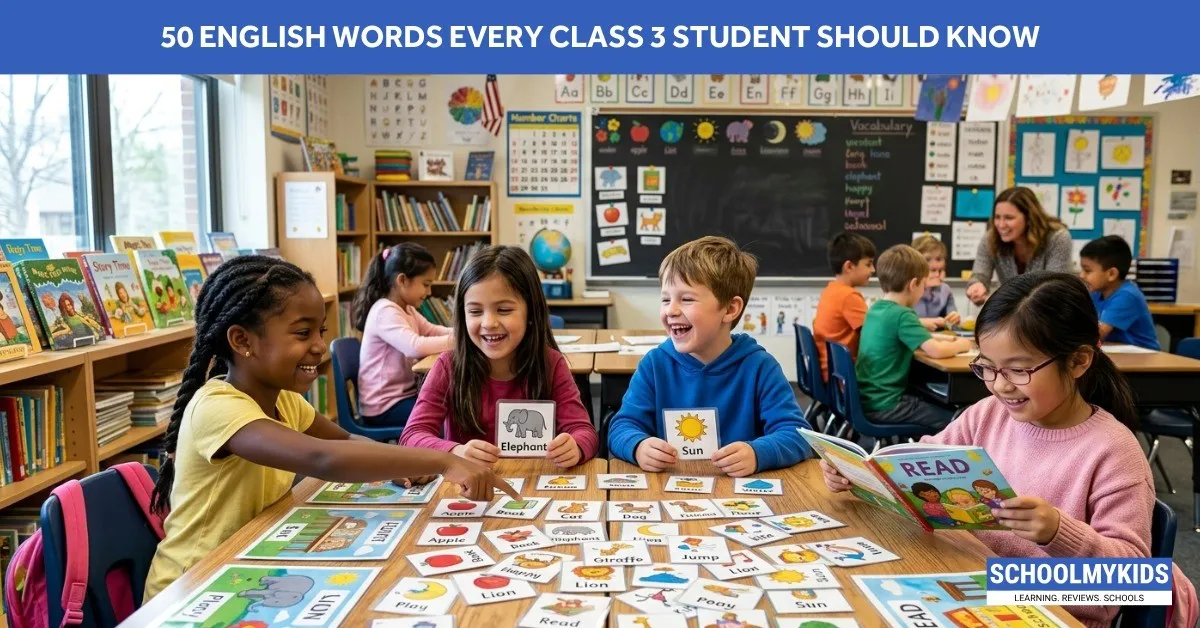
Your Class 3 child reads a story and stops at the word "peculiar." You explain it. Two pages later, the same thing happens with "astonished." By chapter three, you're frustrated, and your child has lost interest.
This is happening to most Class 3 students right now. The vocabulary jump from Class 2 to Class 3 is real. Stories get more complex. Your child needs a vocabulary foundation they can actually build on.
The problem isn't that they're not reading enough. It's that nobody sat down and said, "These are the fifty words you need to understand to make reading feel manageable."
Words About Feelings And Emotions
Class 3 students need to express how characters feel. Not just "happy" or "sad." Real emotional vocabulary.
No. | Word | Meaning |
|---|---|---|
1 | Delighted | Really happy about something special |
2 | Furious | Extremely angry |
3 | Miserable | Very unhappy and sad |
4 | Terrified | Extremely scared |
5 | Proud | Feeling good about something you did well |
6 | Embarrassed | Feeling shy or uncomfortable because people are looking at you |
7 | Relieved | Happy that something bad didn’t happen |
8 | Nervous | Worried and a bit scared about something that might happen |
9 | Curious | Wanting to know more about something |
10 | Jealous | Sad or angry because someone has something you want |
Action Words That Replace "Run" And "Walk"
Class 3 stories use varied verbs. Your child needs to understand them without stopping to ask.
No. | Word | Meaning |
|---|---|---|
11 | Stumbled | Walked unsteadily and almost fell |
12 | Sprinted | Ran very fast |
13 | Trudged | Walked slowly because tired or sad |
14 | Paced | Walked back and forth repeatedly |
15 | Scrambled | Climbed or moved quickly and messily |
16 | Dashed | Ran suddenly and quickly |
17 | Crept | Moved quietly and slowly, trying not to be noticed |
18 | Wobbled | Moved unsteadily from side to side |
19 | Collapsed | Fell suddenly because tired or hurt |
20 | Skipped | Walked forward with a hop in your step, showing happiness |
Description Words That Make Stories Real
These words paint pictures. They're what make stories vivid.
No. | Word | Meaning |
|---|---|---|
21 | Peculiar | Strange or unusual, but not in a bad way |
22 | Vast | Very large, huge |
23 | Resilient | Strong and able to recover quickly after something bad |
24 | Fragile | Easily broken or damaged |
25 | Transparent | Clear, you can see through it |
26 | Scorching | Very hot, burning hot |
27 | Serene | Calm and peaceful |
28 | Treacherous | Dangerous and can’t be trusted |
29 | Abundant | Existing or available in large amounts |
30 | Barren | Empty, with no plants or life |
Thinking And Understanding Words
These words describe how characters think and figure things out.
No. | Word | Meaning |
|---|---|---|
31 | Determined | Having made a firm decision to do something |
32 | Bewildered | Confused and not understanding what’s happening |
33 | Skeptical | Not believing something easily, wanting proof |
34 | Ingenious | Very clever and inventive |
35 | Contemplate | To think deeply about something |
36 | Decipher | To figure out or understand something that’s hard to read or understand |
37 | Scrutinize | To look at or examine something very carefully |
38 | Dubious | Doubtful or not sure if something is true |
39 | Astute | Smart and good at noticing things |
40 | Perplexed | Confused and puzzled about something |
Connecting Words That Improve Writing
These words help kids write better sentences and connect ideas.
No. | Word | Meaning |
|---|---|---|
41 | Subsequently | After something else happens, later |
42 | Furthermore | Additionally, also, besides |
43 | Nevertheless | However, despite that |
44 | Consequently | As a result, because of that |
45 | Initially | At first, in the beginning |
46 | Simultaneously | At the same time |
47 | Albeit | Although, even though |
48 | Conversely | On the other hand, the opposite |
49 | Predominantly | Mostly, mainly, the largest part |
50 | Endeavor | To try hard to do something |
How To Actually Teach These Words (Not Just List Them)
Reading the words once isn't enough. Your child needs to encounter them repeatedly in different contexts.
Read stories together. When you hit one of these words, pause. "That's 'delighted.' Remember, that means really happy about something special. The character in this story is delighted. How do you think they look?"
Use them in real life. "I'm determined to finish this project today." Your child hears the word being used naturally. They absorb it.
Create silly sentences together. "The cat was furious about the barren food bowl." Make up stories. Laugh. Learning sticks when it's fun.
Don't quiz them. Seriously. Quizzing kills interest. Just use the words. Repeat them. Your child picks them up through exposure.
What Class 3 Reading Actually Requires
By the end of Class 3, your child should be able to read chapter books independently. Most grade-level reading expectations place children at longer stories and early chapter books by year-end. Stories with real plots, not just simple narratives. Understanding these fifty words makes that possible.
They're also starting to understand character development. Why people do things. How emotions drive actions. These vocabulary words make that internal world visible.
Frequently Asked Questions
Q1: Should my Class 3 child know all these words?
By the middle of Class 3? Most of them, yes. Not all immediately. But encountering them repeatedly through reading is essential.
Q2: Should I teach them all at once?
Absolutely not. One at a time over the school year. Mix teaching with reading. Encounter the word in a story. Discuss it. Move on. Your child picks it up through context.
Q3: My child knows some of these words but forgets others. Is that normal?
Yes. Brain development. They'll remember "delighted" because it sounds fun. Might forget "simultaneously" for months, then suddenly use it. That's normal language learning.
Q4: What if my child isn't interested in reading?
Then start with stories about their interests. Manga. Comics. Picture books. Don't force "proper" literature. Interest matters more than content type. Once they're reading, these words appear naturally.






Be the first one to comment on this story.