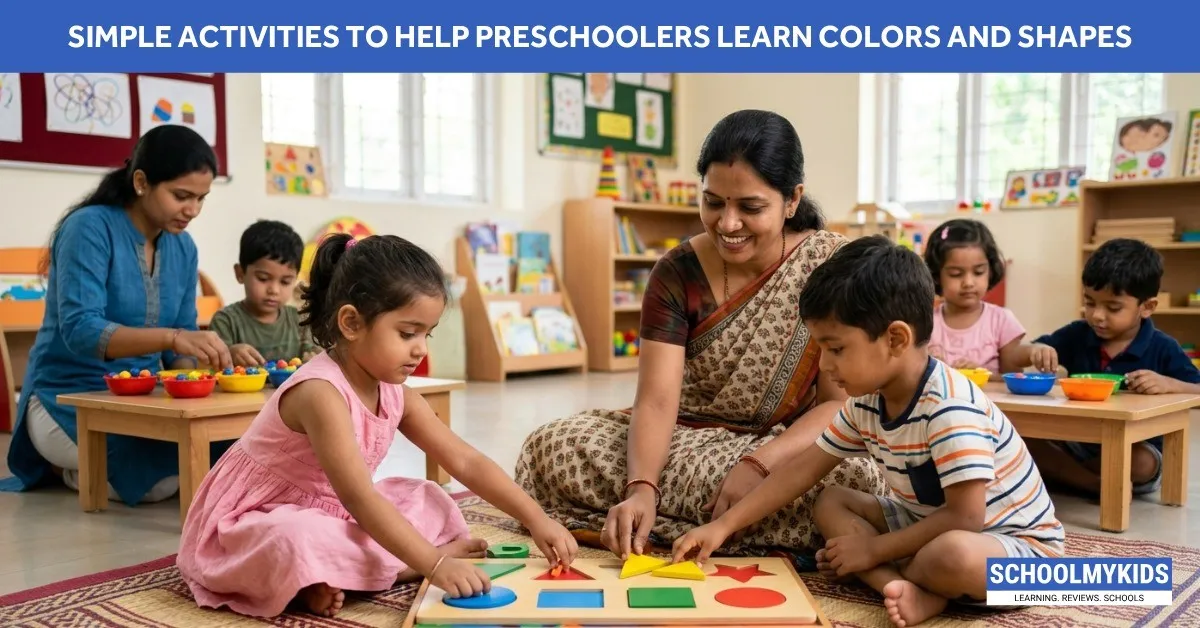
Your three-year-old calls every color “blue.” You’re starting to wonder if you should be doing flashcards or something. Meanwhile, you’re scrolling social media, seeing parents post pictures of their kids reciting colors like it’s the Olympics.
Stop. Your kid’s totally normal. Color matching often begins much earlier, but consistent naming usually settles between ages three and four. Even then, the naming lags behind the recognition. They know blue and red look different. Naming them consistently? That takes more time.
And worksheets and flashcards? They’re not going to speed up the process. Your preschooler’s brain develops on its own timeline. What matters is whether they see colors and shapes repeatedly, in real contexts, during play.
What’s Actually Happening In That Preschooler Brain
Between eighteen and twenty-four months, many kids start noticing color differences and can match a red block to a red cup. Naming is a separate skill. CDC milestones list showing knowledge of at least one color (pointing when asked) around 30 months. Consistent naming of basic colors more often settles between ages three and four, sometimes later, depending on exposure and the child.
Shapes follow a similar timeline. Circles and squares get recognized around two or three. Triangles come later. Your preschooler does not need to know all shapes. They need to recognize the basic ones and start understanding what a shape even is.
The thing nobody talks about is two-attribute thinking. Your kid can identify red. They can identify circles. But connecting them? “The red circle”? That’s higher-level thinking. That develops between three and four.
Why Play Is Actually The Method, Not Just The Vehicle
Parents sometimes think play is how you deliver learning. Like you hide learning inside play to trick the kid into education. Actually, for preschoolers, play IS the learning.
When your preschooler sorts blocks by color, they’re not practicing sorting. They’re learning what color is. When they stack shapes into a shape sorter, they’re not practicing shape recognition. They’re understanding spatial relationships and what shapes do.
The learning happens through the doing. Not before. Not after. During.
This is why worksheets don’t work. Your kid can sit and color shapes you point to. But they’re not learning anything deeper. They’re following instructions. When they play with actual blocks and sort them, their brain is engaged in the concept itself.
The Activities That Actually Stick (Real Ones You Can Do Today)
Finding things around the house matters more than you think. Ask your preschooler, “Can you find something red?” Don’t point. Let them hunt. Their brain is actively searching for the concept. “Find a circle.” They look for round things. They find a plate. A clock. A frisbee. They’re connecting the abstract shape to real objects.
This works because the learning happens in context. The shape or color isn’t isolated on a flashcard. It’s part of something they care about.
Sorting mixed items by color and shape is simple but effective. Grab buttons. Blocks. Pasta. Whatever. Mix them together. Have your preschooler sort them into piles. Today, sort by color. Tomorrow, sort the same items by shape. Same materials. Different sorting rule. Your kid starts understanding that objects have multiple features.
Naming while playing with toys creates natural repetition. You’re playing with blocks. You hand them a yellow one. “Here’s a yellow block.” You’re not drilling. You’re describing what’s happening. Your kid hears the color name connected to the object repeatedly. The word sticks because it’s tied to something they’re actually doing.
Sensory bins with colored items engage their whole body. Fill a container with rice. Add some red buttons. Add some blue blocks. Some green shells. Your preschooler digs around. Feels the textures. Finds the colored items. The sensory experience makes the color learning stick better than just looking at a picture.
Painting and coloring without pressure works because there’s no right or wrong. Give paints. Let them paint. Talk about the colors they’re using. Don’t correct. Don’t say “that tree is supposed to be green.” Just observe. “You used a lot of purple today.” No judgment. Kids learn colors better when they’re experimenting with them, not when they’re being corrected.
Singing about shapes or colors creates rhythm and memory. Make up a simple song. “Circle, circle, what do you see? I see a circle looking at me.” Sing it while pointing to round things. The rhythm makes it memorable. Your kid connects the word with the shape through music, not through drilling.
What Actually Matters More Than You Think
Your kid will learn colors and shapes. They don’t need intensive teaching. They need exposure. You pointing things out casually. Natural repetition.
The frustration most parents feel comes from comparing their three-year-old to someone else’s four-year-old who can name every color. Development isn’t linear. Some kids jump ahead on colors, slow on shapes. Some kids don’t care about either until age four and suddenly know everything.
Also, your preschooler probably knows way more than they can say. They might not name the color, but they can point to it. That’s learning happening. Just not visible yet.
If by age 4 there is still no interest in sorting by any visual feature and other language or learning concerns are present, a chat with the pediatrician is reasonable.
Key Takeaways
Color matching often starts at 18-24 months. Consistent naming of basic colors commonly arrives between ages 3-4 (wide normal range)
Basic shape matching often appears around 18-24 months. Naming of common shapes strengthens across the preschool years
Play-based learning works better than worksheets for preschoolers
Natural exposure to colors and shapes through daily life matters more than flashcards
Two-attribute thinking (color AND shape) develops between 3-4 years
Sorting by multiple attributes teaches that objects have multiple properties
Sensory activities create stronger memory connections
Singing and rhythm improve retention of color and shape vocabulary
Observation and casual naming during play beats formal instruction
Frequently Asked Questions
Q1: My preschooler is 3.5 and still doesn’t consistently name colors. Is that normal?
Yes. Totally normal. Some kids aren’t reliably naming colors until 4 or 5. Development varies. Keep casual exposure going. It’ll click.
Q2: Should I correct my child if they call colors wrong?
Not in the moment. It breaks the flow. Later, casually mention the right name. “This is actually red, not orange.” Then move on. Pressure kills learning for preschoolers.
Q3: My kid loves screens. Can I use apps to teach colors and shapes?
Screens aren’t ideal for this age. Physical manipulation matters. But if your kid does watch educational content, that’s fine. Just make sure there’s also physical play time where they touch and sort and build.
Q4: What if my preschooler has no interest in colors or shapes?
That’s fine. Don’t force it. Talk about them incidentally. Play with what they care about. Their curiosity will develop naturally. Some preschoolers are more interested in letters or animals or vehicles. The learning style matters more than the topic.
Q5: How long do these activities take to show results?
Naming colors consistently takes months, not weeks. But you’ll see recognition faster. A few weeks of regular exposure and your kid can point to colors even if they can’t name them yet.




Be the first one to comment on this story.