Your four-year-old holds a pencil like a fist. Pushes so hard the lead breaks. Can’t draw a straight line. You’re worried they won’t be ready for school.
Then you see other kids the same age writing their names effortlessly. Your kid is just sitting there frustrated. You start thinking about occupational therapy. About whether something’s wrong.
Nothing’s wrong. Your child’s fine-motor skills just aren’t developed yet. And nobody told you that’s normal. That it’s something you can actually build before school starts. That pushing pencil work before the foundation is ready creates exactly the frustration you’re watching.
What Fine-Motor Skills Actually Are and Why They’re Different From What You Think
Fine-motor skills aren’t about writing. That’s the confusion. Writing is just one output of fine-motor development. Real fine-motor skills are about the tiny muscles in your fingers, hands, and wrists working together with your brain to do precise movements.
This involves:
Finger strength - Can your child hold something without dropping it? Can they pick up small objects? Can they maintain grip for extended time?
Hand coordination - Can both hands work together? Can one hand hold while the other manipulates? Can they cross the midline of their body?
Wrist stability - Is their wrist stable when they reach? Or does it flop around? Stability is the foundation for controlled movement.
Finger dexterity - Can they use individual fingers intentionally? Or do all fingers move together in one unit?
Visual-motor integration - Can they look at something and move their hands to match what they see? This is massive and often overlooked.
Writing requires all of these working together. If any piece is missing, writing becomes either impossible or incredibly frustrating.
Why Schools Are Pushing Writing Earlier and Why That’s Backfiring
Current kindergarten curricula expect children to write. Not just scribble. Actual letter formation, often starting early in the year.
Common Core (L.K.1.a) requires printing many uppercase and lowercase letters by the end of kindergarten, and many districts introduce letter formation practice in the first months.
This is newer. Fifteen to twenty years ago, kindergarten was largely play-based. Fine-motor development happened naturally through play.
Research comparing 1998 and 2010 classrooms shows teachers’ academic expectations rose sharply and time spent on play dropped (Bassok, Latham & Rorem, 2016). Now there’s pressure. Performance metrics. Early literacy standards. Schools measure writing ability, and it counts.
Parents panic. They push pencil work at home. Four-year-olds who aren’t ready sit at tables doing writing worksheets. Getting frustrated. Building negative associations with writing. Hating it before they even start.
Meanwhile, their fine-motor skills are screaming “not yet.” But nobody’s listening.
The Real Problem: Skipping The Foundation
What most parents do: Child turns four. School’s starting soon. Time to teach writing.
What actually needs to happen: Fine-motor skill building through play for two years before writing is even introduced. Then writing happens naturally because the foundation is solid.
A child who spent two years building hand strength through play, pinching small objects, manipulating things, coordinating both hands, and tracking with their eyes while moving their hands writes easily in kindergarten.
A child who went straight to pencil work at age four with underdeveloped fine-motor skills struggles. Hates it. Associates writing with frustration.
Same child. Different foundation.
What Happens Inside The Hand And Brain
When a young child picks up a pencil, their brain has to manage several things simultaneously:
Holding the pencil with appropriate pressure (not too hard, not too loose)
Stabilizing the wrist
Moving the fingers to create shapes
Looking at what they’re creating
Recognizing if the shape matches what they intended
Adjusting based on feedback
That’s complex. More complex than it looks.
A child whose fingers are too weak can’t hold the pencil properly. Their brain gets overwhelmed. They either press too hard (breaking the lead) or too loose (nothing shows up). Frustration happens.
A child with poor visual-motor integration looks at the pencil going down the page but can’t control what’s coming out. That’s terrifying. They see other kids writing smoothly while their pencil does random things.
What Development Actually Looks Like (Ages 2-5)
Age 2-3:
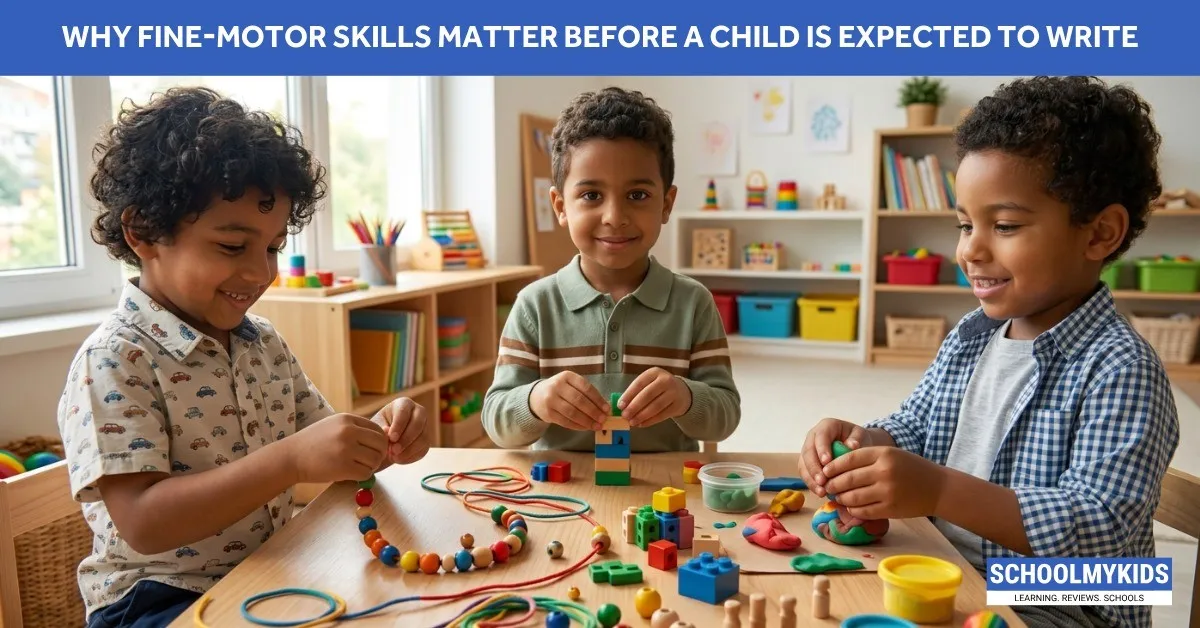
Gross motor skills are the priority. Running, jumping, climbing. But fine-motor development starts. Picking up small objects with thumb and fingers. Stacking blocks. Pouring water (messily). Opening containers.
Your child is building hand strength without realizing it.
Age 3-4:
Hand preference becomes clear (left or right). Pinching gets stronger. Scissors work (safety scissors, cutting paper). Drawing becomes intentional as they’re trying to make shapes, not just scribbling randomly.
String activities. Threading beads. Lacing. This builds precision. Finger independence. Coordination.
Age 4-5:
Copying shapes becomes possible. Square, then triangle. Not perfectly, but recognizably. Hand strength lets them do sustained activities like coloring for ten minutes without exhaustion. Fine-motor control is close to ready for writing.
Each stage builds on the previous. Skipping steps creates gaps.
Activities That Actually Build Fine-Motor Skills (Not Worksheets)
Stringing and Lacing
Your child threads beads on a string. This is literally the best fine-motor builder. It requires:
Pincer grip (thumb and fingers working together)
Hand-eye coordination
Bilateral coordination (both hands working)
Patience
Problem-solving (figuring out how to thread)
Beads, pasta with holes, foam pieces. Any of these work. Do this regularly. Not as punishment. As play.
Playdough And Modeling Activities
Rolling, squishing, pinching playdough builds hand strength. Pinching small pieces off a ball. Rolling it into a snake. Creating objects.
This is why preschools do so much with playdough. It’s not busywork. It’s essential fine-motor development disguised as play.
Add tools. Rolling pins. Cookie cutters. Plastic needles. More variety means more skill-building.
Scissor Work
Safety scissors cutting paper or yarn. Your child needs to:
Hold scissors correctly
Coordinate both hands (one holding paper, one cutting)
Make repeated cutting motions
Control where they’re cutting
Start with cutting strips. Progress to cutting along lines. Then shapes. This takes months to develop. That’s normal.
Water Play With Funnels And Containers
Pouring water, transferring from one container to another, funneling. Hand control. Wrist stability. Visual feedback (they can see if they spilled).
This sounds like just play. It’s building serious fine-motor coordination.
Drawing And Painting
No pressure to make things look good. Just drawing. Lines. Shapes. Whatever.
Crayons, markers, pencils. Different implements feel different. Build varied hand control.
Large paper encourages bigger movements. This is good. Smaller paper comes later when control is better.
Pinching Activities
Picking up small objects with thumb and fingers. Clothes pegs. Tweezers picking up pom-poms. Sorting small beads.
This is pincer grip development. Essential for pencil grip later.
What NOT To Do (Even Though Everyone Suggests It)
Don’t use pencil control workbooks for young children.
Those dotted-line tracing books? For four-year-olds? They’re frustrating. Your child’s hand isn’t ready. The frustration backfires. Pencil work becomes something they dread.
Wait until age 5, when their hand is actually ready.
Don’t force pencil grip before the child is ready.
Yes, pencil grip matters eventually. But forcing it before hand strength exists is pointless. Let them hold it however feels comfortable. Grip naturally develops as hand strength increases.
Don’t make writing practice feel like work.
Writing should emerge from play, not from assignments. If your child is practicing letters because they want to write their name, beautiful. If they’re doing letter worksheets because you told them to, that’s building resistance.
The Current Generation’s Challenge (Screen Time Factor)
Kids born after 2020 are getting less free play. More structured activities. Earlier screen exposure. All of this reduces fine-motor development opportunities.
A child spending time on tablets (tapping with index finger only) gets less hand strength development than a child manipulating blocks and playdough.
A child with early screen exposure sometimes has weaker visual-motor integration. The eyes and hands aren’t coordinating as well because they haven’t practiced together enough.
Teachers are noticing this. Surveys of educators in 2024 and 2025 show most report that young children now struggle more with pencil grip, scissors, and basic hand strength than kids the same age did five years earlier. This isn’t typical development. It’s environmental.
If your child has heavy screen time, prioritize fine-motor activities even more. It’s not punishment for screen time. It’s building what they’re missing.
Red Flags vs Normal Development
Normal but needs support:
Four-year-old can’t write letters yet (completely normal)
Holds pencil in unusual way (develops with practice)
Tires quickly when drawing or writing (hand strength still building)
Difficulty cutting with scissors (skill takes time)
Worth checking with specialist:
Five-year-old can’t pick up small objects with thumb and fingers
Significant difference in left vs right hand strength
Can’t coordinate both hands together at all
No interest in manipulation activities despite exposure
Most kids fall into normal-but-needing-support. This is just development. They’re not behind. They’re on track.
What To Tell Your Child (Instead Of Pressure)
Don’t say, “You need to practice writing.”
Say, “Want to play with beads?” Or “Help me with this lacing?” Or “Let’s make playdough snakes.”
The child doesn’t know they’re building skills. They think they’re playing. Which is perfect. That’s how young children learn best.
When writing emerges naturally, when they want to write their name or label a drawing, support it. Celebrate it. But don’t force it earlier than interest appears.
The Long Game
A child with solid fine-motor skills by age 5 writes easily in kindergarten. Handwriting comes naturally. They can focus on the content (what to write) rather than struggling with the mechanics (how to form letters).
A child without fine-motor foundation struggles with handwriting throughout elementary school. They spend so much energy on pencil control that they can’t focus on actual writing. Writing remains difficult and disliked.
Same child. Different foundation. Everything that follows is different.
Key Takeaways
Fine-motor skills are foundation for writing, not something that develops through writing instruction
Hand strength, coordination, visual-motor integration must develop before formal writing
Play-based activities (stringing, playdough, scissors, drawing) build these skills naturally
Pushing pencil work before foundation is ready creates frustration and resistance
Current generation has weaker fine-motor development due to more screen time, less free play
Kindergarten writing readiness depends on development that happened ages 2-4, not age 5 instruction
What To Do Starting Today
If your child is under five, prioritize fine-motor play over pencil work. Beads. Playdough. Scissors. Lacing. Drawing. These are the investments.
If your child is in kindergarten and struggling with writing, check fine-motor skills first. Hand strength okay? Scissors work? Pincer grip developed? If not, build those while writing practice continues.
If your child is older and writing is still difficult, occupational therapy might help. But also consider whether fine-motor development was skipped earlier. Understanding the gap helps you address it.
Your child doesn’t need to write early. They need to play. To build hand strength. To coordinate their hands and eyes. To manipulate things in their environment.
That foundation, built through play, makes writing effortless when the time comes.






Be the first one to comment on this story.