Every year it goes the same way. Someone buys bamboo sticks and paper. The kids paint ten faces. Everyone watches it burn. It’s fun, but by the third year, children start saying “again?”
And that’s fair. Dussehra has so much more going on. Stories, food, plays, plants, books, even how different states celebrate it. Most of it never reaches children because we stop at the effigy.
So today we are going to explore seven things you can do instead, or along with it. Nothing here needs a big budget. Most need paper, a pen and about an hour.
Easy Ramayana Role-Play Activity for Kids
Ramleela is performed in many parts of India around this time. Kids watch it, but they rarely get to be in it.
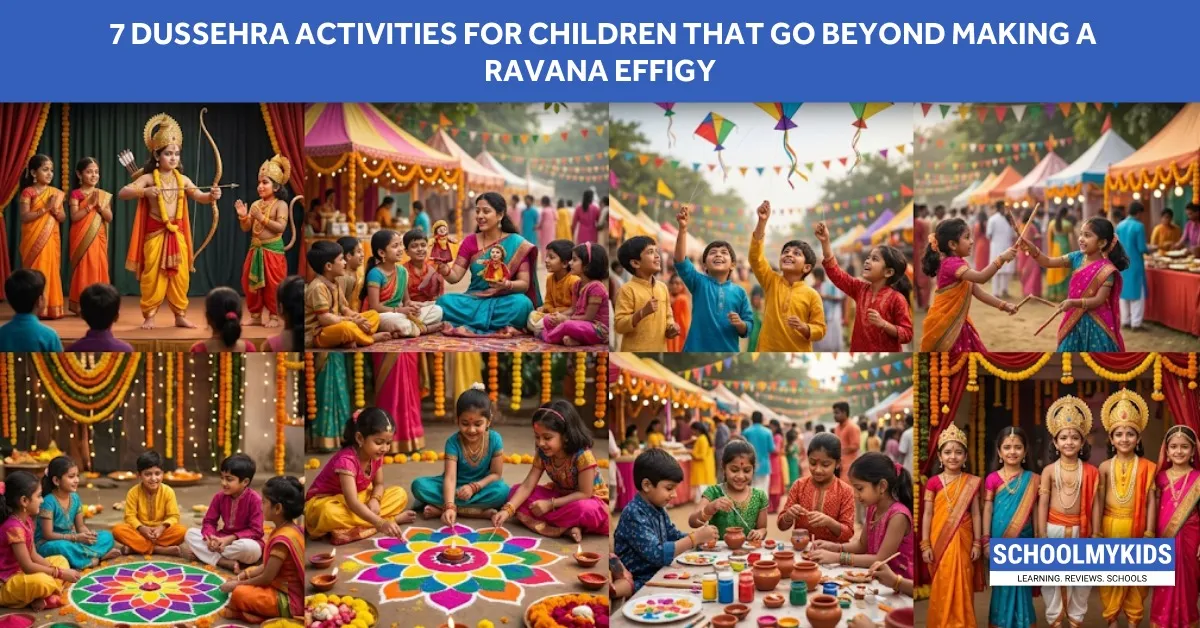
Pick one short scene. Not the whole story. Maybe Hanuman ji crossing the sea, or Sita Mata’s first meeting with Rama ji. Give every child a role, even a small one. Use dupattas, towels and cardboard as costumes.
Don’t aim for a perfect show. The goal is that they understand the scene well enough to say the lines in their own words. A child who has played Hanuman ji will remember the story longer than one who sat through a TV episode.
Best for ages 5–10 | 20–40 minutes
Ten Heads Ten Habits: A Simple Dussehra Reflection Activity
This one is a twist on the Ravana idea, with no burning needed. Draw Ravana with ten heads on a big sheet. On each head, a child writes one habit they want to leave behind. Lying. Skipping homework. Fighting with a sibling. Staying on the phone too long.
Older students can make it more honest. Ask them to also write one habit they want to start. Keep it private if they want. Some children will not share this in front of everyone, and that’s okay.
Parents can join in too. When a child sees an adult write “getting angry quickly” on one head, it stops feeling like a lecture.
Best for ages 8–15 | 20–30 minutes
How Different States Celebrate Dussehra: A Mini Research Project for Children
Dussehra is not the same everywhere. In Himachal Pradesh, the Kullu Dussehra goes on for about a week. In Mysuru, the Dasara celebrations are known for the procession and the palace lighting. Bastar in Chhattisgarh has its own Dussehra, which lasts around 75 days, far longer than most people expect. In West Bengal and nearby states, this time is mostly about Durga Puja and the victory of Goddess Durga over Mahishasura.
Turn this into a small project. Give each child one state. Ask them to find three facts and draw one picture. Then they present it to the family in two minutes.
For older children, add one more rule: they must use two different sources and check that the facts match. That’s a useful habit for school projects too.
Best for ages 9–14 | 30–45 minutes
Ayudha Puja Style Book and Tool Cleaning Activity for Kids
In parts of South India, people clean and worship their tools, instruments and books around Navami and Vijayadashami. Vehicles, machines, musical instruments, and school books all get attention.
You can borrow the idea without making it complicated. Ask your child to clean and arrange their school bag, books and stationery. Cover the notebooks, label the shelf, throw away broken pens.
It sounds boring, but a clean study table does help kids start studying faster. Plus, this ties into a real tradition. In Kerala, Vijayadashami is also when many families start a child’s first lessons in writing, which is called Vidyarambham. So the link between this day and learning is already there.
Best for ages 6–12 | 20–30 minutes
Retell the Ramayana From Another Character’s Point of View
Most children know the Ramayana from one angle. This activity gets them thinking.
Ask them to retell one part of the story from a different character’s point of view. How did Hanuman ji feel when he reached Lanka? What was Sita Mata thinking in the garden? What would a villager in Ayodhya have felt on hearing the news?
This doesn’t change the story or question anyone’s beliefs. It’s a writing and thinking exercise. Children who do this learn that one event can look different from different places, which is a skill they need in history and English classes.
Younger kids can do it as a drawing with speech bubbles. Older students can write a one-page diary entry.
Best for ages 8–16 | 25–40 minutes
Simple Festival Cooking Activity With Kids on Dussehra
Festival food is one of the easiest ways to get kids involved. Let them handle a simple dish while you supervise. Washing vegetables, rolling dough, mixing batter, arranging sweets on a plate. Anything that doesn’t involve a hot stove or a sharp knife for younger ones.
While cooking, ask your child to find out one thing. Is there a special dish made in your family or region around Dussehra? Ask the grandparents. Write the recipe down in a notebook. That notebook can become a small family record.
It also shifts the day. Instead of kids sitting with a phone while adults work in the kitchen, everyone ends up in the same room.
Best for ages 5–12 (with adult help) | 30–45 minutes
Apta Leaves and Planting a Sapling: Nature Activity for Dussehra
In Maharashtra and parts of Karnataka, people exchange the leaves of the apta tree on Dussehra and call it “sona” (gold). It’s a way of sharing good wishes.
You can build on this. Go with your child to a nearby park or nursery. Pick a small plant or sapling. Plant it in a pot at home or in a school or society garden. Write the date on a stick and let your child look after it. Choose a plant that matches your local climate so it has a real chance of surviving.
Check what grows well in your area before buying. A plant that dies in two weeks teaches the wrong lesson. If you don’t have space, ask a local nursery or your resident welfare association what can be planted in shared areas.
Best for ages 4–10 | 20–40 minutes
What These Activities Offer
Each idea stays low-cost, takes under an hour, and gives children a clear skill or memory they can use later at school. Role-play builds recall, the habits sheet encourages self-reflection, the state project trains fact-checking, and planting links the festival to everyday care for living things.
Note: Always supervise younger children with soil, water, and any kitchen tools.
Do You Still Need to Burn the Ravana Effigy?
You don’t have to skip it. For many families, it’s the main event, and children enjoy it. Some local authorities and societies have their own rules on gatherings and fireworks, so check what applies in your area.
If you want a calmer version, you can make the effigy and keep it for display, or make a smaller one from paper and use it for the “ten heads, ten habits” activity above. Both options are fine. The point is to add something, not to take something away.
Quick Dussehra Activity Plan for One Afternoon
Don’t try to do all seven. Pick two or three.
For a 10-year-old, try the state project (3) and cooking (6). For a teenager, try retelling the story (5) and the ten habits sheet (2). For a young child under 7, a short role-play (1) and planting a sapling (7) work well.
Keep each activity to 30 or 45 minutes. Children lose interest fast if it feels like homework.
Key Takeaways for Parents
Dussehra has more to offer children than the effigy alone.
Short role-plays of one Ramayana scene help kids remember the story.
The “ten heads, ten habits” sheet turns the Ravana idea into self-reflection.
Researching how different states celebrate Dussehra makes a good mini project.
Cleaning and arranging books links to Ayudha Puja and Vidyarambham traditions.
Retelling a story from another character’s view builds thinking and writing skills.
Cooking together gets children off screens and into family traditions.
Exchanging leaves and planting a sapling connects the festival with nature.
Pick two or three activities, not all seven.
Frequently Asked Questions About Dussehra Activities for Children
Q1: Which activity works best for children under 8?
Short role-play and planting a sapling usually work best. Young children learn through doing and don’t sit still for long. Keep each activity under 30 minutes and let them use simple props like towels and paper crowns.
Q2: My child’s school gives a lot of homework during the Dussehra holidays. How do I fit this in?
Pick one activity and do it in a single sitting. The state research project can also count as a learning task if your child’s teacher agrees. Don’t add all seven. A relaxed festival day is more useful than a packed one.
Q3: Is it fine to change how we celebrate Dussehra at home?
Yes. Families celebrate this festival in many different ways across India, and traditions vary even between neighbouring towns. Adding activities doesn’t take anything away from what you already do. Ask the elders at home which customs matter most to your family and keep those.
Q4: How can older students use Dussehra for something useful?
Retelling the story from another character’s view is a good writing exercise for Class 8 and above. The state research project also helps with checking facts from more than one source. Both build skills that show up in school projects and exams.


Be the first one to comment on this story.