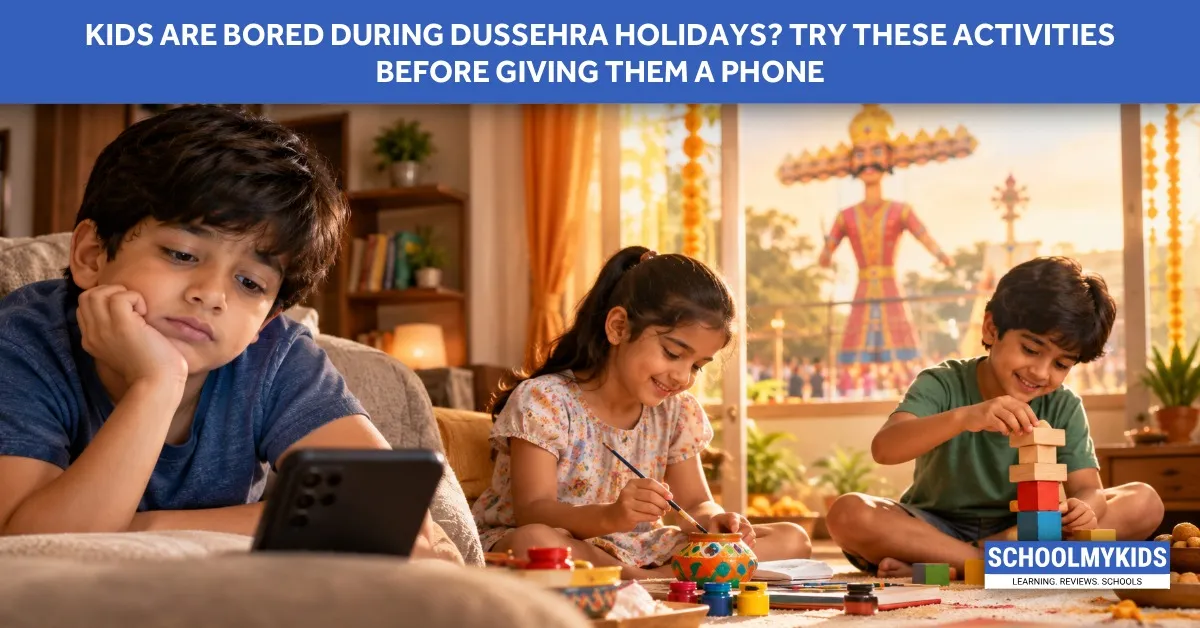
You handed your 10-year-old a phone last Dussehra. Just for an hour, you said. That hour became three. Then the whole day.
Sound familiar? You’re not alone.
Every October, parents face the same problem. School’s out. Dussehra holidays stretch for a week or more. Kids finish their homework in two days. Then what?
They come to you. “I’m bored.” You say go play. They say there’s nothing to do. You say read a book. They say they’ve read all their books.
And then you do it. You unlock the phone. You tell yourself it’s just for a little while. You know how that ends.
So before you hand over that screen, try something else. These are some activities that actually work. No Pinterest-perfect crafts. No expensive supplies. Just things that keep kids busy for more than ten minutes.
First, Understand Why They’re Bored
Why does your kid say “I’m bored” five minutes after finishing breakfast?
Boredom isn’t about having nothing to do. It’s about having nothing interesting to do. And interesting to a kid means messy, active, or slightly risky. Not sitting quietly with a worksheet.
You know what else? Kids today are used to fast stimulation. The phone gives them that. A cartoon often changes scenes every one to three seconds. A game rewards them instantly.
Real life doesn’t work that way. Research from 2024 on young children shows that learning to handle everyday boredom is linked to better self-regulation and coping skills later. So when you take away the phone, everything feels slow. That’s the gap you need to fill.
Activity 1: Build a Ravana That Falls Apart
You don’t need a craft store. You don’t need a Pinterest account. You don’t need to spend money.
Gather old newspapers. Find a glue stick or some tape. Grab a few markers.
Tell your kid: “Make a Ravana. It has to be tall. It has to have ten heads. It can look terrible.”
That last part matters. Kids get stuck when they think something has to be perfect. Give them permission to make it ugly.
A neighbor’s son, Aarav, age 9, spent two hours on this last year. No phone. No complaints. His Ravana had seven heads and one arm. He didn’t care. He was proud.
Why does this work? Because it’s tactile. It’s messy. It has a clear goal but no correct answer.
Activity 2: Go to a Ramlila Rehearsal (Not the Final Show)
You’ve probably taken your kids to the big Ramlila on Dussehra night. The loud one. The crowded one. They fidget through the whole thing.
Try something different. Go to a rehearsal. Any local Ramlila group practices for weeks before the main event. These rehearsals are open. They’re free. And they’re way more interesting for kids.
Why? Because things go wrong. The actor playing Ram forgets his lines. The guy playing Ravana trips over his costume. The sound system cuts out. Kids love seeing adults mess up.
Imagine this. You take your 8-year-old to a Tuesday evening rehearsal. There are maybe 20 people there. Someone hands your kid a small flag to wave. For the next hour, they’re not bored. They’re part of something.
Activity 3: The Great Dussehra Scavenger Hunt
You can set this up in 15 minutes.
Write a list of ten things on a piece of paper. Not generic things. Specific things you know are around your neighborhood or house.
For example:
A leaf that’s bigger than your hand
Something orange
A stone with a hole in it
A flower with exactly five petals
A wrapper that says “recycle”
A stick shaped like the letter Y
Give your kid the list. Give them a bag. Tell them they have one hour to find as many as they can. Keep them in a safe, familiar area and stay within sight or earshot, especially near roads.
Why does this work? Because it turns a boring walk into a mission. Kids love missions. They forget they’re “just walking.”
One parent tried this with her two kids, ages 7 and 11. They spent 90 minutes outside. They argued about whether a rock counted as “something orange.” They came back sweaty and happy.
Activity 4: Cook Something That Requires Smashing
Kids love destruction. Give them a safe way to destroy something, and they’ll be occupied for a long time.
Make a simple snack that requires crushing, mashing, or smashing.
Example 1: Take plain biscuits. Put them in a zip-lock bag. Give your kid a rolling pin or a heavy spoon. Tell them to crush the biscuits into tiny pieces. Then mix with melted chocolate or honey. Roll into balls. Refrigerate.
Example 2: Boil potatoes. Let them cool. Give your kid a fork. Tell them to mash the potatoes until there are no lumps. Add butter and salt. That’s dinner. Stay close when anything hot or sharp is involved.
Why does this work? Because it’s physical. It’s loud. It makes a mess. And at the end, they get to eat what they made. That’s a win for a bored kid.
Activity 5: The “No Phone, No Problem” Challenge
This one is for older kids. Ages 10 and up.
Your kid says they’re bored. You say: “Okay. I’ll give you the phone for one hour. But first, you have to entertain yourself for one hour without it. If you succeed, you get two hours of phone time.”
If this sounds like a reward for the phone to you, try this instead: “You have one hour to create your own fun. It can be anything. A game. A drawing. A story. A fort. Anything. If you do it, you get to choose dinner tonight.”
Now the reward isn’t screen time. It’s control. Kids love control.
Why does this work? Because it flips the script. Instead of you telling them what to do, you’re asking them to decide. That’s harder than it sounds. But most kids rise to it.
What About the Phone?
You might be thinking: “This is a lot of effort. The phone is easier.”
You’re right. The phone is easier. In the short term.
But when you hand over the phone, your kid disappears into a screen. They don’t learn to handle boredom. They don’t learn to make their own fun. Unstructured play is repeatedly linked by the American Academy of Pediatrics to stronger problem-solving, creativity, and emotional regulation. And next holiday, they’ll ask for the phone even faster.
The activities above take some setup. Maybe 10 minutes of your time. But they pay off. Your kid learns that boredom is a starting point, not a crisis.
FAQs
My kid refuses to do any of these. What then?
Start smaller. Don’t announce “we’re doing an activity.” Just leave the newspaper and glue on the table. Walk away. Curiosity usually wins.
What if the activity lasts only 10 minutes?
That’s fine. Ten minutes of real engagement beats three hours of passive screen time. You can try another activity later.
Do I have to do these with my kid?
Not always. For the scavenger hunt and cooking, yes. For the Ravana and the challenge, you can supervise from a distance. Your presence is nice. Your absence is sometimes better.
Key Takeaways
Boredom is normal. Kids need to learn how to handle it.
Short, messy activities work better than structured crafts.
Give kids permission to make things ugly. Perfection kills fun.
Use local resources. Ramlila rehearsals are free and more interesting than the final show.
Turn walks into missions. Turn cooking into smashing. Turn free time into a challenge.
The phone will still be there tomorrow. The boredom won’t.
So before you unlock that screen, try one thing. Just one. Start with the Ravana. It’s a mess. That’s the point.




Be the first one to comment on this story.