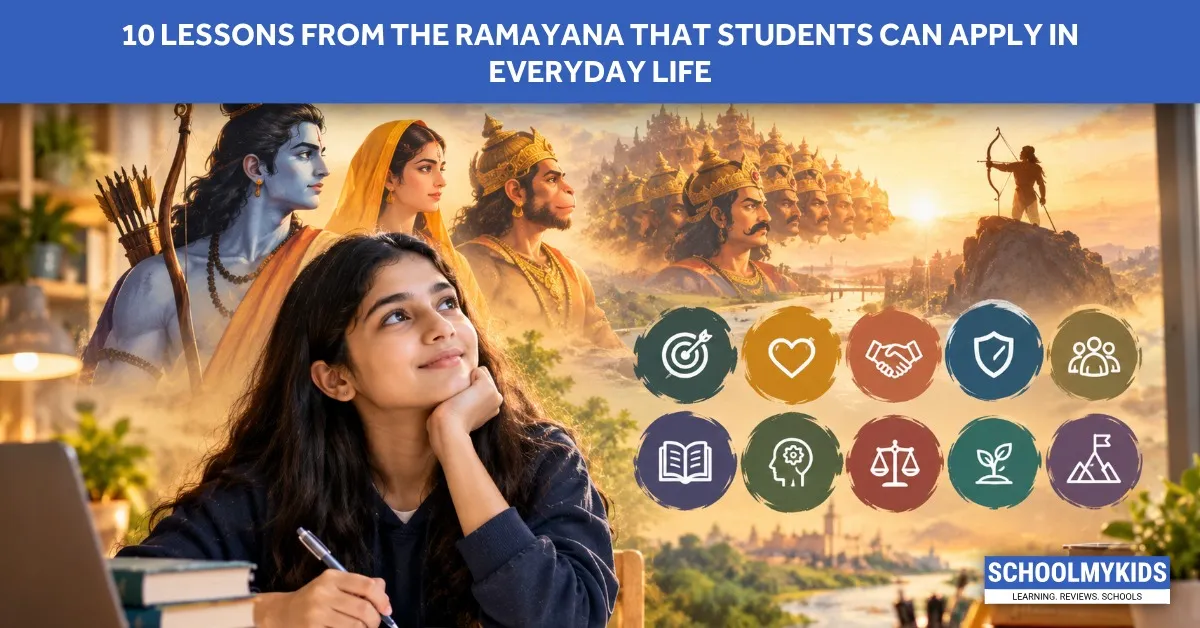
Diwali is almost here. The lanes in your colony are already full of lights. Someone's practising for the Ramleela. And your mother has started dropping hints about cleaning your room before Lakshmi Puja.
It's also the time when the Ramayana comes up everywhere. Not as a chapter you have to memorise. More like a story your grandmother tells while frying pakoras. The same story every year. Good wins. Ravana burns. Lamps are lit.
But most of us hear the ending and miss the middle. The middle is where the real stuff is. The fear. The bad decisions. The waiting. The people who helped. The people who didn't listen.
And it turns out, the middle has a lot to say to a student sitting with a syllabus and a phone.
1. The Exile Was Not a Punishment. It Was a Reset.
King Dashrath of Ayodhya had four sons. Lord Ram was the eldest. Everyone loved him. The kingdom was getting ready for his coronation.
Then Queen Kaikeyi remembered two old boons. She asked for her son Bharat to be king and for Ram ji to be sent to the forest for fourteen years.
King Dashrath was heartbroken. But he had given his word. Ram ji could have fought it. He was the rightful heir. He had the people behind him. But he said yes. He took Sita ji and Lakshman ji and walked into the forest.
Think about that. He gave up a throne because his father had given his word. Not because he was weak. Because he thought keeping your word mattered more than winning.
You will face your own version of this. A bad mock test. A subject you just can't get. A year that didn't go as planned. You can treat it as a punishment, or you can treat it as a reset. The story doesn't end in the forest. It ends with him coming back.
Your bad semester is not the end of your story either.
2. Hanuman ji Forgot Who He Was. Do You Remember?
Hanuman ji was not always the calm, wise figure you see in pictures. As a child, he was mischievous. He troubled the rishis. He caused problems in their yagyas. Finally, the sages cursed him. He would forget his own powers. His strength. His ability to fly. All of it. Gone. Until someone reminded him.
He grew up thinking he was ordinary. He didn't know what he could do.
Years later, when the search for Sita ji reached a dead end, it was Jambavan, the bear king, who reminded him. He told Hanuman ji what he was capable of. And Hanuman ji remembered.
You have a version of this. A subject you think you're bad at because one teacher said so in Class 8. A skill you never tried because someone laughed at you.
Before you decide you're "not a maths person" or "not creative," check once. Do one small thing. You might surprise yourself.
3. The Bridge Was Built One Stone at a Time.
The Ram Setu is the part everyone remembers. But the details matter.
Lord Ram's army needed to cross the sea to Lanka. The vanar sena carried massive boulders and logs and dropped them into the water. And then there was the squirrel.
A tiny squirrel. Picking up small pebbles and dropping them into the sea. That's all it could do. It wasn't lifting mountains. It was carrying pebbles.
Lord Ram noticed. He picked the squirrel up and stroked its back. It is said that three lines appeared on its back, and squirrels still carry those lines today. A statue of that squirrel now stands in Ayodhya, facing the Ram Mandir, honouring a story told in many regional and folk versions of the Ramayana for centuries.
Your syllabus is a bridge. It looks impossible from the shore. But it's built by showing up on a boring Tuesday. One chapter. One page. One numerical. You don't have to lift the mountain. You just have to carry your pebble.
4. Ravana Was Brilliant. And He Still Fell. Why?
Ravana was not a cartoon villain. He was a scholar. He had mastered the Vedas and the six shastras. He had written books on astrology and medicine. He composed the Shiva Tandava Stotram. He was a veena player. He was, by every measure, one of the most learned people of his time.
His ten heads are often read in different ways. Some say they represent the four Vedas and six shastras. Some say they represent ten emotions. Lust, anger, delusion, greed, pride, envy, mind, intellect, will, and ego.
Either way, the lesson is the same. Talent alone doesn't decide where you end up. Character does.
You can be the smartest person in the room and still lose because you didn't listen, or you didn't plan, or you thought you could wing it.
5. Choose Your Sena Carefully.
Lord Ram did not win alone. He had Hanuman ji. He had Sugriva. He had Lakshman ji. He had an entire vanar sena. He even had Vibhishana, who came from the enemy's side, and Ram ji listened to him.
Your friends are your sena. But not all of them.
Some friends will pull you toward the syllabus. Some will pull you toward the group chat at 1 am before an exam. Some will tell you the paper is easy and make you panic. Some will sit with you and actually explain the chapter you missed.
Choose the ones who make you better. Not the ones who make you feel better about doing nothing.
Research shows peer groups strongly shape study habits and exam outcomes. Students whose close friends prioritise academics tend to perform better themselves (OECD PISA peer-effect analyses and NCERT studies on Indian adolescents).
6. Listening Is a Superpower. Ravana Didn't Have It.
Ravana's brother Vibhishana warned him. He told him to return Sita ji. He spoke the truth without fear. Ravana didn't listen. His ego was louder than his brother's advice. He branded Vibhishana a traitor and exiled him.
Vibhishana left. He crossed over to Lord Ram's side. And after the war, it was Vibhishana who was crowned king of Lanka.
Who is warning you right now?
A teacher who says you're rushing. A parent who says you're distracted. A friend who says you're not sleeping enough.
You don't have to agree with everyone. But you have to listen. Good ideas don't check your title first.
7. Patience Is Not Passivity.
Ram ji waited fourteen years. He didn't wait by doing nothing. He built alliances. He planned. He prepared.
Students confuse patience with "I'll study later." That's not patience. That's procrastination with a nicer name.
Real patience is when you keep doing the boring work even when the result hasn't arrived yet. When you revise a chapter you've already revised. When you solve one more mock test even though the last one was bad.
The result comes. It just doesn't come on your schedule. Studies on deliberate practice and spaced revision show that steady smaller efforts over time beat last-minute cramming for long-term retention.
8. Sita ji Did Not Break.
We talk about Lord Ram's calm. We talk about Hanuman ji's strength. We rarely talk about Sita ji.
She was held captive in Ashok Vatika. She was tested. She was doubted. And she still stood her ground. Scholars describe her resilience, her courage, her refusal to lose hope in the worst circumstances. She opposed Ravana with bravery and bought time for Ram ji to find her.
School life has its own Ashok Vatikas. Being left out. Being bullied. Being told you're not enough by people who should know better.
You don't have to fight every battle loudly. Sometimes resilience is just getting up the next morning and going to school.
9. The Ten Heads Are Still Growing.
Every year, we burn Ravana. And every year, the same ten weaknesses grow back in us.
Comparison. Distraction. Ego. Anger. Shortcuts.
The burning is symbolic. It's not a one-time event. It's a reminder to do it again this year. To pick one head and cut it down.
This Diwali, pick one. Just one. Maybe the distraction head. Maybe the comparison head. Thirty days. Try to beat it.
10. Diwali Is Not About the Lamps. It's About Coming Home.
The story ends with Lord Ram, Sita ji, and Lakshman ji returning to Ayodhya after fourteen years. The people lit lamps to welcome them home. That is why we celebrate Diwali. Many people believe Lord Ram returned to Ayodhya after fourteen years in exile, and people lit earthen lamps to mark his homecoming.
Not because a war was won. Because a family came home.
You have your own Ayodhya. Your people. Your home. Your peace. The exam matters. The marks matter. But they are not the whole story. The story is about coming back to yourself after a bad result. Coming back to your people. Coming back to the things that make you feel like you.
This Diwali, light the lamp. Eat the mithai. Fight with your cousin over the last kaju katli. And take one lesson with you.
Not all ten. That's too much pressure. Just one.
The rest will come when you're ready.
Happy Diwali.







Be the first one to comment on this story.