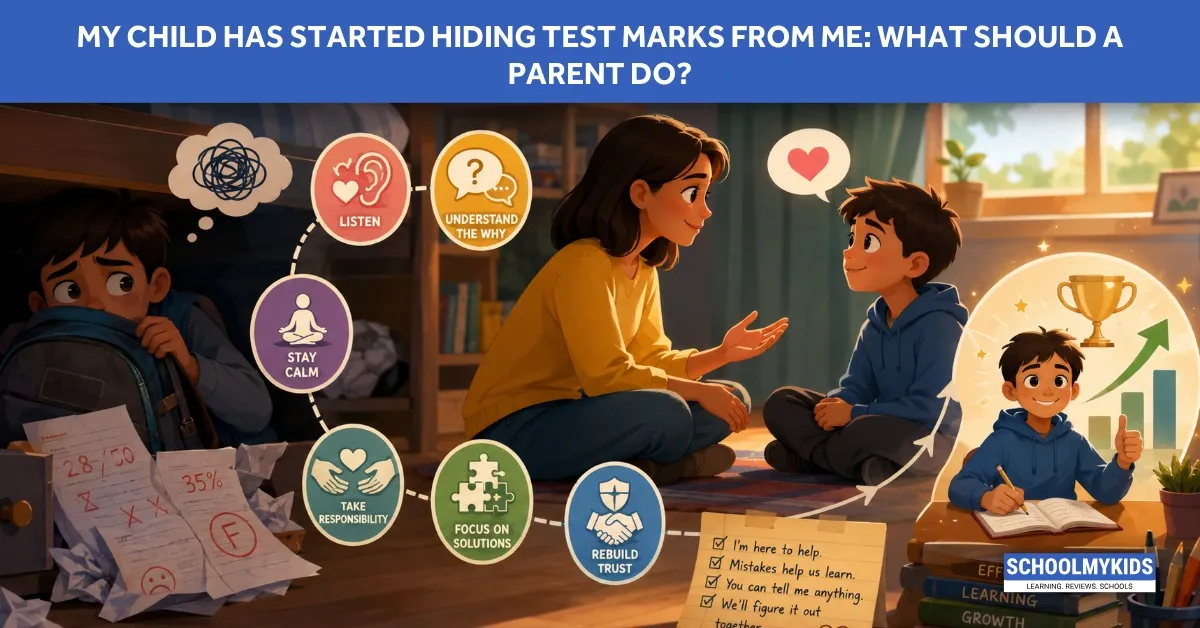
You’re cleaning your son’s room. You find crumpled papers under the bed. Test sheets. From weeks ago. He never showed them to you.
Your heart sinks.
You open them. Math test. 28 out of 50. Not terrible. But not great either. Why did he hide it?
You remember him saying he did well on the test. You remember him being confident about it. Now you realize he lied to your face.
You’re confused. Hurt. Worried. Is something wrong? Is he struggling? Why would he hide instead of just telling you?
This is where a lot of parents freeze up. They don’t know how to respond. Do they get angry? Do they stay calm? Do they confront him immediately or wait?
Most parents panic and make it worse.
Why Kids Actually Hide Marks: Understanding The Real Reason
Your child isn’t hiding marks to be defiant. Research shows that this is rarely the actual reason.
Kids hide marks because they’re scared. Scared of your reaction. Scared of punishment. Scared of disappointing you. Scared of being called stupid or lazy.
In their head, the conversation goes like this: “If I show mom/dad the low marks, they’ll yell at me. They’ll take away my phone. They’ll tell me I’m not studying enough. I’ll get grounded. Life will be miserable.”
So they hide the marks instead. It’s a survival mechanism. Not a sign of a bad kid. A sign of a scared kid. Studies of adolescents consistently link concealment of grades to fear of parental reaction and negative parent-child interactions rather than simple defiance.
Some children have learned that bad marks equal punishment. Maybe in past situations, they got yelled at. Got compared to their cousin who got better marks. Got lectures about wasting their parents’ money on school fees.
Now they’re just trying to avoid that pain again.
Other children are perfectionists. They put enormous pressure on themselves. When they don’t do well, they feel like failures. They’re ashamed. Hiding it feels easier than admitting they tried hard and still didn’t make it.
Some children are dealing with actual learning struggles. They find the subject genuinely difficult. But they haven’t told you because they’re worried you’ll think they’re dumb. So they hide the evidence instead of asking for help.
Survey data and psychological studies from the last decade show that a substantial minority of school-age children hide or minimise poor marks, often because they anticipate disappointment, comparison, or loss of privileges at home. The behaviour is usually a protective strategy, not a character flaw.
Understanding why your child is hiding marks changes how you respond. You’re not dealing with a liar. You’re dealing with a scared kid.
What This Behavior Actually Signals: Red Flags Worth Noticing
When a child starts hiding marks, it’s a signal. Something’s not right in the communication between you and your child.
It could mean:
Your child is afraid of your reaction to bad marks
Your child is struggling academically but hasn’t told you
Your child feels pressured to be perfect
Your child doesn’t trust you with bad news
Something else is going on at school that’s affecting performance
The hiding itself isn’t the problem. The hiding is telling you there’s an underlying problem.
Some parents focus on the hiding. “Why did you lie to me?” They get angry about the dishonesty. But they miss the real issue. Why was your child scared enough to lie?
What NOT To Do: Common Mistakes Parents Make
Don’t Explode
Your instinct might be to yell. “Why would you hide this? This is unacceptable!” Yelling confirms your child’s fear. It proves that showing you bad marks leads to punishment. Next time, they’ll hide even better.
Don’t Shame Them
“You’re so lazy.” “You’re not trying hard enough.” “Your cousin got 95% in math.” Shame doesn’t motivate kids. It makes them hide more. It also damages self-esteem.
Don’t Immediately Punish
Taking away their phone or grounding them might feel like appropriate consequences. But it doesn’t solve the actual problem. It just teaches them to hide better next time. Longitudinal work also shows that punitive responses to underperformance predict lower later achievement.
Don’t Compare To Other Kids
“Why can’t you be like your friend?” This is probably the worst thing you can do. It creates resentment. Makes your child feel like they’re not good enough for you. Drives a wedge between you.
Don’t Assume Laziness
“You’re not studying enough.” Maybe true. But maybe not. Maybe your child is studying but finding the subject genuinely hard. Maybe there’s a learning issue you don’t know about. Don’t assume.
What You Should Actually Do: Step By Step
Step 1: Stay Calm
This is hard but crucial. Your child hid marks. That’s disappointing. But calmness is more important than your initial reaction.
Take a breath. Don’t confront immediately when you’re angry. Wait until you can talk without yelling.
Step 2: Have A Real Conversation
Sit down with your child. Not in front of siblings. Not as punishment. As a conversation.
Start with curiosity, not accusation. “I found these test papers. Can you tell me what happened?”
Listen to what they say. Don’t interrupt. Let them explain.
Step 3: Understand The “Why”
Ask questions. “Why didn’t you show me these marks?” Listen to the answer honestly.
“Were you worried about how I’d react?” If yes, that tells you something important about your relationship.
“Are you struggling with this subject?” If yes, that’s the real issue to address.
“Did something happen at school?” If yes, there might be other problems you don’t know about.
Step 4: Take Responsibility For Your Part
If your child was scared to show you bad marks, some of that is about you. Your past reactions. Your expectations. Your way of responding to disappointment.
You don’t have to accept all blame. But you can say: “I realize I might have made you feel scared to tell me about bad marks. I’m sorry about that.”
This matters. A lot. It changes the whole conversation from “you did something wrong” to “we need to fix this together.”
Step 5: Focus On Solutions, Not Punishment
“So math is hard. Let’s figure out how to help you. Do you want a tutor? Do you want to study together? What would help?”
This is where the actual parenting happens. Not in punishment. In problem-solving together.
Step 6: Rebuild Trust
Tell your child: “I want you to tell me about all your marks. Good and bad. I promise I won’t yell. I might be disappointed sometimes. But I’m here to help, not punish.”
Then actually do this. When they show you marks, respond calmly. Even if they’re bad. This rebuilds trust.
Make it a regular habit to ask about tests in a low-pressure way: “How did the math paper feel?” rather than “What marks did you get?” This keeps the door open before any hiding starts.
Words That Help Instead of Hurt
Try these instead of “Why did you hide this?”
“I found these papers. Can you help me understand what happened?”
“Were you worried about how I would react?”
“Thank you for telling me the truth now. Let’s figure this out together.”
“I care more about you being honest with me than about any single mark.”
Understanding Your Child’s Perspective: Important To Remember
Your child is in school. They get a test back. They did worse than they wanted. They feel bad about it.
Now they have a choice. Tell you and face whatever happens. Or hide it and avoid the problem.
From their perspective, hiding feels safer.
Think about when you mess up at work. Do you immediately tell your boss? Or do you try to fix it quietly first? Your child is doing the same thing.
Also remember: to your child, school feels high-stakes. They see their friends getting 90s. They get 60s. They feel like a failure. Teachers might make comments. Other kids might tease.
Then they come home to parents who expect good marks. It feels like failure everywhere. The hiding is them trying to preserve some piece of self-respect.
Understanding this doesn’t mean ignoring the hiding. It means responding with compassion instead of anger.
Why Schools Don’t Always Help With This
Schools focus on academics. They give marks. Send reports. But they often don’t help kids develop resilience or healthy attitudes toward failure.
A child gets a bad mark. The teacher might say “study harder.” But nobody asks why the child found it hard. Nobody helps the child develop a growth mindset about failure.
Then the child goes home. The parent gets upset too. So the message the child gets is: “Bad marks mean you’re bad. Everyone’s disappointed in you.”
This creates shame. Which leads to hiding.
A better approach would be: multiple adults (teachers, parents, counselors) working together to help the child see that one bad test doesn’t define them. That struggling with something is normal. That asking for help is good.
But this often doesn’t happen. So parents have to fill that gap.
Real Situations: What Actually Happens
Situation 1:
Ananya got 35% in English. She was scared her parents would compare her to her brother who gets 90s. So she hid the mark. Her parents found out eventually. They yelled. She cried. Now she’s even more scared. Future marks will definitely be hidden.
Better approach: When parents found out, instead of yelling, they could ask what happened. “You usually do better in English. What made this test hard?” Then help her work on reading skills or whatever the issue was.
Situation 2:
Raj got 60% in math. He’s not actually that interested in math. He wants to study music. But his parents have always pushed him toward science and math. So he hid the mark. His parents found out through the school. Instead of understanding his feelings, they blamed him for not focusing.
Better approach: Maybe Raj needs to talk about what he actually wants to study. Maybe he needs permission to pursue his interests instead of his parents’ dreams.
Situation 3:
Priya got a bad mark because of personal issues. Her parents had just gone through a tough time. She was stressed at home. Her school marks dropped. She hid them because she didn’t want to add to her parents’ stress.
Better approach: Priya needed her parents to know she was struggling, not with academics primarily, but with the home situation. The mark was a symptom.
When You May Need Extra Support
If the low marks keep coming, if your child seems unusually anxious or withdrawn, or if the same subject stays difficult for months, talk to the class teacher first. Ask what they are seeing in class. If needed, request a meeting with the school counsellor or consider a learning assessment. Early support is far more useful than waiting for the next bad result.
Key Takeaways
Hiding marks is a sign your child is scared, not defiant
Stay calm when you discover hidden marks
Focus on understanding why, not punishing
Take responsibility for your part in creating fear
Problem-solve together instead of lecturing
Rebuild trust by responding calmly to future bad marks
Help your child see failure as learning, not shame
Consider if there are other issues affecting academics
FAQs
Q1: Should I punish my child for hiding marks?
Punishment usually makes things worse. Your child will just hide better next time. Instead, have a conversation about why they were scared to show you. Address the underlying fear. Then work together on how to improve marks. Punishment might feel satisfying in the moment, but it damages trust long-term.
Q2: What if my child keeps hiding marks even after I’ve talked to them?
That means they still don’t feel safe. Your past responses still scare them. It might take several conversations before they believe you won’t yell. Also consider: are there other issues? Is your child being bullied? Struggling with a learning disability? Sometimes hiding marks is a symptom of bigger problems that need addressing.
Q3: How do I help my child do better in the subject where they got low marks?
First, ask your child what’s hard about it. Is it the subject itself? The teacher? Not understanding the concepts? Then work with them. Maybe they need a tutor. Maybe they need to study differently. Maybe they need confidence-building. Never shame them. Work as a team.
Q4: What if the marks are really bad (like 20% or 30%)?
Really bad marks need attention, but not in the form of punishment. Something’s seriously wrong. It may signal gaps in foundational skills, learning differences, or emotional load that a conversation alone cannot fix. Either your child doesn’t understand the basics. Or there’s something else going on (bullying, mental health, learning disability, home problems). Talk to the teacher. Get their perspective. Consider getting professional help if needed. But the conversation with your child should be about understanding and helping, not about punishment.







Be the first one to comment on this story.