Your child got selected. The school sends an email. “Kindly pay the admission fee by Friday to confirm the seat.”
You’re excited. Your child is excited. You open your laptop to make the payment.
Then you stop.
Something feels off. You haven’t actually looked at the school’s website properly. You know the school’s name. You know it’s supposedly good. But do you actually know what they offer?
This happens to parents constantly. They get caught up in the admission process. They’re happy the child got selected. They pay immediately.
Then a few weeks in, they realize things they should have checked earlier.
“Why doesn’t the school have a science lab?”
“They said they have computers, but there are only 10 for 300 students?”
“The fee structure is different from what was written on the website?”
By then, it’s too late. You’ve paid the fee. Your child is enrolled. You’re stuck.
This doesn’t have to be you. Spend 20 minutes checking these things before you pay anything.
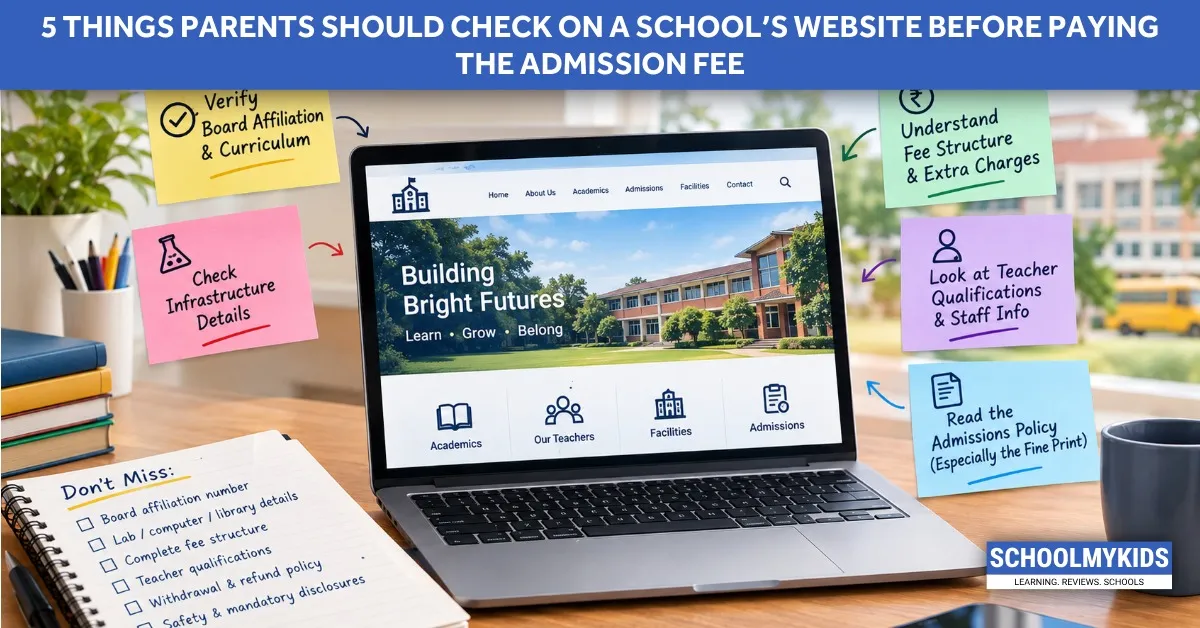
#1: Verify The Board Affiliation And Curriculum They Actually Follow
This is the first thing to check. And honestly, most parents skip it.
Your school says it follows CBSE. But are they actually affiliated with CBSE? There’s a difference between saying you follow CBSE and being officially recognized by CBSE.
Go to the school’s website. Look for the affiliation number. CBSE schools have a specific affiliation code. It is usually in the “About Us” section, “School Information” page, or under mandatory disclosures.
Write down this code. Then go to the official CBSE SARAS portal (saras.cbse.gov.in). Search using the affiliation number, school name, state or district. Confirm the status shows as currently affiliated and check up to which class (Secondary or Senior Secondary).
Why does this matter? CBSE itself has issued repeated public notices in 2025 and 2026 telling parents to verify affiliation before paying any fee. Only officially affiliated schools can register students for Class 10 and 12 board exams and issue recognised marksheets. If the school only says “CBSE pattern” or “proposed affiliation”, that is not the same thing. If a school claims to be CBSE but isn’t officially affiliated, your child’s board exam won’t be recognized. Your marks won’t count for college admission. This is a serious issue.
Some schools are affiliated with state boards (UP Board, Karnataka Board, etc.). Some are ICSE. Some are IB. Each has different curricula and different value in college admissions.
Know which one you’re choosing. Know if it’s actually affiliated. Don’t assume. For ICSE schools, verify on the official CISCE website (cisce.org). For state boards, check the respective state education department portal.
#2: Check The Infrastructure Details They List
Schools love to talk about their infrastructure. “We have a modern laboratory.” “State-of-the-art computer lab.” “Well-equipped library.”
These words sound nice. But what do they actually mean?
Look for specific numbers on the school website. Not vague claims. Actual details.
For science labs: How many? One lab for 500 students? Or one lab per class? Does the website mention what equipment is available?
For computers: How many computers? Ratio per student? Are they for classroom use or just for IT classes?
For library: How many books? Updated periodicals? Is it open during lunch break? Can students borrow books?
For sports: What facilities exist? Just a ground or actual courts for different sports?
Check the photo gallery if they have one. Look at actual images of these facilities. Not just professional renderings. Real photos.
If the website doesn’t mention specific numbers, that’s suspicious. National data shows why specifics matter. As per UDISE+ 2024-25, only 57.1% of secondary schools in India have an integrated science lab. Computer availability stands at around 65 to 70% of schools, and functional computers for teaching are even lower in many states. Vague claims of “modern labs” or “state-of-the-art computers” often hide these gaps. A school proud of its infrastructure will put numbers. “Our science lab has 25 microscopes.” Not “well-equipped lab.”
#3: Look At The Fee Structure And What’s Actually Included
Admission fee. Tuition fee. Activity fee. Sports fee. Transport fee. Building fund. Annual fund. Examination fee. Computer lab fee.
Schools charge for everything. But the fee structure on the website should be clear about what’s included and what’s extra.
Read it carefully. Is transport included or extra? Is lunch included? What about field trips? Who pays for that?
Some schools hide costs. They quote a base fee. Then add 10 other charges that aren’t mentioned upfront.
Get the complete fee structure in writing. Not just what’s on the website. Ask the school for a detailed PDF or document listing every charge.
Compare with other schools. This helps you understand if you’re being charged fairly or if one school is significantly more expensive.
Also check: do they have a refund policy if you withdraw? Many parents later discover extra charges that were never listed upfront. Recent parent surveys show that a large share of private-school families face annual fee hikes of 30 to 80% and unexpected development, activity or building fees. Courts have repeatedly ordered schools to refund non-refundable admission fees when the child never attended classes, calling the practice an unfair trade practice. Know this before you pay.
#4: Verify Teacher Qualifications And Staff Information
This matters. A lot. But many schools keep this vague on their websites.
Look for information about teachers. Qualifications. Experience. The school website should mention this somewhere.
Are teachers qualified for their subjects? A physics teacher should have a physics degree. Not just any degree.
Are there specialist teachers or does one person teach everything? In primary, sometimes one teacher teaches all subjects. That’s normal. But in upper classes, you want specialists.
Check the principal’s background. Qualifications. Years in education. This reflects the school’s seriousness about academics.
Some school websites list staff names and qualifications. Some don’t mention anything. If they don’t provide this info, call and ask. A good school is transparent about their staff.
High teacher turnover is a problem. If the school website shows that teachers are constantly changing, that’s a red flag. Your child’s learning suffers if teachers keep changing.
CBSE Affiliation Bye-Laws require a pupil-teacher ratio not exceeding 30:1 overall and at least 1.5 teachers per section (excluding principal, physical education teacher and counsellor). National UDISE+ 2025-26 data shows the average has improved, but many individual schools still fall short in upper classes.
#5: Read The Admissions Policy Carefully (Especially The Fine Print)
Every school has an admissions policy. It’s usually buried somewhere on the website. But it’s important.
Read it. Completely.
Does the school have a waitlist system? How does it work? When do they confirm seats?
What documents do you need to submit? What’s the deadline?
Most importantly: what’s their withdrawal policy? What happens if you want to take your child out mid-year? Do you get any refund? How much notice is needed?
Also check: does the school have a re-admission policy? If your child doesn’t get promoted, can they retake the year? Or do they have to leave?
Some schools have transfer policies. If you’re moving cities, what happens? Can you get a transfer certificate easily or do they make it difficult?
Read the code of conduct too. What’s expected from students? What are the rules? Your child should understand these before admission.
Quick Red-Flag Checklist
Before you pay, scan for these warning signs on the website:
No affiliation number or the SARAS check fails
Only vague words like “modern” or “state-of-the-art” with zero numbers
Fee structure missing or incomplete
No staff list or teacher qualifications
No safety certificates or mandatory public disclosure page
Board results for the last three years missing or hidden
If two or more of these are missing, pause and dig deeper. Most ranking parent guides treat this checklist as the final filter.
Bonus: Safety And Mandatory Disclosures
While you’re on the website, also look for safety-related information. CBSE-affiliated schools must display details of fire safety certificates, building safety, drinking water and sanitation, and often CCTV and student safety policies under mandatory disclosures.
If these are missing or outdated, treat it as a red flag the same way you would missing lab numbers or teacher details. Child safety and basic compliance are non-negotiable.
Why Some Schools Keep Website Information Vague
Some schools intentionally keep information vague on their websites. Why?
They don’t want parents comparing infrastructure easily. If you can’t see exact numbers, you can’t compare them to other schools.
They want you calling and visiting. Personal interaction sometimes leads to decisions people wouldn’t make from just information online.
Some schools genuinely haven’t updated their websites. It’s outdated. Infrastructure information is from 2020, not 2026.
Some schools are in transition. They’re building new labs or making changes. They don’t want parents complaining about what isn’t ready yet.
None of these are good reasons. A transparent school puts complete information online. CBSE now requires affiliated schools to upload mandatory disclosures (fee structure, teacher strength, infrastructure, results) on their websites.
Questions To Ask On The Phone After Checking The Website
After you check the website, you’ll have questions. Call the school. Ask directly.
“Your website says you have a lab. Can you tell me exactly what equipment is there and the student-to-equipment ratio?”
“How many students per class in the primary section?”
“What’s the teacher-student ratio overall and in the middle and secondary sections?”
“Can I visit the school and see the facilities in person?”
“Are there any charges beyond what’s listed in the fee structure for the current academic year?”
“What’s your refund policy if I withdraw mid-year or before the session starts?”
Write down their answers. Keep them for reference. If there’s a dispute later, you have documentation.
Real Situations Where This Matters
Parent A didn’t check the website carefully. Enrolled her child thinking the school has a proper computer lab. On the first day, she found out there are only 8 computers for 200 students. Too late to change schools.
Parent B checked and called. The website said “modern infrastructure.” When she asked for details, the school mentioned they’re renovating the lab. It won’t be ready for 2 years. She chose a different school that had infrastructure ready now.
Parent C found out after admission that the school has a “non-refundable admission fee” policy. Mid-year, due to personal reasons, he wanted to withdraw. Tried to get the fee back. Couldn’t. It was in the fine print he didn’t read.
Parent D compared fee structures from 5 schools online. Found that one school was charging ₹20,000 more annually for the same facilities as another school. Chose the cheaper one.
These situations are real. They happen to parents who don’t check before paying.
Key Takeaways
Check CBSE (or relevant board) mandatory public disclosures page on the school website
Verify board affiliation using official CBSE/state board websites
Look for specific numbers about infrastructure, not vague claims
Get complete fee structure including all extra charges
Check teacher qualifications and staff information
Read admissions and withdrawal policies completely
Call the school with your questions
Visit in person if possible
Get answers in writing
Compare with other schools
Don’t pay until you’re completely sure
Check the last three years of Class 10 and Class 12 board results (CBSE requires schools to publish them)
FAQs
Q1: What if the website doesn’t have all this information?
That’s a red flag. A school not transparent about basic information might not be transparent about other things either. Call the school directly and ask. If they’re evasive or give vague answers, that’s another red flag. You can also ask to visit in person to see facilities yourself.
Q2: Can a school change fees after I’ve paid admission?
It happens. That’s why you need the fee structure in writing. Some schools show base fees on the website but add extra charges later. Get a document listing all charges for the year. Ask if these can change mid-year and if there are any guarantees.
Q3: How do I verify if a teacher’s qualification is real?
You can’t fully verify without seeing original documents. But you can ask the school for proof during the admission process. Ask to see certificates. A good school won’t mind. Also check if teachers are registered with the state’s teacher registration system (most states now have one) and ask the school for the staff strength and qualification list that CBSE requires them to disclose.
Q4: Is visiting the school in person necessary?
Not absolutely necessary but highly recommended. Website photos can be outdated or staged. Visiting gives you real sense of how the school actually looks, how many students are there, how teachers interact. You can also talk to parents whose children already study there.







Be the first one to comment on this story.