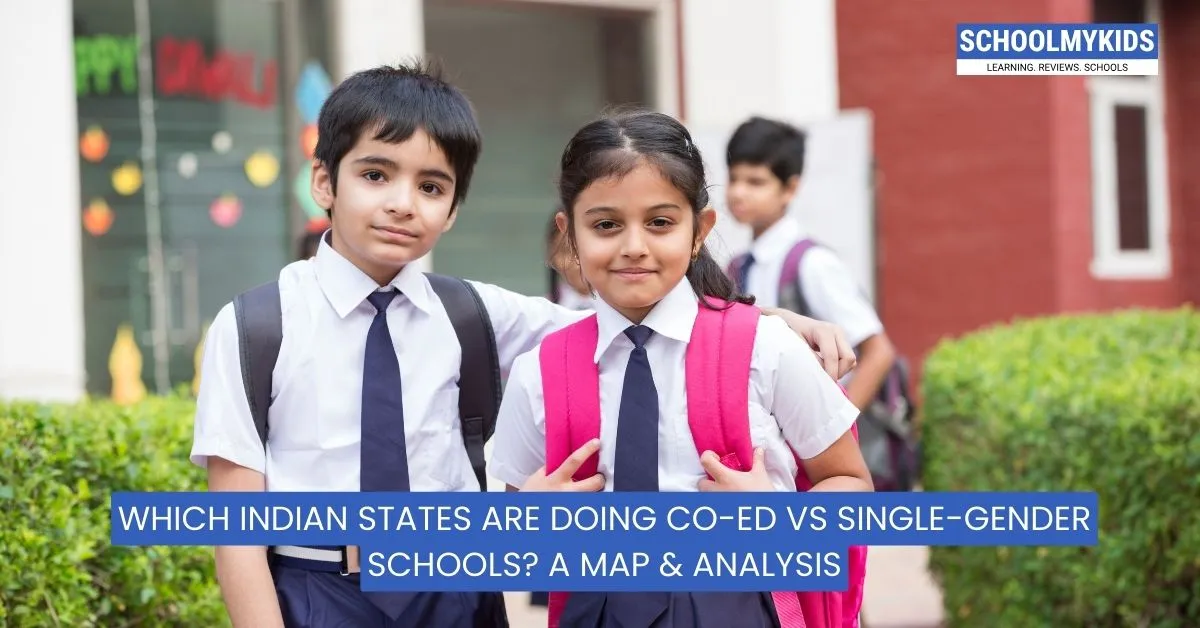
Most Indian schools are co-educational, but a significant minority of state and private institutions continue to run single-gender schools, especially for girls at the secondary and higher-secondary levels in North and West India. The exact co-ed vs single-gender split by state is not fully published in one public dataset, but UDISE+ and related analyses show clear regional patterns that allow a reasonable state-wise picture.
Where Co-Ed Dominates
Across India, co-educational schools are the default at the primary level in almost every state, including rural areas. States such as Kerala, Tamil Nadu, Karnataka, Himachal Pradesh, and most of the North-East (for example, Mizoram and Tripura) rely overwhelmingly on co-ed institutions even in upper primary and secondary grades, supported by relatively high enrolment parity and better female teacher representation.
Urban areas nationwide also lean heavily toward co-ed schools, particularly among newer private unaided institutions that find co-education more economical and aligned with contemporary views on gender equality. In these states and cities, single-gender schools tend to be legacy government girls’ schools or a small number of elite boys’ schools, rather than the norm.
States With More Single-Gender Schools
Single-gender schools—especially girls-only institutions—play a bigger role in parts of North and West India where safety, social norms, and distance to school are major barriers to girls’ education. Rajasthan, Uttar Pradesh, Bihar, Haryana, and some districts of Madhya Pradesh and Gujarat have substantial networks of government and aided girls’ schools at the upper primary and secondary levels, often correlated with lower female secondary GER and higher dropout.
In these states, boys-only schools also exist, particularly at the secondary and higher-secondary level and in older urban institutions, but girls’ schools have expanded faster where policymakers use single-gender schools and separate toilets as tools to boost girls’ enrolment and retention. The presence of many single-teacher and infrastructure-poor schools in states such as Rajasthan and Jharkhand further complicates co-ed implementation in conservative rural communities.
What a Map of India Would Show
A thematic map using UDISE+ school lists and management data would likely show:
- High co-ed concentration: Southern states (Kerala, Tamil Nadu, Karnataka, Andhra Pradesh, Telangana), much of the East and North-East, and metros like Mumbai, Delhi, Bengaluru, and Chennai, dominated by co-ed schools at all stages.
- Mixed pattern: States like Maharashtra, Gujarat, West Bengal, and Odisha with mostly co-ed schools, but noticeable clusters of single-gender schools in certain districts and urban pockets.
- Higher single-gender density: Northern and north-central states such as Rajasthan, Uttar Pradesh, Bihar, Haryana, and parts of Madhya Pradesh, showing larger belts of girls-only and boys-only secondary schools, especially in rural and small-town areas.
Co-Ed vs Single-Gender: Key Differences
Data Gaps and How to Get Exact Numbers
Public summaries of UDISE+ 2023–24 and 2024–25 focus on enrolment, GER, dropout, and school types by management, but do not yet provide a simple, state-wise breakdown labelled “co-ed vs single-gender schools.” To obtain precise state-wise counts or to build an accurate map, institutions typically:
- Download school-level UDISE+ data (where accessible) and classify schools as co-ed, boys-only, or girls-only from their profiles.
- Overlay this with district shapefiles to visualise clusters of single-gender schools and relate them to indicators like girls’ GER, dropout, and female teacher share.
In practical terms, India is steadily moving toward co-education as the norm, but single-gender schools remain strategically important in parts of North and West India, where they are often used to overcome social and safety barriers to girls’ secondary education







Be the first one to comment on this story.