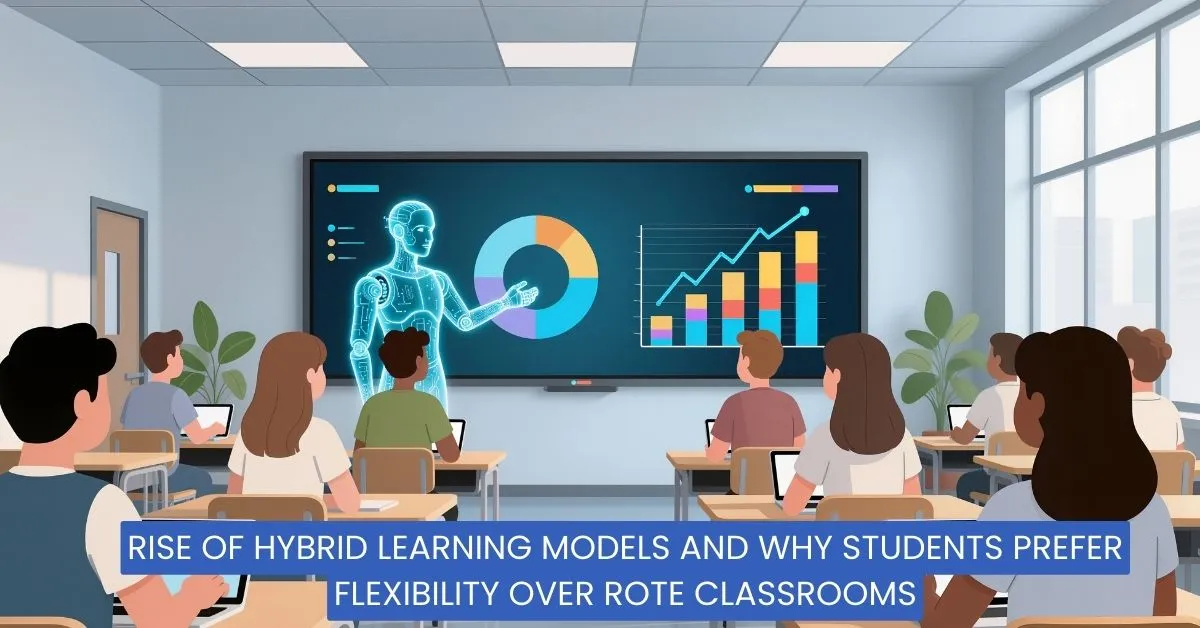
The traditional classroom, defined by fixed schedules, rigid locations, and one-size-fits-all instruction, is no longer the undisputed model for education. In an era of rapid digital transformation, a profound shift is occurring, driven not by institutional mandates but by the preferences of the modern student. The rise of hybrid learning models—blending in-person interaction with flexible online components—marks a fundamental evolution, offering a dynamic environment that students overwhelmingly prefer over the monotony of rote classrooms. This model successfully addresses the complex realities of modern student life, prioritizing flexibility and personalized learning as cornerstones of academic success.
For decades, education followed a rigid script: fixed classrooms, fixed timings, fixed syllabi, and fixed answers. Students were expected to sit still, listen quietly, memorise faster, and reproduce information on command. Whether they understood it or not was secondary.
Then technology intervened. Not politely. Abruptly.
Hybrid learning models did not rise because they were trendy. They rose because traditional classrooms stopped matching how students actually learn, think, and live.
What Hybrid Learning Really Means (Not the Buzzword Version)
Hybrid learning is not “online classes plus homework.” It is a blended system where:
- Core concepts can be learned digitally at a student’s pace
- Classroom time is used for discussion, application, and doubt-solving
- Learning is not tied to one place, one hour, or one teaching style
In short, content delivery becomes flexible, while human interaction becomes more meaningful.
That alone explains half its success.
Why Rote Classrooms Are Losing Students
Let’s be honest. Rote classrooms fail students in predictable ways.
1. One Speed for Everyone Is a Terrible Idea
In a traditional classroom:
- Fast learners get bored
- Average learners barely keep up
- Slow learners feel stupid
Hybrid learning allows students to pause, rewind, revisit, or skip ahead. Learning finally adapts to the student instead of punishing them for being different.
2. Memorisation Is Confused With Intelligence
Rote learning rewards recall, not understanding.
Students are trained to:
- Memorise definitions
- Replicate answers
- Forget everything after exams
Hybrid models shift focus toward:
- Concept clarity
- Application-based learning
- Continuous understanding instead of one-time performance
Students prefer this because, shockingly, they like knowing why something works.
3. Attendance ≠ Learning
Traditional classrooms equate physical presence with learning. Hybrid learning breaks that illusion.
Students care less about:
- Sitting on a bench for six hours
And more about:
- Whether the time spent actually improves their understanding
Flexibility lets students manage energy, attention, and mental health better. That alone makes hybrid models attractive.
Flexibility Is Not Laziness, It’s Control
One of the biggest myths is that flexibility makes students lazy. In reality, it makes them responsible.
Hybrid learning gives students control over:
- When they learn
- How they revise
- How often they practice
This autonomy builds:
- Self-discipline
- Time management
- Ownership of learning outcomes
Rote classrooms remove control and then complain that students lack motivation. That logic never made sense.
Technology Didn’t Replace Teachers, It Fixed Their Role
Hybrid models do not eliminate teachers. They liberate them.
Instead of repeating the same lecture:
- Teachers focus on mentoring
- Address individual doubts
- Encourage critical thinking
- Facilitate discussions
Students value this shift. They don’t want a human textbook. They want guidance, feedback, and clarity.
Why Students Actively Choose Hybrid Models
Students today live in a world of:
- On-demand information
- Personalized content
- Adaptive technology
Rigid classrooms feel outdated because they ignore how learning already happens outside school.
Students prefer hybrid learning because it offers:
- Pace control
- Better revision methods
- Less performance anxiety
- More relevance to real-world skills
It aligns education with reality, not nostalgia.
The Pandemic Didn’t Create Hybrid Learning, It Exposed the Need for It
The shift didn’t begin in 2020. The pandemic simply revealed how fragile the old system was.
Once students experienced:
- Recorded lectures
- Digital notes
- Online assessments
- Flexible schedules
There was no going back entirely.
Hybrid learning became the default expectation, not an experiment.
The Future Classroom Is Not Fully Online or Fully Offline
The future belongs to adaptive education, not extreme positions.
The most effective learning environments will:
- Use online tools for content delivery
- Use physical classrooms for interaction
- Measure understanding, not attendance
- Value skills, not just marks
Hybrid learning is not perfect, but it is closer to how humans actually learn.
Final Thought
Students are not rejecting education. They are rejecting inefficient education.
Hybrid learning models succeed because they respect:
- Time
- Individual differences
- Mental bandwidth
- Practical outcomes
Rote classrooms demand obedience. Hybrid models earn engagement.
That difference explains everything.






Be the first one to comment on this story.