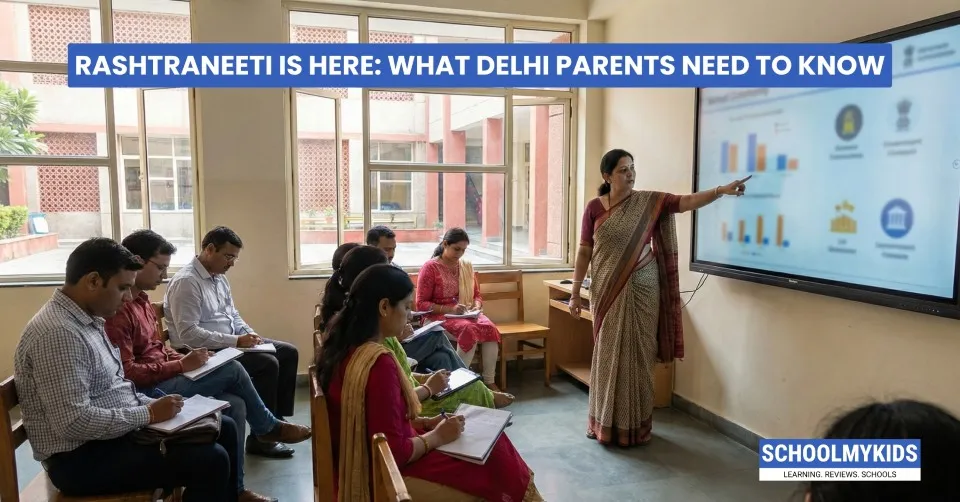
If your child studies in a Delhi government school, there's something new coming to their classroom. It's called Rashtraneeti, and it's going to be part of what they learn from Class 1 all the way to Class 12.
What is Rashtraneeti?
Think of Rashtraneeti as a new subject that teaches kids about how our country works, our history, and what it means to be a responsible citizen. The Delhi government launched it in September 2025, and the idea is simple: help students understand governance, democracy, and their role in society.
This isn't just another textbook chapter. It's meant to give your child practical knowledge about citizenship, not just theory they'll forget after exams.
What Will Students Actually Learn?
The curriculum covers two main areas:
Understanding Organizations and Their History
Your child will learn about the RSS (Rashtriya Swayamsevak Sangh), which is turning 100. The chapter, called RSS@100, will talk about how it started in 1925 in Nagpur and what it has done over the years. This includes things like blood donation drives, helping during natural disasters like the Kedarnath floods and the Bihar floods, and their work during the COVID-19 pandemic.
The lessons will also cover the organization's principles like discipline, service, and social responsibility. Education Minister Ashish Sood explained that the point is to help students understand a century-old organization that's been part of India's social landscape, nothing more complicated than that.
Learning About Freedom Fighters
Beyond organizational history, Rashtraneeti will introduce students to freedom fighters, both the famous ones and those who don't get as much attention in regular textbooks. We're talking about people like Veer Savarkar, Subhas Chandra Bose, Shyama Prasad Mukherjee, and Sardar Vallabhbhai Patel.
Your child will learn what these individuals did for India's independence and how they contributed to building the nation we live in today.
How Does This Affect Your Child's Studies?
You're probably wondering: Is this going to add more pressure? Will there be extra exams? How much time will this take?
Here's what we know so far. Teachers are already being trained through SCERT (State Council of Educational Research and Training) to teach this material. Handbooks are ready, and the full textbooks will be published in November 2025.
This means your child's teachers will know how to handle the content properly. It's not being dumped on students without preparation.
In terms of study load, Rashtraneeti is being included in the existing curriculum structure. It's not meant to overwhelm students but to give them context about their country that they might not get elsewhere.
What This Means for Your Child's Preparation
Civic education is not like math or science, where there's one right answer. This is about understanding systems, learning history, and thinking about society.
This curriculum is trying to do something bigger. It wants students to actually care about how their country functions, not just memorize facts for a test.
Should You Be Involved?
Yes, but not in a stressful way. Here's how you can help:
Talk to your child about what they're learning. Ask them questions like, "What did you learn about India's freedom movement today?" or "Can you tell me about any social service activities you read about?"
These conversations don't need to be formal. Just show interest. When children see their parents care about what they're learning, they engage more deeply with the material.
You don't need to become an expert yourself. Just be curious along with your child.
Conclusion
Education isn't just about getting good marks. It's also about understanding the world around you. Rashtraneeti is attempting to bridge that gap between textbook knowledge and real-world awareness.
Will it work? That depends on how it's taught and how students respond. The government says they're focusing on factual, historical learning rather than pushing any particular viewpoint. Teachers will play a huge role in making sure the content is delivered in a balanced way.







Be the first one to comment on this story.