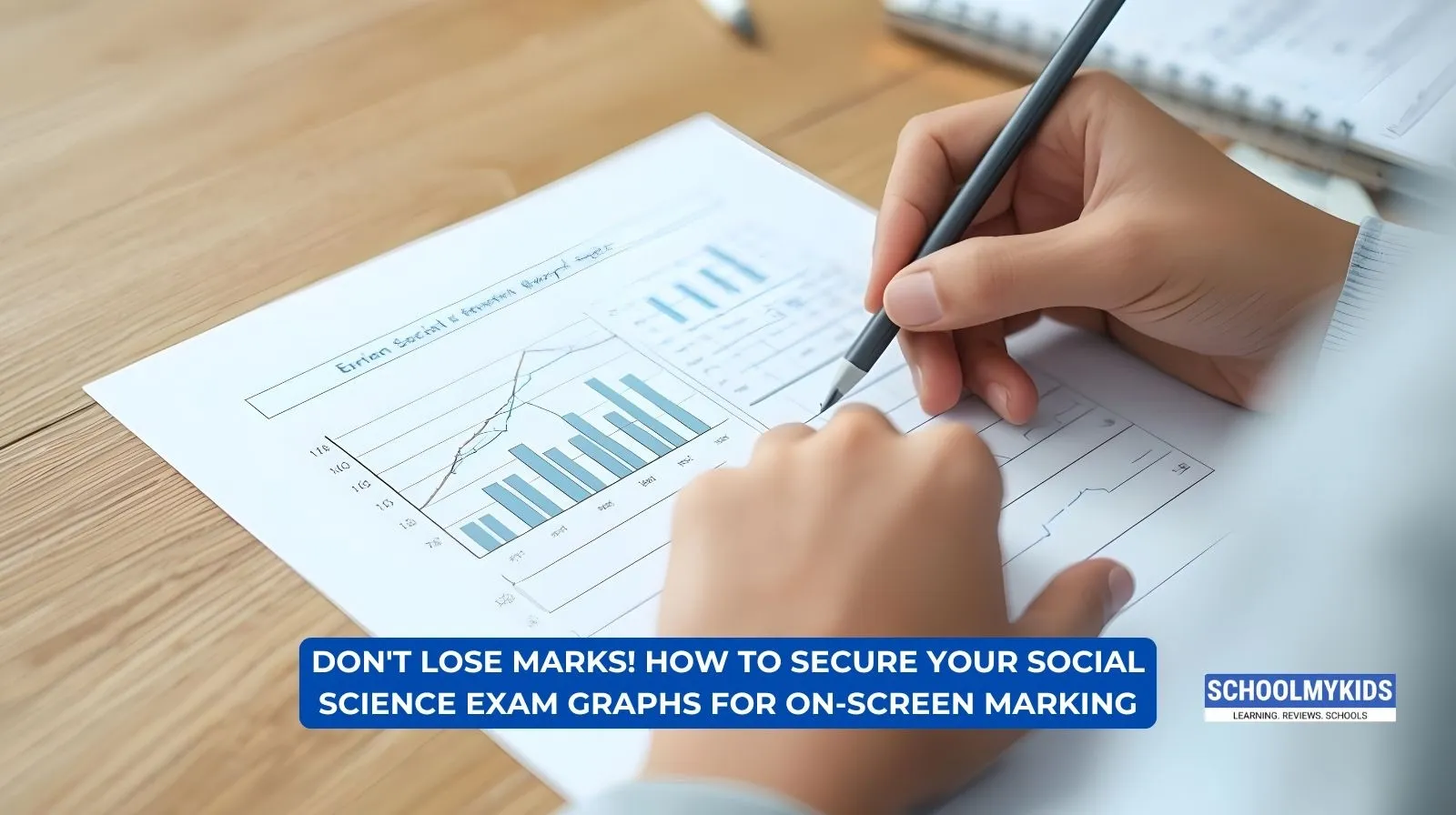
You've studied hard. You know your maps. You can locate every river, every battle site, every trade route. But there’s something that could quietly cost you marks. Not because of what you wrote, but because of where you placed your map sheet.
CBSE has introduced On-Screen Marking (OSM) for the 2026 board examinations. And if you're appearing in Class 12 History or Geography, there's one very specific thing you need to know before you walk into that exam hall.
What Exactly Is On-Screen Marking?
In the traditional system, your physical answer sheet would go to an examiner who'd sit with it and check it page by page. Under OSM, your answer sheet is scanned after the exam and the examiner checks it digitally, on a screen.
This means your entire answer book is converted into a digital file. Every page becomes an image. The examiner sees your answers just like you'd see a PDF on a computer.
Now, if something disrupts the scanning process, or a page ends up out of order digitally, the examiner might not even see your work properly. That's a problem. And this is exactly where the map sheet issue comes in.
The Map Sheet Rule That Every Class 12 Student Must Know
In History and Geography, your question paper itself contains a map/graph sheet with certain questions based on it. You're supposed to mark or complete that sheet and attach it to your answer book.
The following is the mistake that many students make without even realising it:
❌ The Wrong Way: They finish a section, pull out the map sheet, and tuck it in between two written pages, right in the middle of the answer book.
This seems logical. You answered the map question there, so you attach it there. But this is actually the wrong approach for OSM.
When the scanner runs through your answer book, a map sheet inserted between the written pages breaks the flow. It slows down scanning. It can cause errors. And in a digitised system, this is considered an incorrect submission.
✅ The Right Way: Complete ALL your written answers first. Once you're done with every question in the answer book, you'll notice there are some blank pages at the end. That's exactly where your map or graph sheet should go. Attached at the end, after all your written content.
This way, when the answer book is scanned, the written pages flow smoothly first, and then the map sheet is scanned right after, cleanly, without any interruption. The examiner sees everything in proper order on their screen.
Why Does This Matter So Much?
Under OSM, the examiner is working digitally. The system is designed to allocate marks question by question. If your map sheet is stuck somewhere in the middle of written pages, it may not align correctly with the map question in the digital interface. This can create confusion, delay, or, in the worst case, your map work might not get evaluated the way it should.
CBSE and school authorities have specifically highlighted this as an important instruction for the 2026 board exams. It's not a minor detail. It's part of how the new evaluation system works.
A Quick Summary of What to Do
To make it crystal clear, this is exactly what you should do on exam day:
Step 1: Answer all your written questions in the answer book as you normally would.
Step 2: Work on your map or graph sheet whenever that question comes up, but do NOT attach it yet.
Step 3: Once you've finished answering ALL questions in your answer book, go to the blank pages at the end.
Step 4: Attach your map or graph sheet there, at the end, between the blank pages, not between written pages.
That's it. Four simple steps. But they can genuinely make a difference to how your paper gets evaluated.
Conclusion
It's easy to feel overwhelmed with board exam prep. Syllabus, revision, practicals, and now new exam formats on top of it all. But this particular change is simple once you know about it. You just need to remember where to put that map sheet.
Attach it at the end. Not in between. That's the rule.
You've put in the work. Don't let a placement mistake take away marks you genuinely earned.
Good luck for your boards.


Be the first one to comment on this story.